Full Report
The numbers behind Sonova Holding AG: as-reported financial statements and company metrics for FY2022–FY2026, traced to the source filings, opened with the share-price history those statements have to justify. Every linked figure opens the exact page of the filing it was printed on, with the statement row highlighted. Amounts in CHF million unless noted.
Reading notes: Reporting currency is CHF; all figures are in CHF million exactly as printed in the consolidated statements. Sonova's fiscal year ends 31 March; FY labels use the ending calendar year (FY2026 = financial year 2025/26). Each fiscal year in the main columns is cited to that year's own Annual Report (e.g. FY2026 = Annual Report 2025/26). Balance-sheet and cash-flow comparatives were cross-checked against the following year's report. FY2026 (2025/26) is presented on a continuing-operations basis after Consumer Hearing was classified as a discontinued operation (IFRS 5, announced 23 March 2026). Revenue and operating lines therefore step down between FY2025 and FY2026; net income and diluted EPS are stated on a total (incl. discontinued) basis throughout and remain comparable. Segment 'Sales' rows are external sales from Note 2.2; the revenue total ties to the Consolidated income statement 'Sales' line.
Share Price — Available History Since January 2026
The stock closed at CHF 209.40 on Jul 23, 2026 — down 5% over the window shown, trading between CHF 168.05 and CHF 220.60. At that close the stock trades at 29× FY2026 diluted EPS as reported below.
Source: market price feed, daily closes, Jan 2026–Jul 2026 — the feed marks this available history as partial. Price return only, excludes dividends.
FY2026 at a Glance
Operating income (CHF million)
Diluted EPS
Source: FY2026 consolidated statements [1] [2] [3] [4]. Click any linked figure to open the filing page with the row highlighted.
Sales by Segment
| Sales by Segment | FY2022 | FY2023 | FY2024 | FY2025 | FY2026 |
|---|---|---|---|---|---|
| Hearing Instruments | 3,084 | 3,452 | 3,348 | 3,561 | 3,354 |
| Cochlear Implants | 280 | 287 | 279 | 304 | 252 |
| Sales | 3,364 | 3,738 | 3,627 | 3,865 | 3,606 |
Source: Note 2.2 Segment information (external sales); total per Consolidated income statement [5] [1] [6] [2]. Click any linked figure to open the filing page with the row highlighted.
Segment Profit (EBITA)
| Segment Profit (EBITA) | FY2022 | FY2023 | FY2024 | FY2025 | FY2026 |
|---|---|---|---|---|---|
| Hearing Instruments | 783 | 771 | 702 | 721 | 759 |
| Cochlear Implants | 20 | 30 | 25 | 28 | (35) |
| Total (EBITA) | 803 | 802 | 727 | 750 | 724 |
Source: Note 2.2 Segment information — operating profit before acquisition-related amortization (EBITA) [5] [6] [7] [8]. Click any linked figure to open the filing page with the row highlighted.
Income Statement
| Income Statement | FY2022 | FY2023 | FY2024 | FY2025 | FY2026 | FY2027E | FY2028E | FY2029E |
|---|---|---|---|---|---|---|---|---|
| Sales | 3,364 | 3,738 | 3,627 | 3,865 | 3,606 | — | — | — |
| Cost of sales | (903) | (1,101) | (1,016) | (1,081) | (948) | — | — | — |
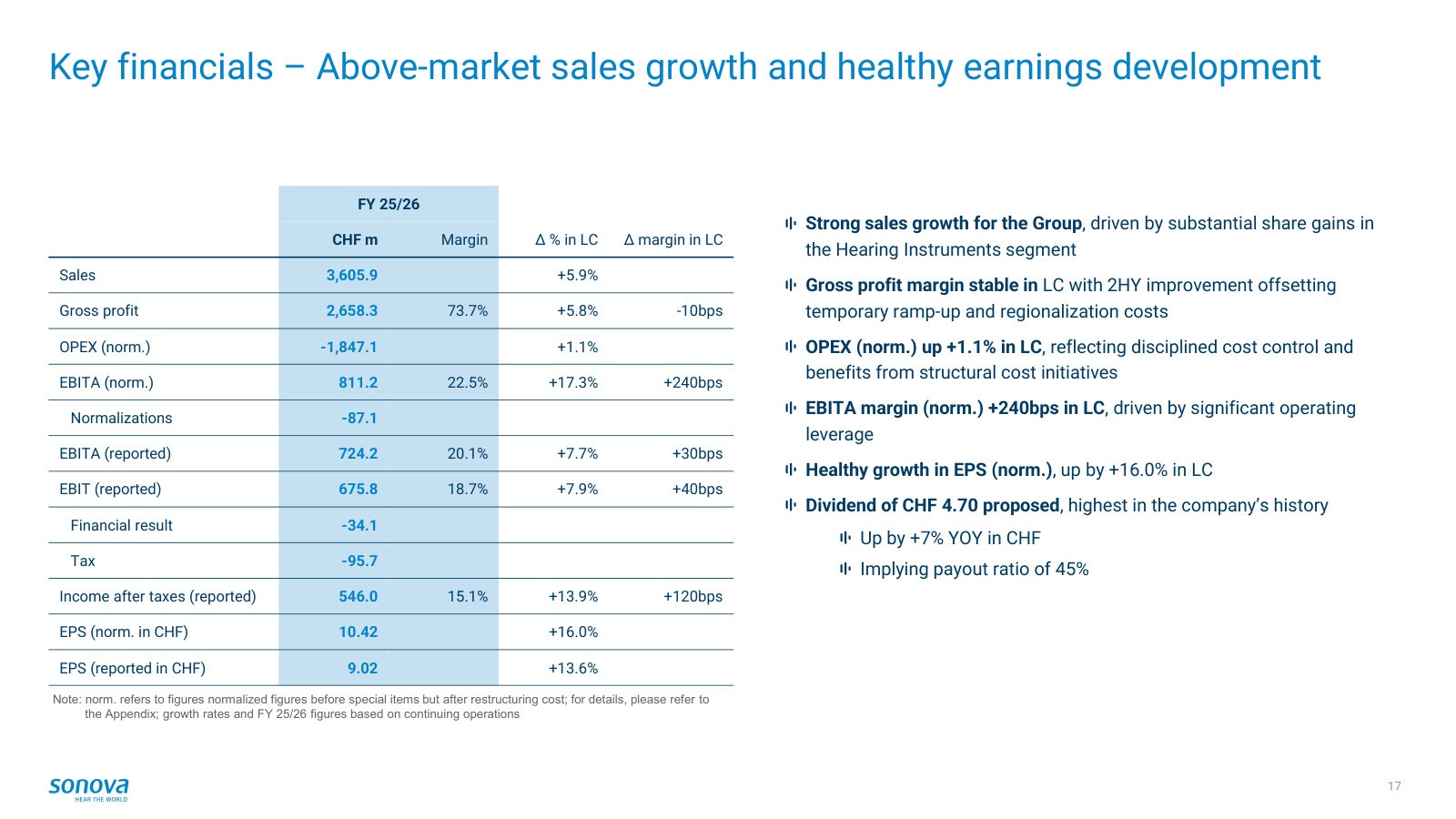
| Gross profit | 2,461 | 2,637 | 2,610 | 2,784 | 2,658 | — | — | — |
| Research and development | (230) | (245) | (239) | (235) | (218) | — | — | — |
| Sales and marketing | (1,138) | (1,316) | (1,346) | (1,465) | (1,336) | — | — | — |
| General and administration | (321) | (330) | (355) | (393) | (407) | — | — | — |
| Operating profit (EBIT) | 760 | 747 | 670 | 692 | 676 | 809 | 884 | 964 |
| Income before taxes | 728 | 716 | 647 | 652 | 642 | — | — | — |
| Income taxes | (64) | (57) | (38) | (105) | (96) | — | — | — |
| Loss after tax from discontinued operations | — | — | — | — | (106) | — | — | — |
| Income after taxes | 664 | 658 | 610 | 547 | 439 | — | — | — |
| Basic earnings per share | 10.42 | 10.75 | 10.08 | 9.07 | 7.23 | — | — | — |
| Diluted earnings per share | 10.35 | 10.72 | 10.05 | 9.04 | 7.22 | 10.64 | 11.80 | 13.11 |
Source: Consolidated income statement [1] [2] [3] [4]. Click any linked figure to open the filing page with the row highlighted.
Columns marked E are consensus analyst estimates from S&P Capital IQ (CapIQ), shown alongside reported results for direct comparison; they are not company guidance.
Estimate source: S&P Capital IQ (CapIQ) consensus, as of 2026-07-23. Estimate figures are S&P Capital IQ consensus (vendor data — no filing page links). EPS and net income use the normalized (adjusted) consensus where the street reports it. Line-item analyst models (segments, drivers, KPIs) are in the Visible Alpha tab.
Balance Sheet
| Balance Sheet | FY2022 | FY2023 | FY2024 | FY2025 | FY2026 |
|---|---|---|---|---|---|
| Cash and cash equivalents | 610 | 414 | 514 | 687 | 722 |
| Trade receivables | 474 | 525 | 538 | 577 | 527 |
| Inventories | 413 | 419 | 436 | 468 | 381 |
| Total current assets | 1,660 | 1,513 | 1,652 | 1,911 | 2,084 |
| Property, plant and equipment | 359 | 371 | 380 | 380 | 362 |
| Intangible assets and goodwill | 2,949 | 3,058 | 3,039 | 2,985 | 2,621 |
| Total assets | 5,588 | 5,552 | 5,792 | 5,924 | 5,629 |
| Current financial liabilities | 374 | 22 | 19 | 374 | 122 |
| Total current liabilities | 1,506 | 1,104 | 1,138 | 1,500 | 1,188 |
| Non-current financial liabilities | 960 | 1,592 | 1,576 | 1,206 | 1,356 |
| Total liabilities | 3,155 | 3,321 | 3,300 | 3,240 | 2,993 |
| Equity | 2,433 | 2,231 | 2,491 | 2,685 | 2,636 |
Source: Consolidated balance sheet (as at 31 March) [9] [10] [11] [12]. Click any linked figure to open the filing page with the row highlighted.
Cash Flow
| Cash Flow | FY2022 | FY2023 | FY2024 | FY2025 | FY2026 |
|---|---|---|---|---|---|
| Cash flow from operating activities | 941 | 784 | 753 | 794 | 708 |
| Purchase of tangible and intangible assets | (107) | (154) | (129) | — | — |
| Purchase of property, plant and equipment | — | — | — | (90) | (81) |
| Purchase of intangible assets | — | — | — | (48) | (21) |
| Cash consideration for acquisitions, net of cash acquired | (594) | (261) | (102) | (77) | (46) |
| Cash flow from investing activities | (706) | (428) | (234) | (213) | (192) |
| Share buyback program | (678) | (446) | — | — | — |
| Purchase of treasury shares | (80) | (56) | (51) | (67) | (63) |
| Dividends paid to shareholders of Sonova Holding AG | (202) | (268) | (274) | (256) | (262) |
| Cash flow from financing activities | (1,392) | (545) | (415) | (402) | (453) |
| Increase in cash and cash equivalents | (1,162) | (197) | 100 | 173 | 52 |
| Free cash flow, derived | — | — | — | 704 | 626 |
Source: Consolidated cash flow statement [13] [14] [15] [16]. Click any linked figure to open the filing page with the row highlighted.
Sales by Business Channel
| Sales by Business Channel | FY2022 | FY2023 | FY2024 | FY2025 | FY2026 |
|---|---|---|---|---|---|
| Wholesale (Hearing Instruments) business | 1,838 | 1,809 | 1,698 | 1,821 | 1,862 |
| Audiological Care / Retail business | 1,237 | 1,358 | 1,410 | 1,488 | 1,492 |
| Consumer Hearing business (divested) | 9 | 284 | 240 | 252 | — |
| Cochlear implant systems | 176 | 185 | 186 | 215 | 180 |
| Upgrades and accessories | 104 | 102 | 93 | 89 | 72 |
Source: company filings [17] [18] [19] [20]. Click any linked figure to open the filing page with the row highlighted.
Sales by Region
| Sales by Region | FY2022 | FY2023 | FY2024 | FY2025 | FY2026 |
|---|---|---|---|---|---|
| EMEA | 1,776 | 1,868 | 1,859 | 1,973 | 1,904 |
| USA | 1,010 | 1,150 | 1,074 | 1,157 | 1,094 |
| Americas (excl. USA) | 245 | 274 | 264 | 279 | 264 |
| Asia/Pacific | 334 | 446 | 429 | 456 | 344 |
Source: company filings [21] [22] [23] [24]. Click any linked figure to open the filing page with the row highlighted.
Profitability Efficiency
| Profitability Efficiency | FY2022 | FY2023 | FY2024 | FY2025 | FY2026 |
|---|---|---|---|---|---|
| EBITA, normalized (before acq. amortization) | 831 | 825 | 748 | 782 | 811 |
| EBITA margin, normalized (% of sales) | 24.7% | 22.1% | 20.6% | 21.6% | 22.5% |
| Gross profit margin (% of sales) | 73.1% | 70.5% | 72.0% | 74.3% | 73.7% |
| R D costs (% of sales) | 6.8% | 6.5% | 6.5% | 5.9% | 6.0% |
| Return on capital employed (ROCE) | 24.1% | 20.8% | 17.7% | 19.9% | 19.0% |
| Basic EPS, continuing operations (normalized) | 10.57 | 10.93 | 9.70 | 10.43 | 10.42 |
Source: company filings [25]. Click any linked figure to open the filing page with the row highlighted.
Capital, Cash Flow Shareholder Returns
| Capital, Cash Flow Shareholder Returns | FY2022 | FY2023 | FY2024 | FY2025 | FY2026 |
|---|---|---|---|---|---|
| Net debt | 1,006 | 1,496 | 1,360 | 1,102 | 994 |
| Operating free cash flow | 764 | 536 | 539 | 582 | 519 |
| Free cash flow | 168 | 274 | 438 | 510 | 474 |
| Capital employed | 3,439 | 3,727 | 3,851 | 3,579 | 3,519 |
| Dividend / distribution per share | 4.40 | 4.60 | 4.30 | 4.40 | 4.70 |
| Employees (end of period, incl. discontinued ops) | 16,733 | 17,608 | 18,151 | 17,990 | 18,447 |
Source: company filings [25]. Click any linked figure to open the filing page with the row highlighted.
Long-Term Record
| Fiscal year | Total revenue | Operating profit (EBIT) | Net income | Diluted earnings per share | Operating cash flow |
|---|---|---|---|---|---|
| FY2017 | 2,396 | 424 | 356 | 5.34 | 522 |
| FY2018 | 2,646 | 483 | 407 | 6.11 | 523 |
| FY2019 | 2,763 | 536 | 460 | 6.95 | 533 |
| FY2020 | 2,917 | 510 | 490 | 7.57 | 843 |
| FY2021 | 2,602 | 620 | 585 | 9.19 | 764 |
| FY2022 | 3,364 | 760 | 664 | 10.35 | 941 |
| FY2023 | 3,738 | 747 | 658 | 10.72 | 784 |
| FY2024 | 3,627 | 670 | 610 | 10.05 | 753 |
| FY2025 | 3,865 | 692 | 547 | 9.04 | 794 |
| FY2026 | 3,606 | 676 | 439 | 7.22 | 708 |
Source: consolidated statements across filings; older years from the standardized feed [13] [1] [14] [2]. Click any linked figure to open the filing page with the row highlighted.
Analyst Consensus
Mean target
Median target
High target
Low target
Street ratings: 4 strong buy, 3 buy, 9 hold, 1 sell, 2 strong sell. Consensus: Hold.
Estimate source: S&P Capital IQ (CapIQ) consensus, as of 2026-07-23. Estimate figures are S&P Capital IQ consensus (vendor data — no filing page links). EPS and net income use the normalized (adjusted) consensus where the street reports it. Line-item analyst models (segments, drivers, KPIs) are in the Visible Alpha tab.
Traceability
324 of 349 figures on this page (93%) link to the filing page where they are printed — click a linked figure to open the source PDF at that page with the row highlighted. Unlinked figures come from standardized data feeds or pre-filing years.
Reporting currency is CHF; all figures are in CHF million exactly as printed in the consolidated statements. Sonova's fiscal year ends 31 March; FY labels use the ending calendar year (FY2026 = financial year 2025/26).
Each fiscal year in the main columns is cited to that year's own Annual Report (e.g. FY2026 = Annual Report 2025/26). Balance-sheet and cash-flow comparatives were cross-checked against the following year's report.
FY2026 (2025/26) is presented on a continuing-operations basis after Consumer Hearing was classified as a discontinued operation (IFRS 5, announced 23 March 2026). Revenue and operating lines therefore step down between FY2025 and FY2026; net income and diluted EPS are stated on a total (incl. discontinued) basis throughout and remain comparable.
Segment 'Sales' rows are external sales from Note 2.2; the revenue total ties to the Consolidated income statement 'Sales' line.
Long-term record FY2017-FY2021 figures are from the standardized data feed and are shown without page links; FY2022-FY2026 are cited to the annual reports.
No quarterly block: Sonova reports semi-annually (half-year and full-year), not quarterly, so the renderer's numeric-feed fallback is used for any interim view.
3 figure(s) differed between the data feed and the filing; the filing value is shown (see the run's metrics/metrics_tab.json for the audit trail).
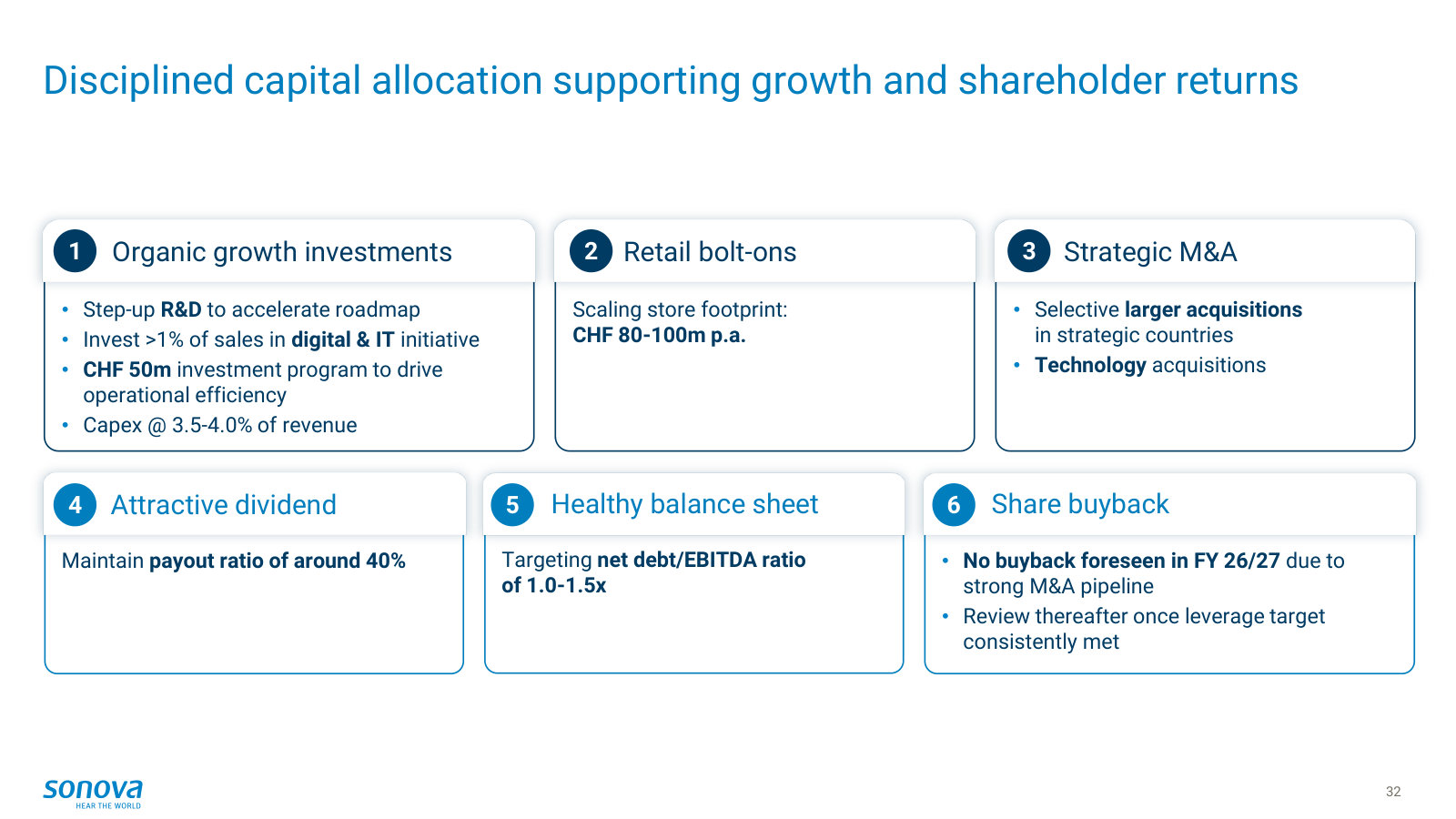
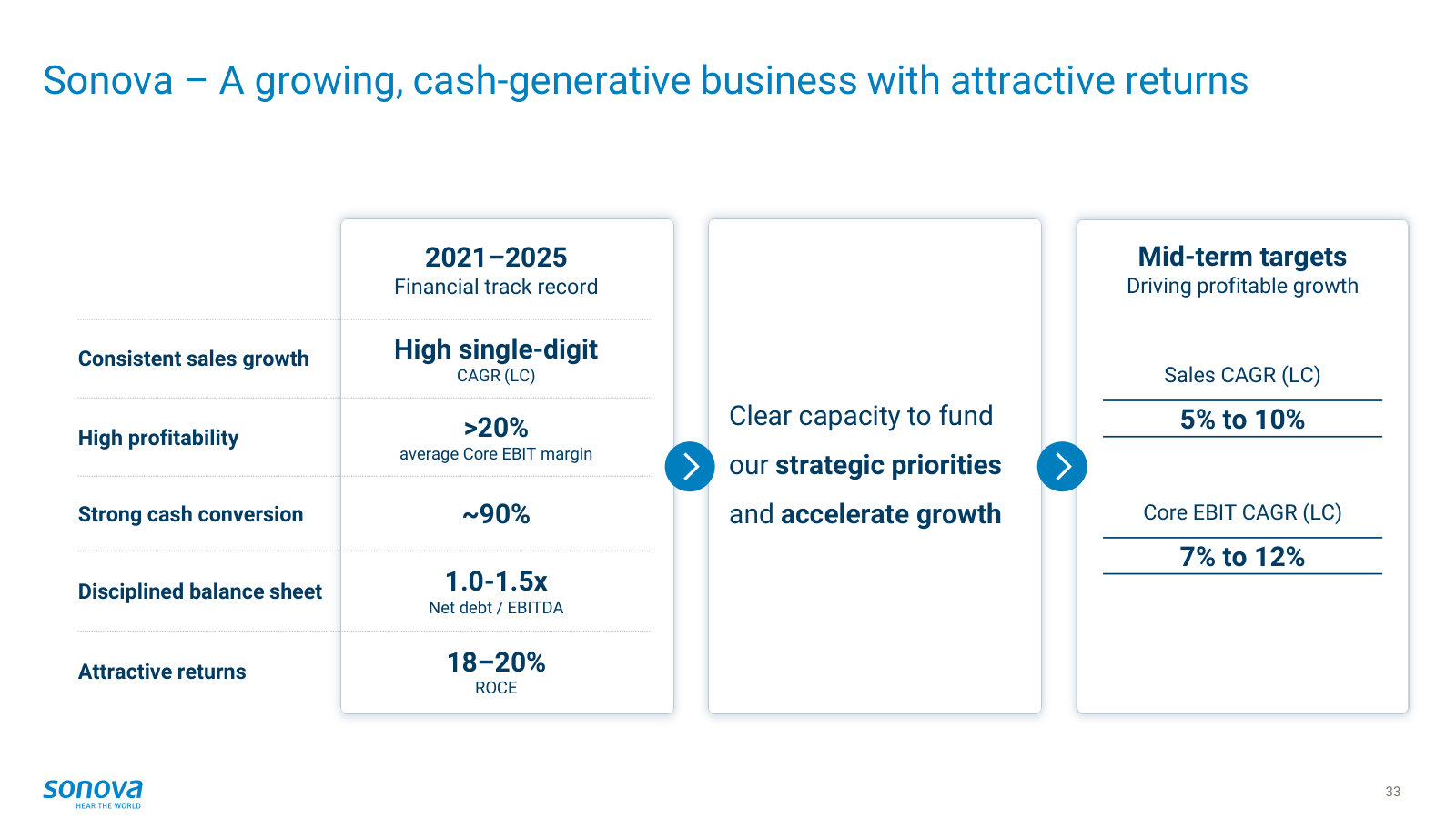
Sonova Holding AG's management explains the business in its own materials. The slides below do the most of that work, pulled from the documents preserved in Sources. Each source link opens the complete presentation at that slide in a new tab.
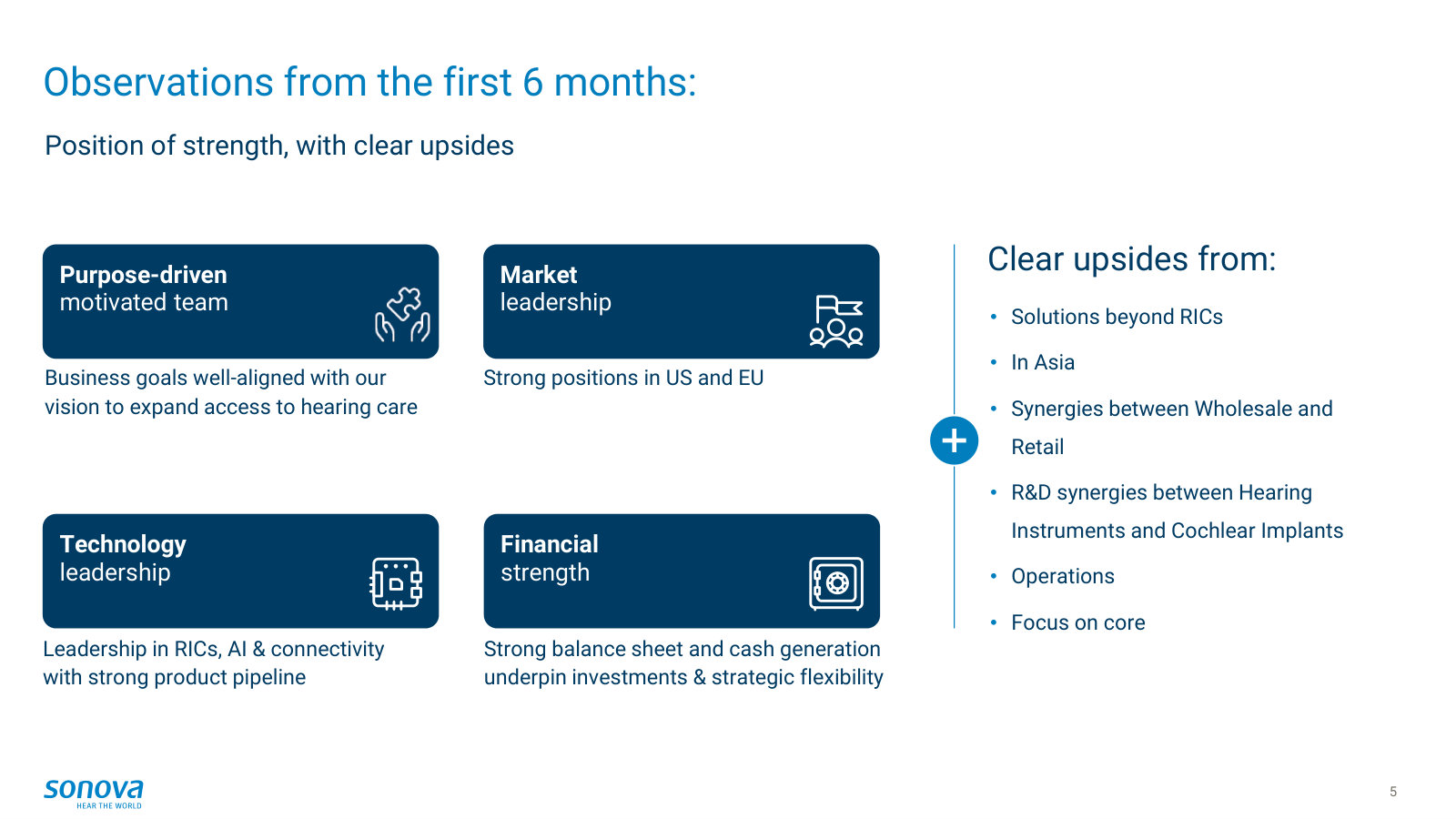
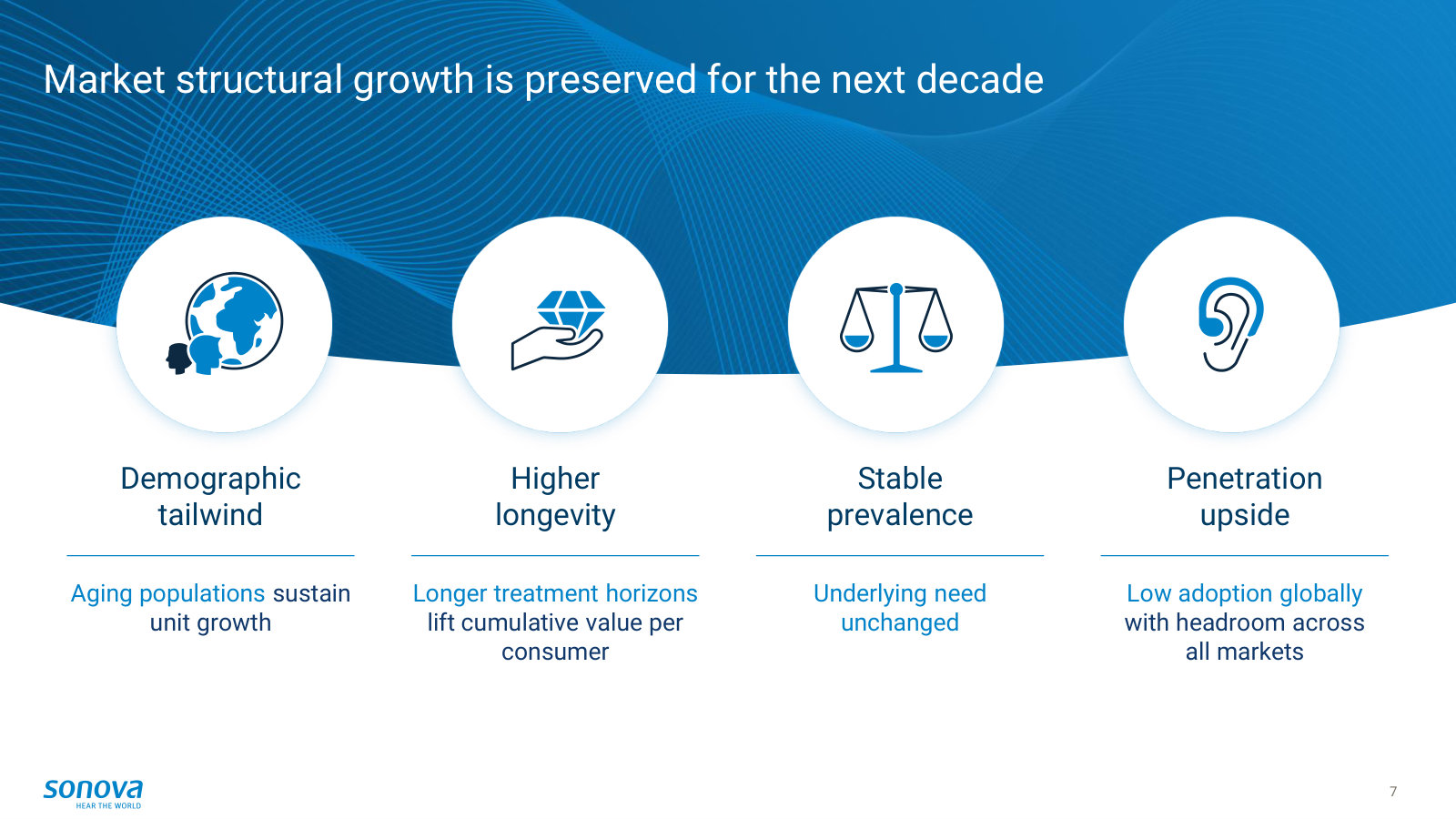
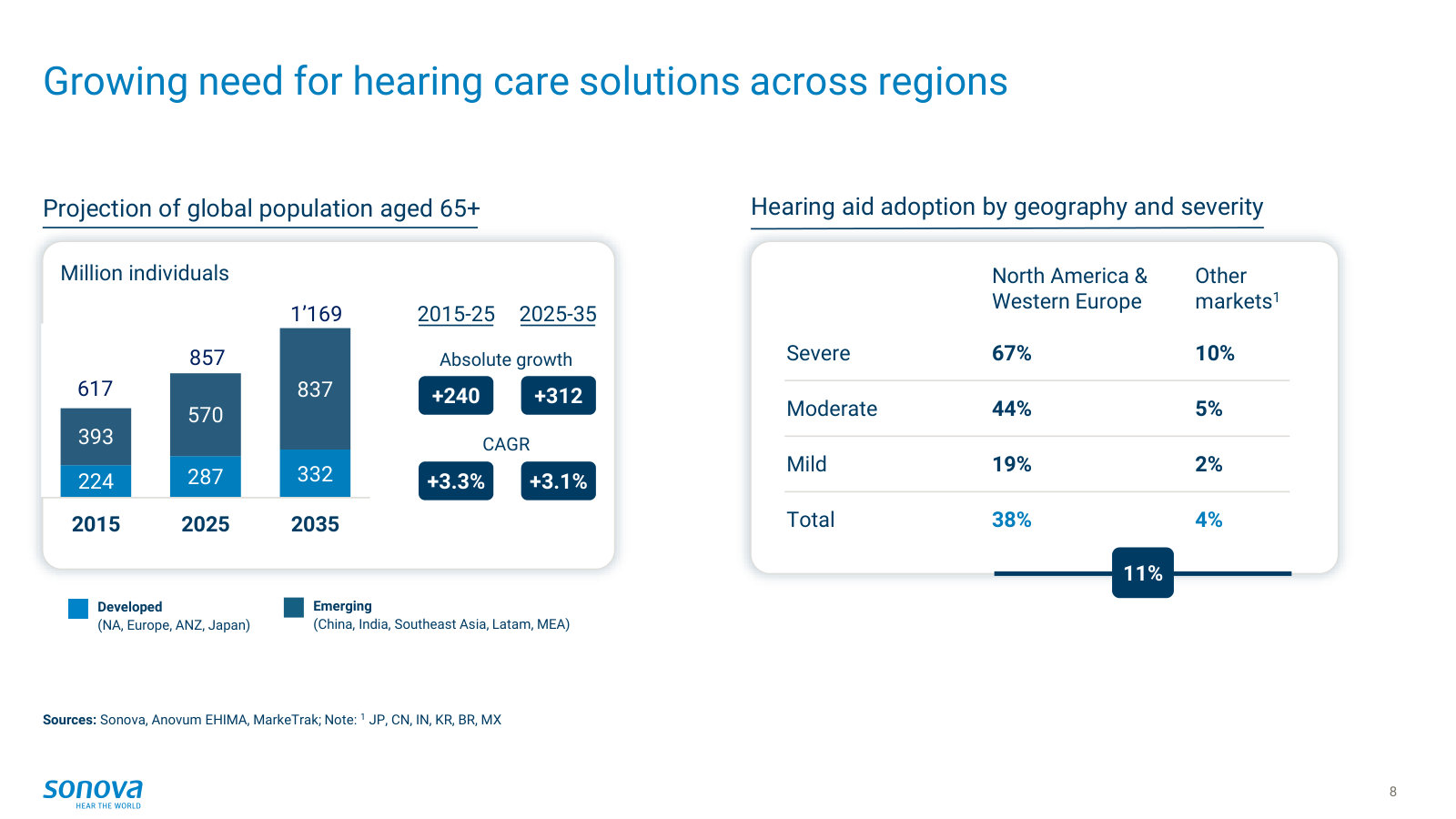
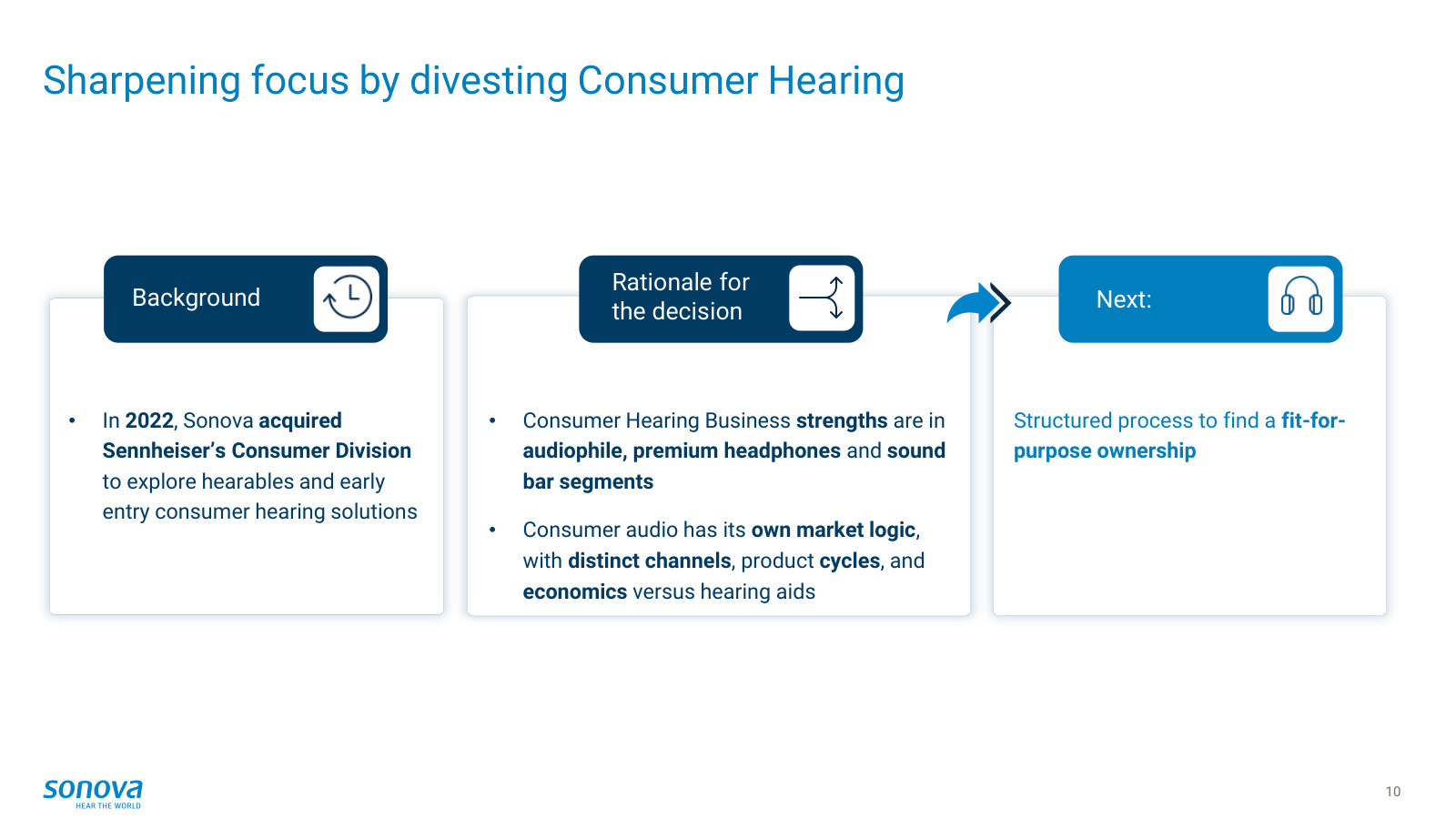
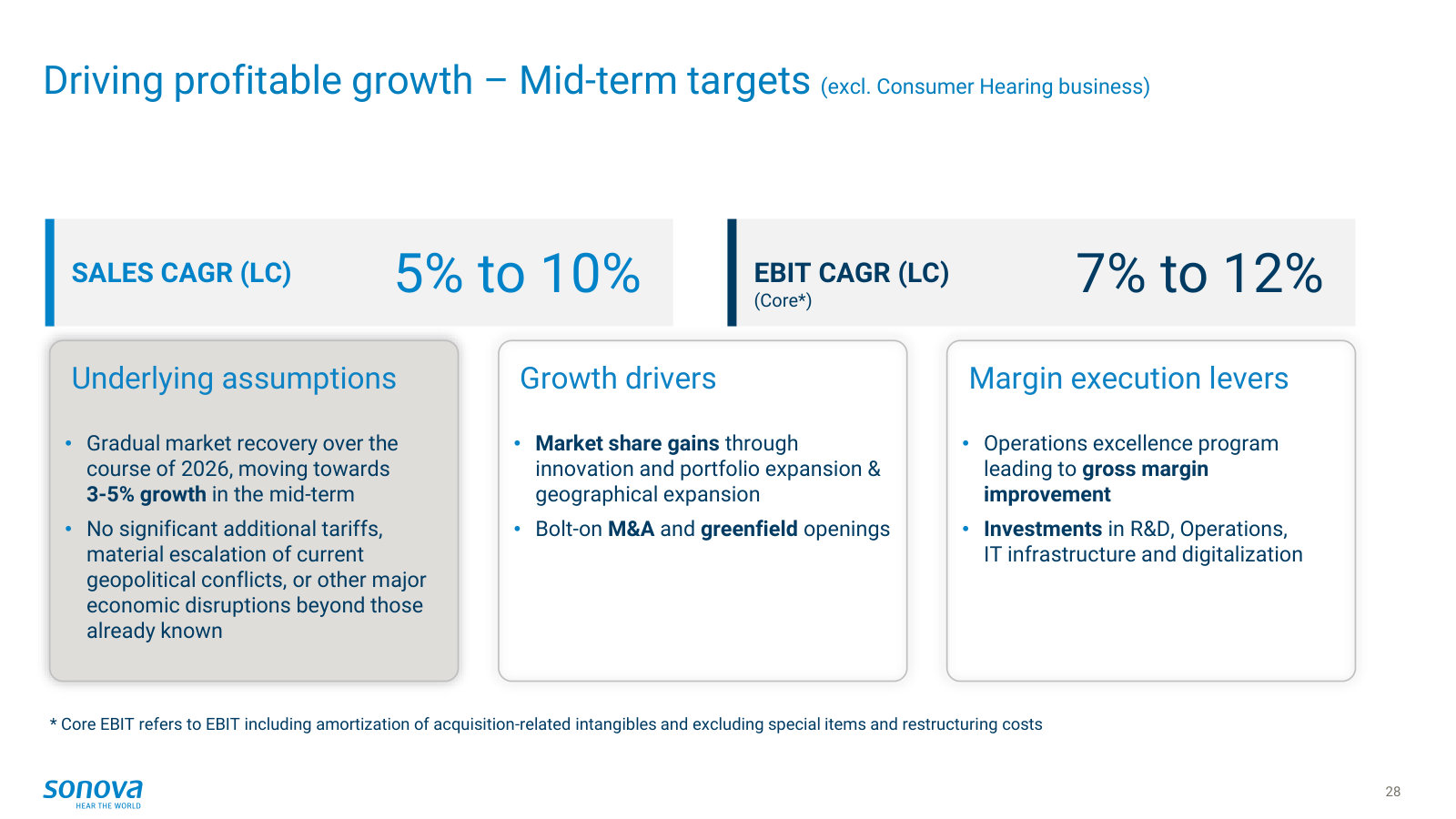
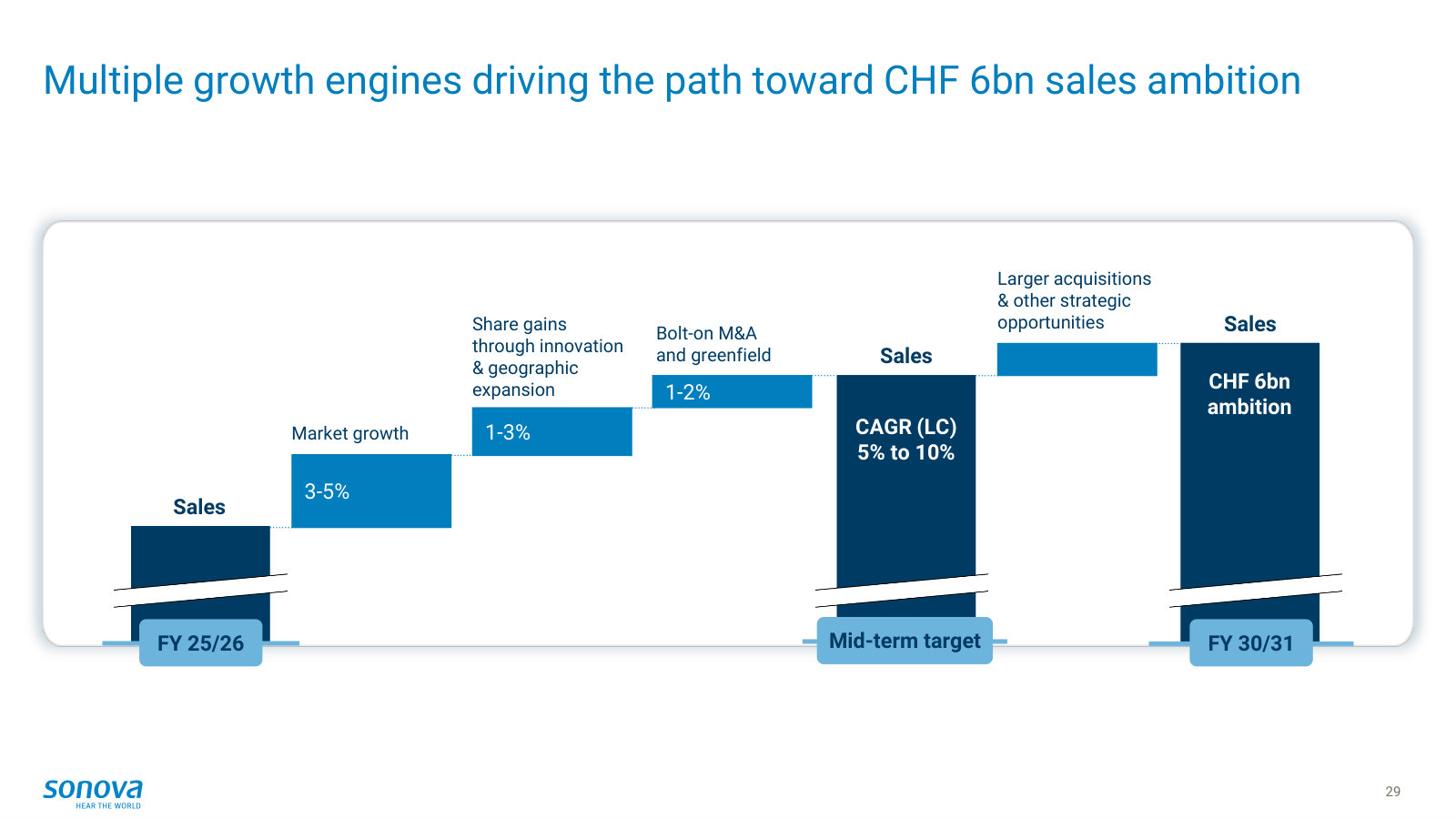
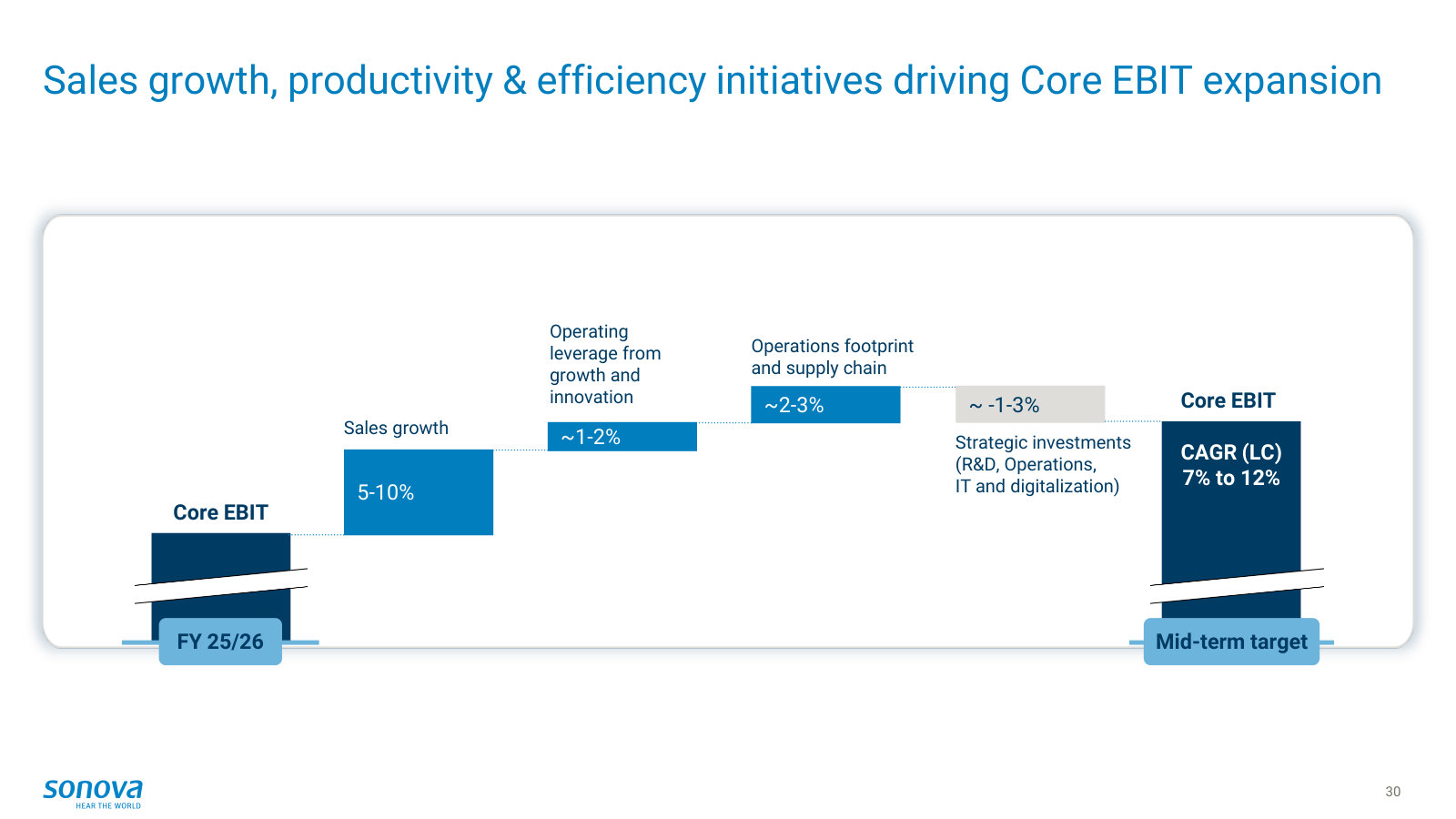
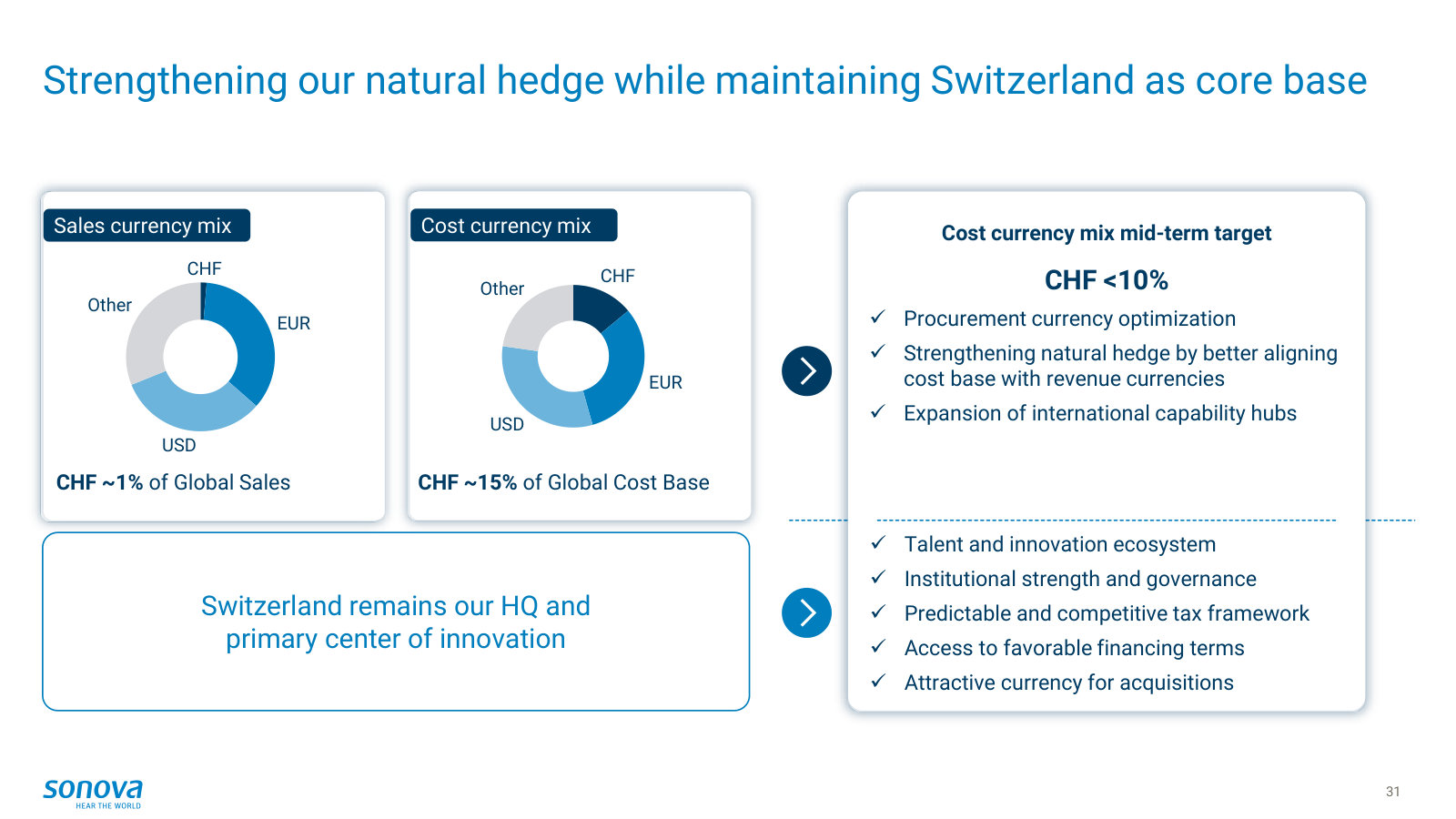
Strategy Update — CHF 6bn Revenue Ambition — FY2030/31 targets
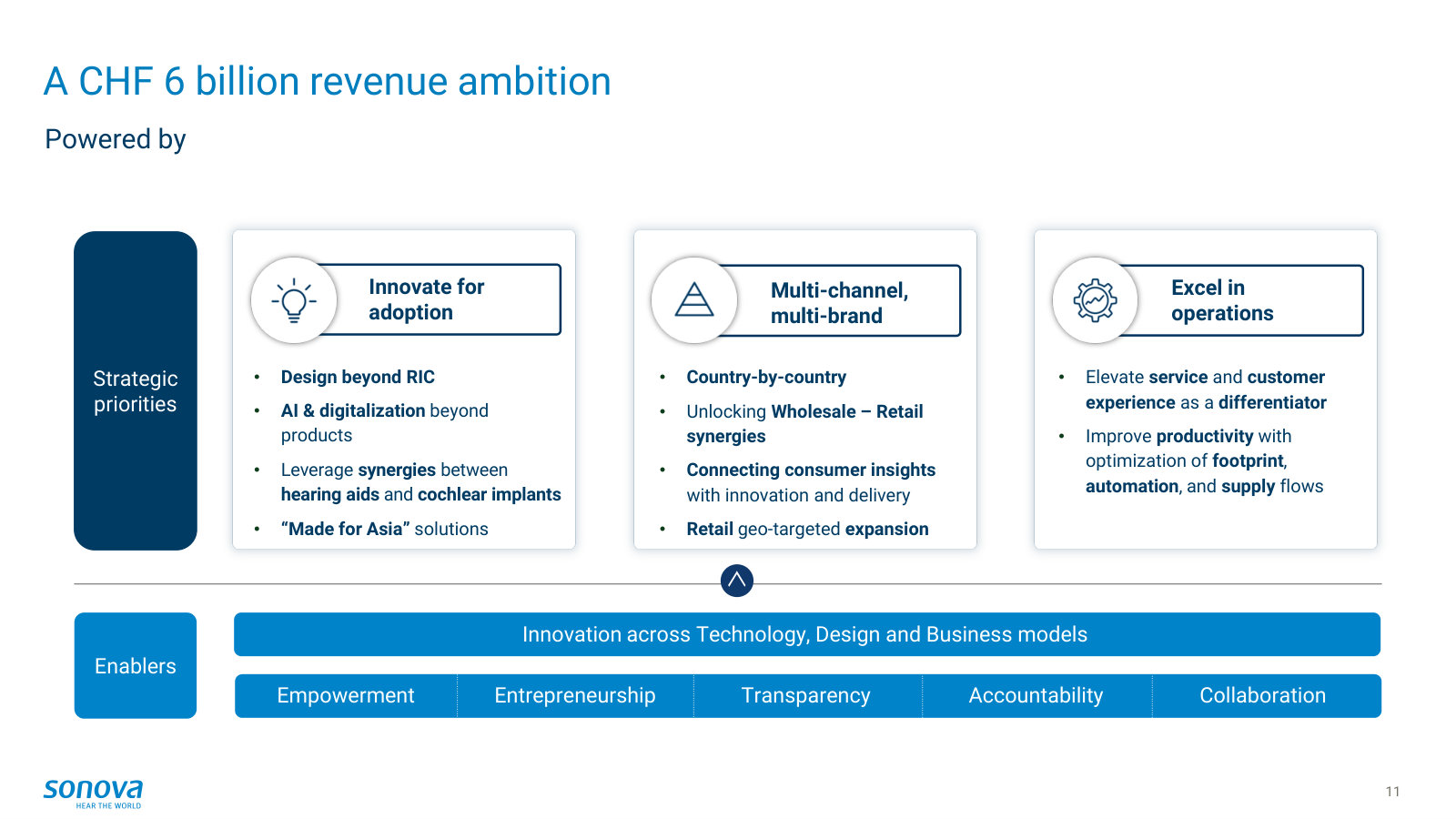
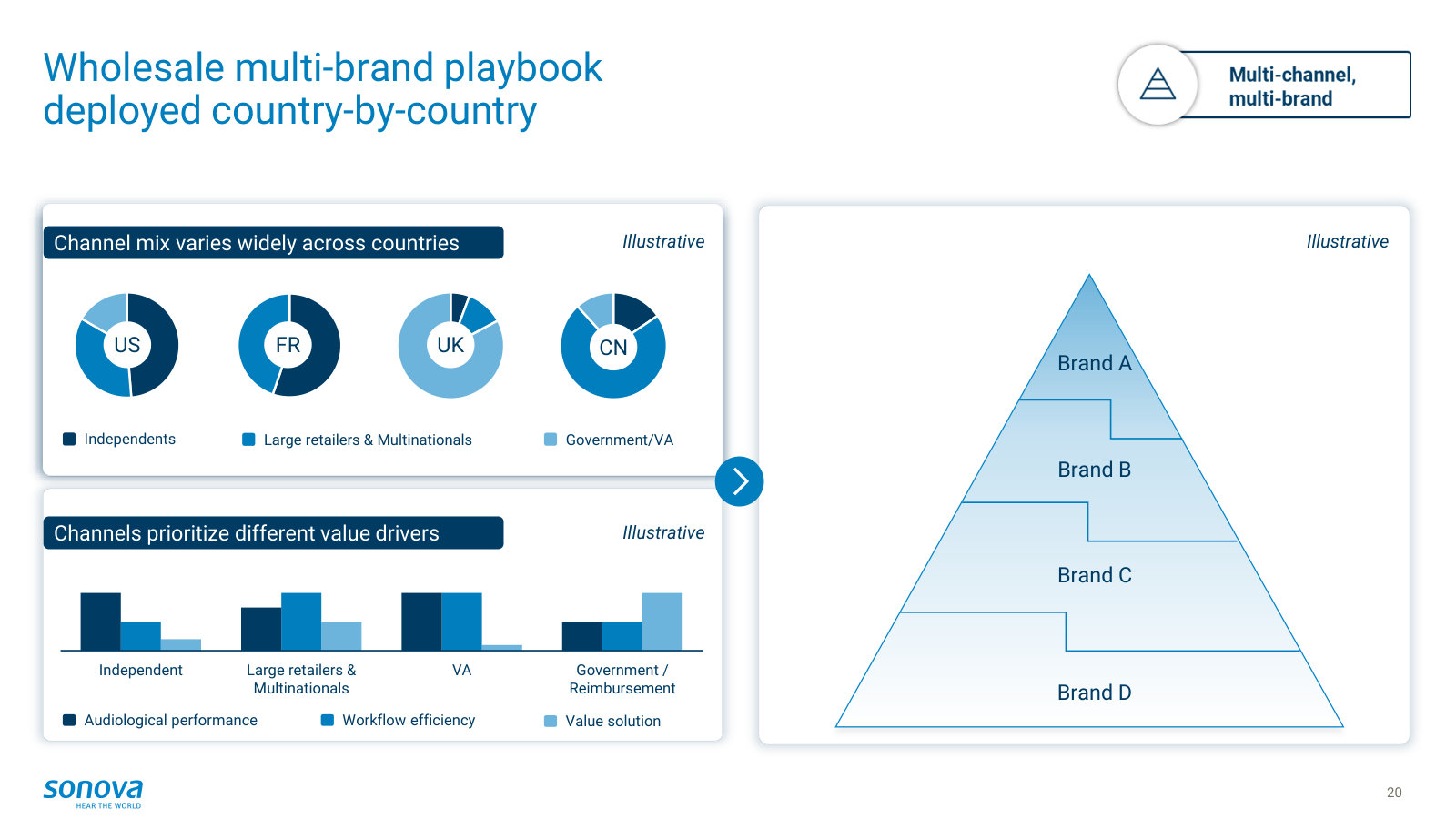
The new CEO's March 2026 strategy reset: the CHF 6bn revenue ambition, mid-term targets, business model and capital plan in one deck. · Open the full document →
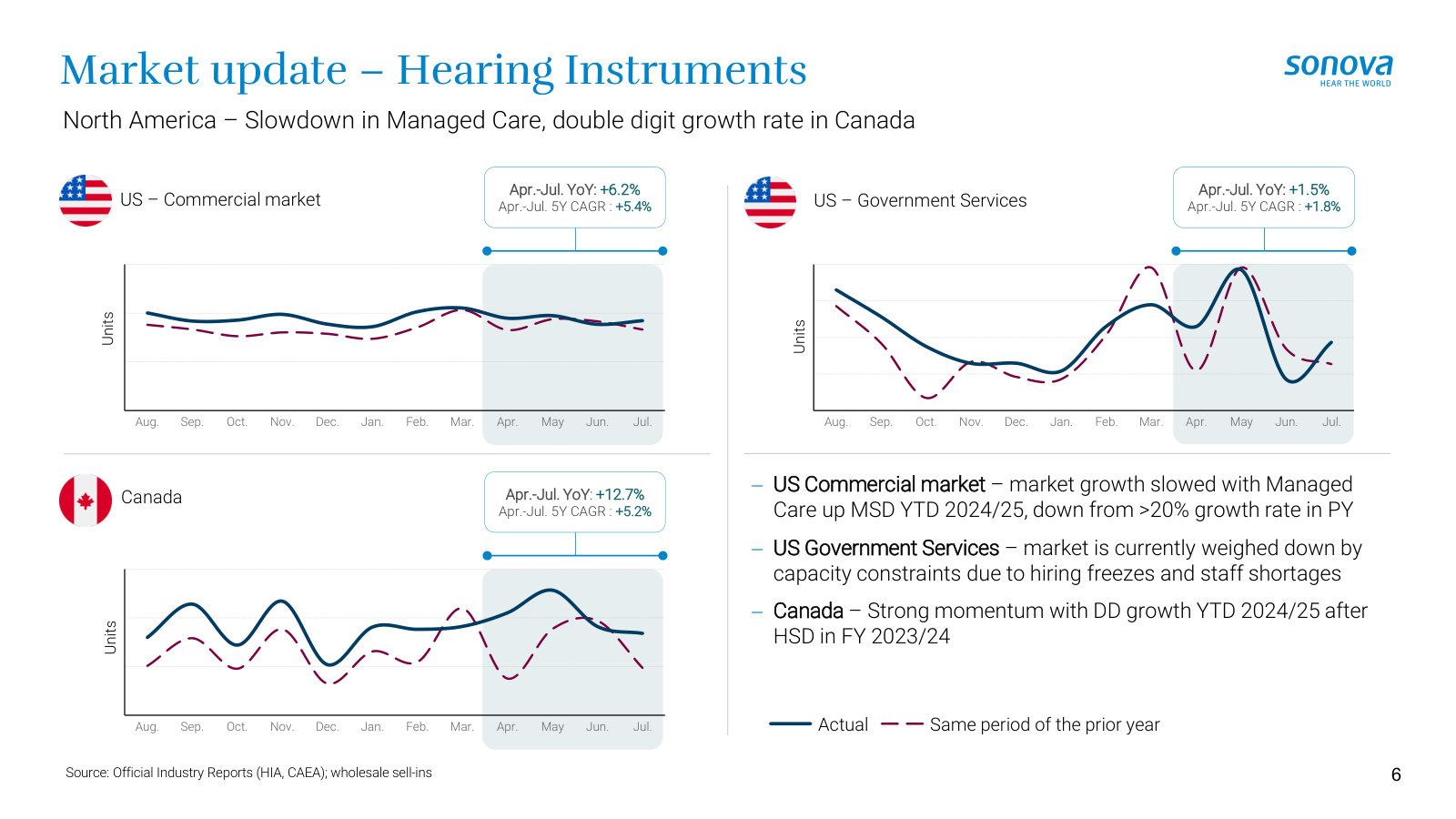
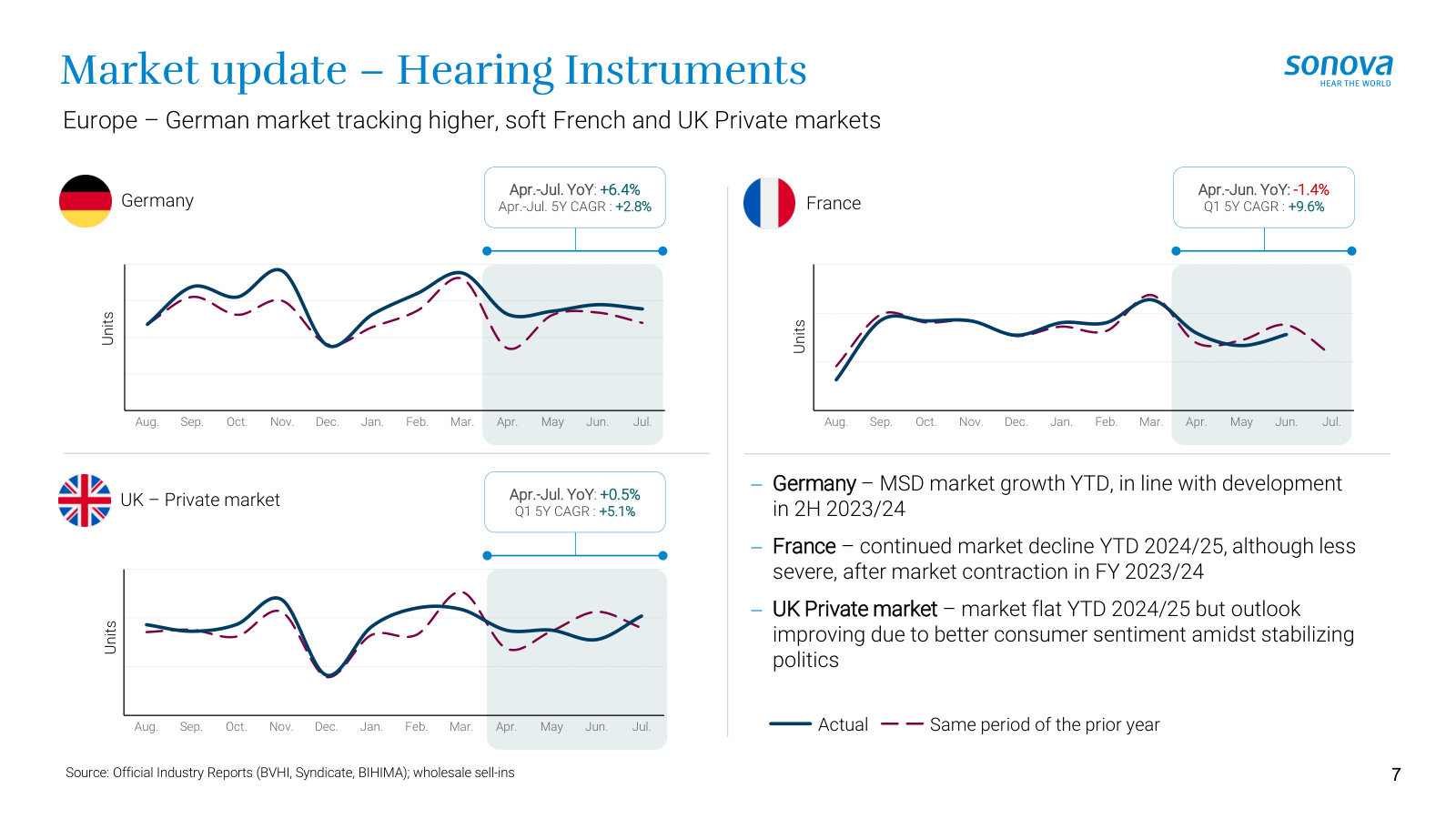
Investor & Analyst Day 2024 — FY2024/25
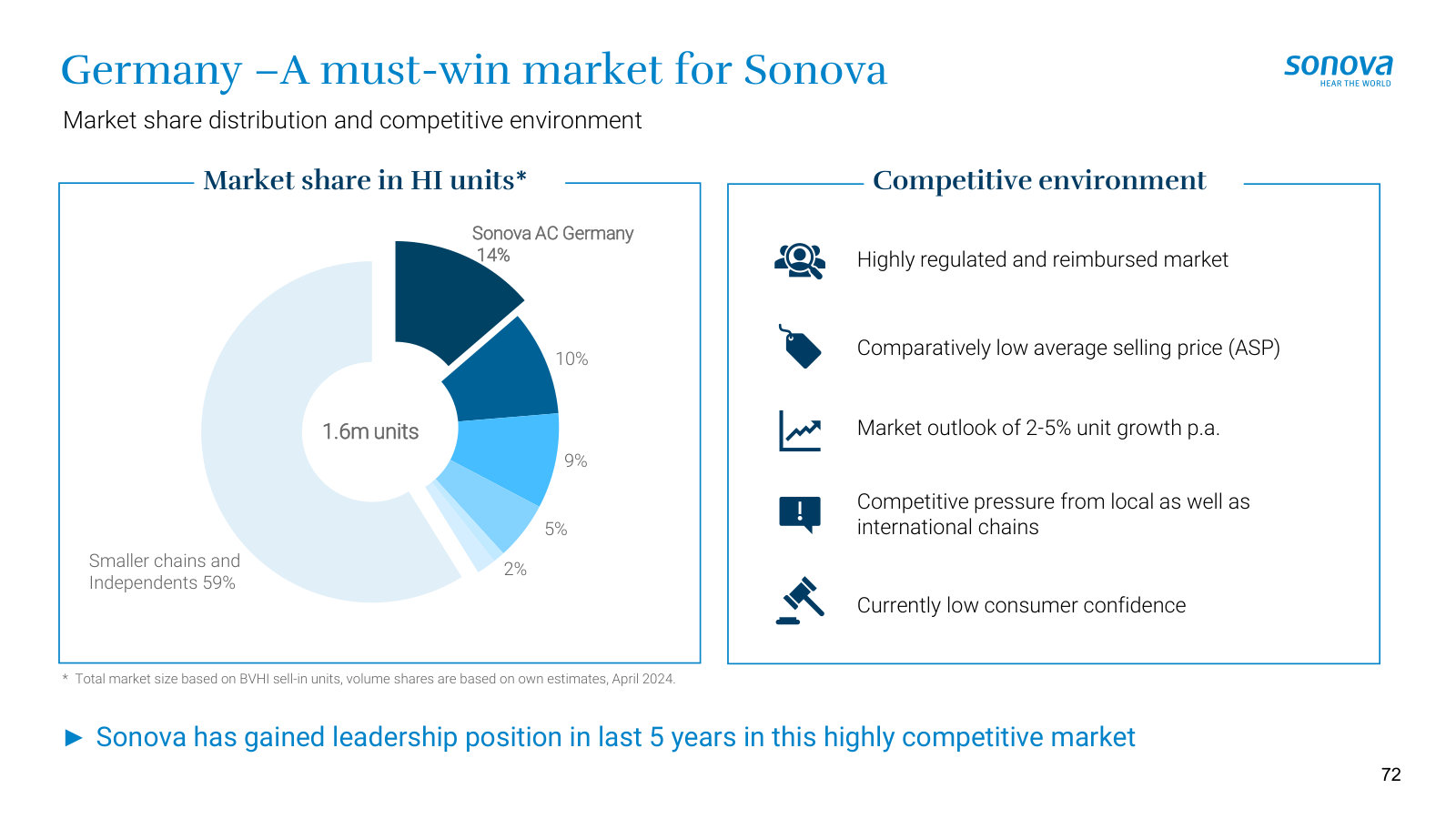
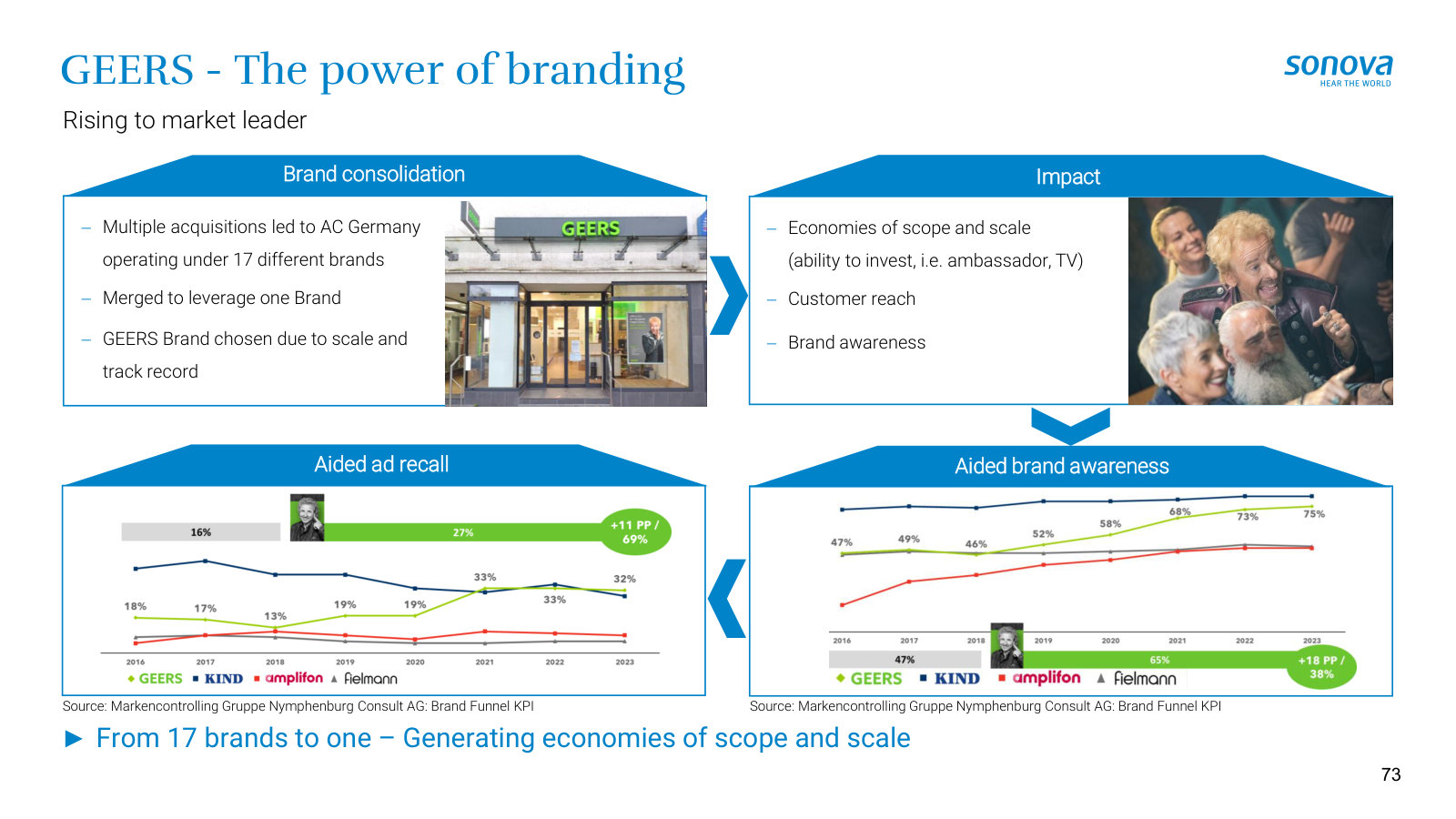
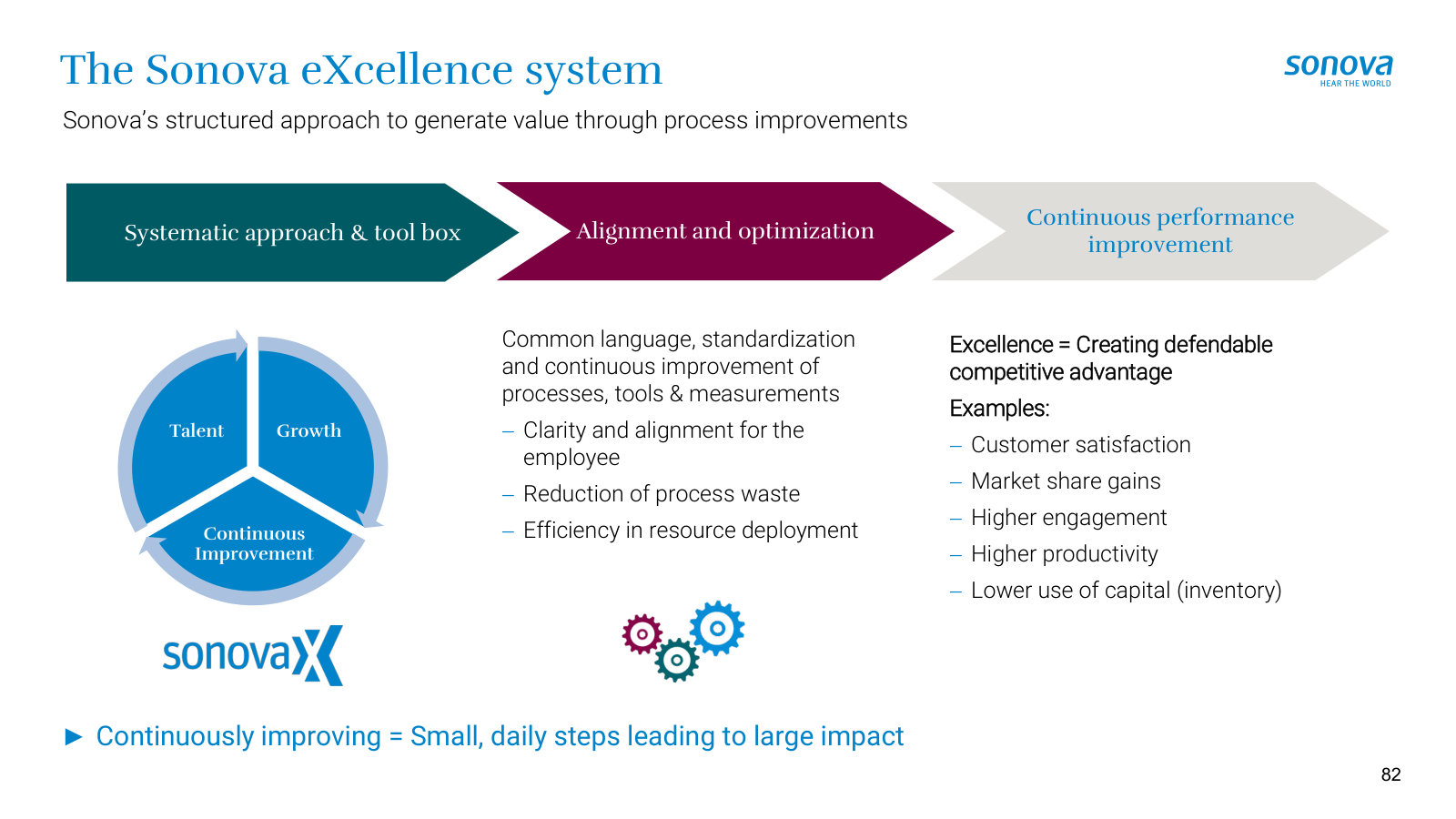
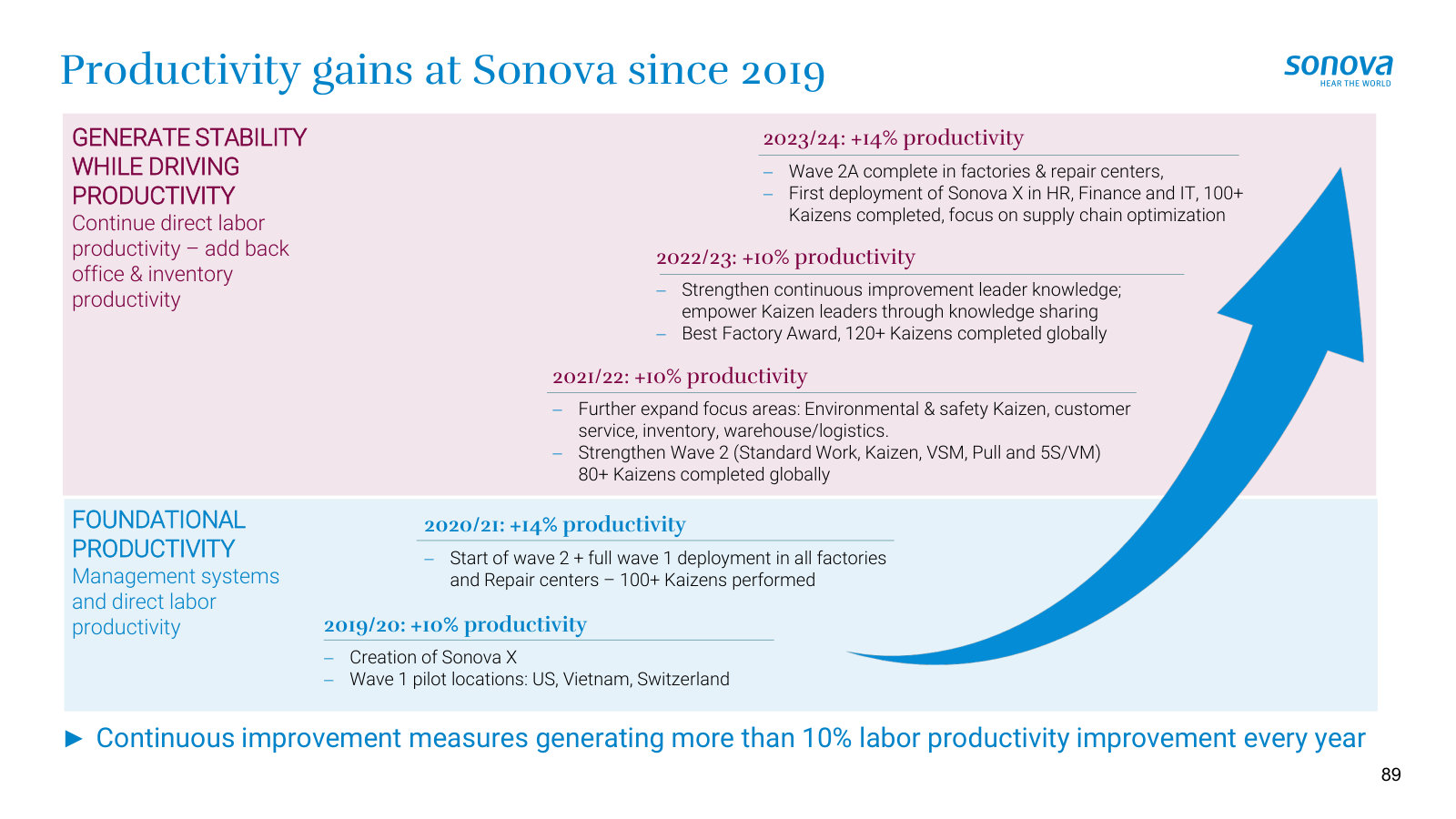
The fullest deep-dive: hearing-instrument market by region, the AI/DNN technology moat, the retail (Audiological Care) engine and Sonova X operations. · Open the full document →
Full-Year Results FY2025/26 — FY2025/26
The latest full-year numbers — current sales, margins and cash by segment and region, plus the FY26/27 outlook. · Open the full document →
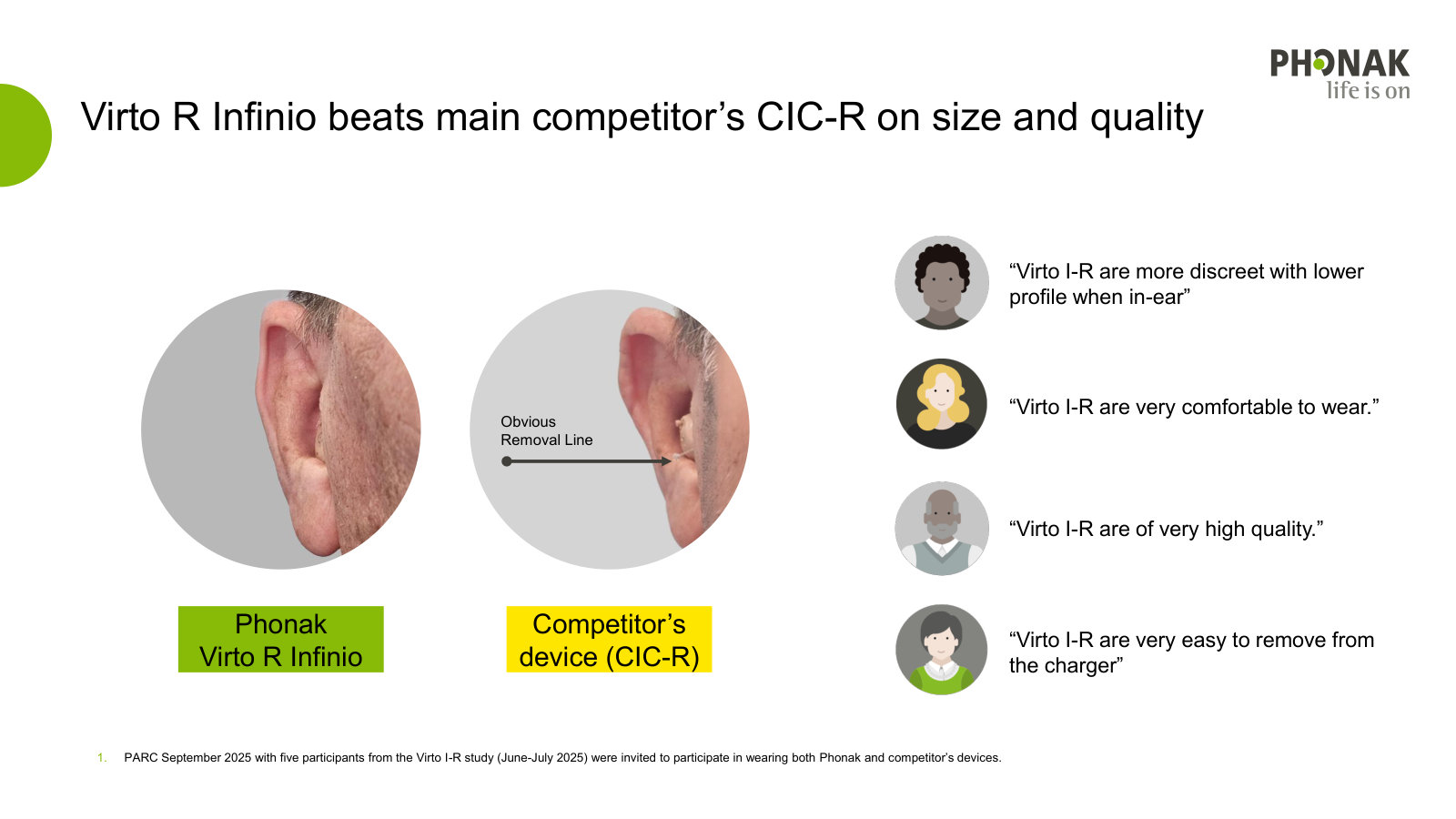
EUHA 2025 — Phonak Infinio Product Presentation — EUHA 2025
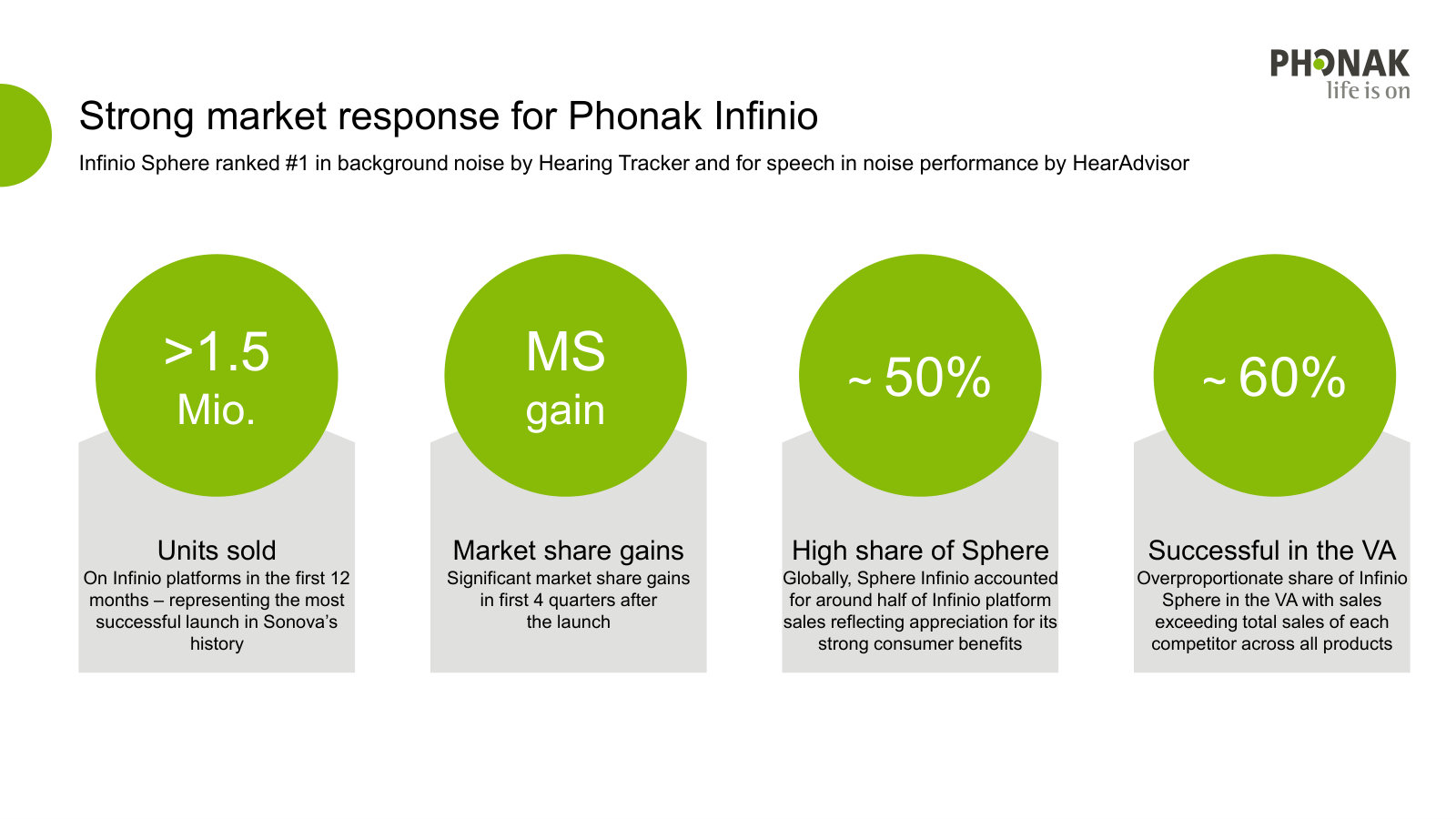
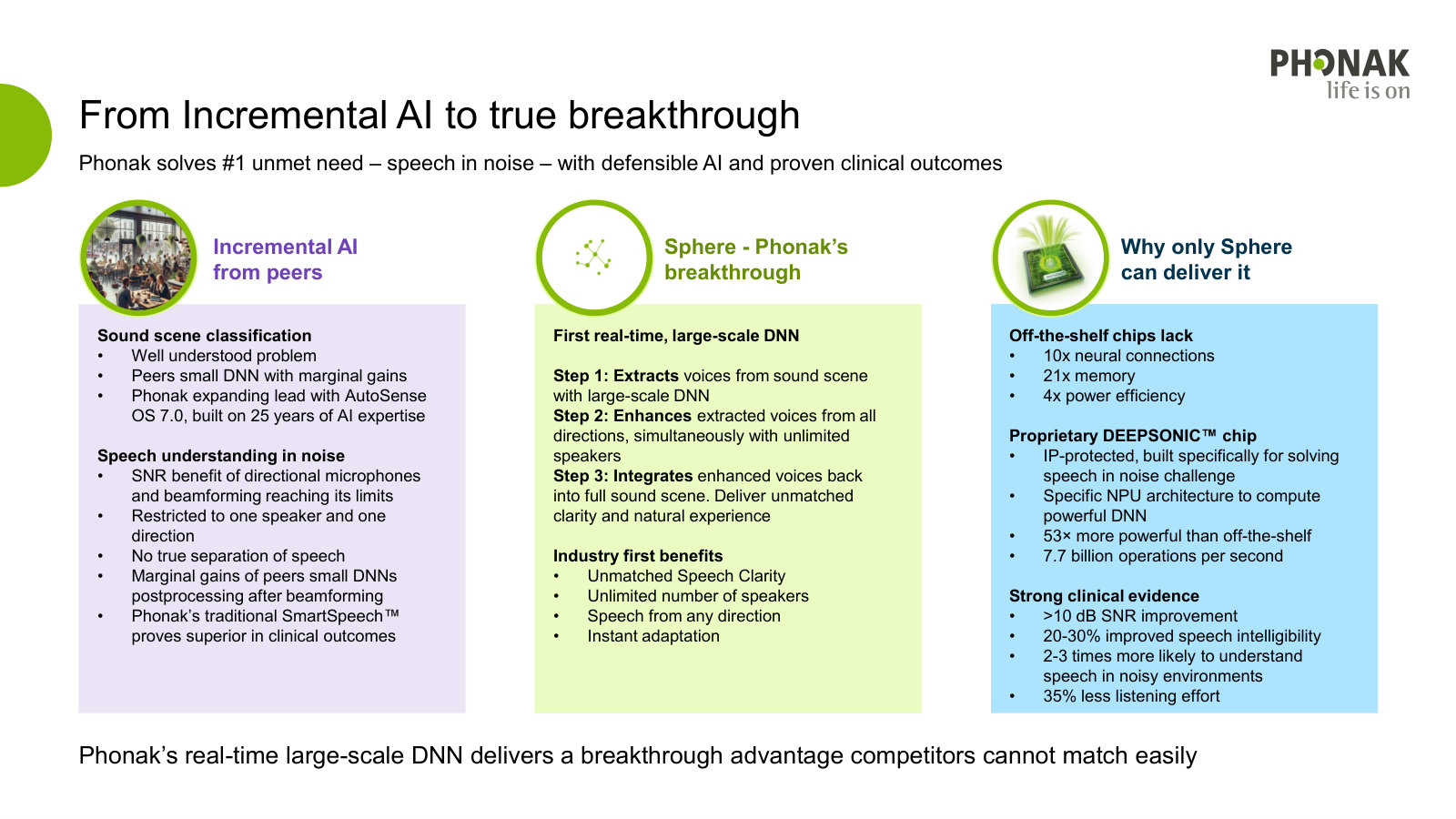
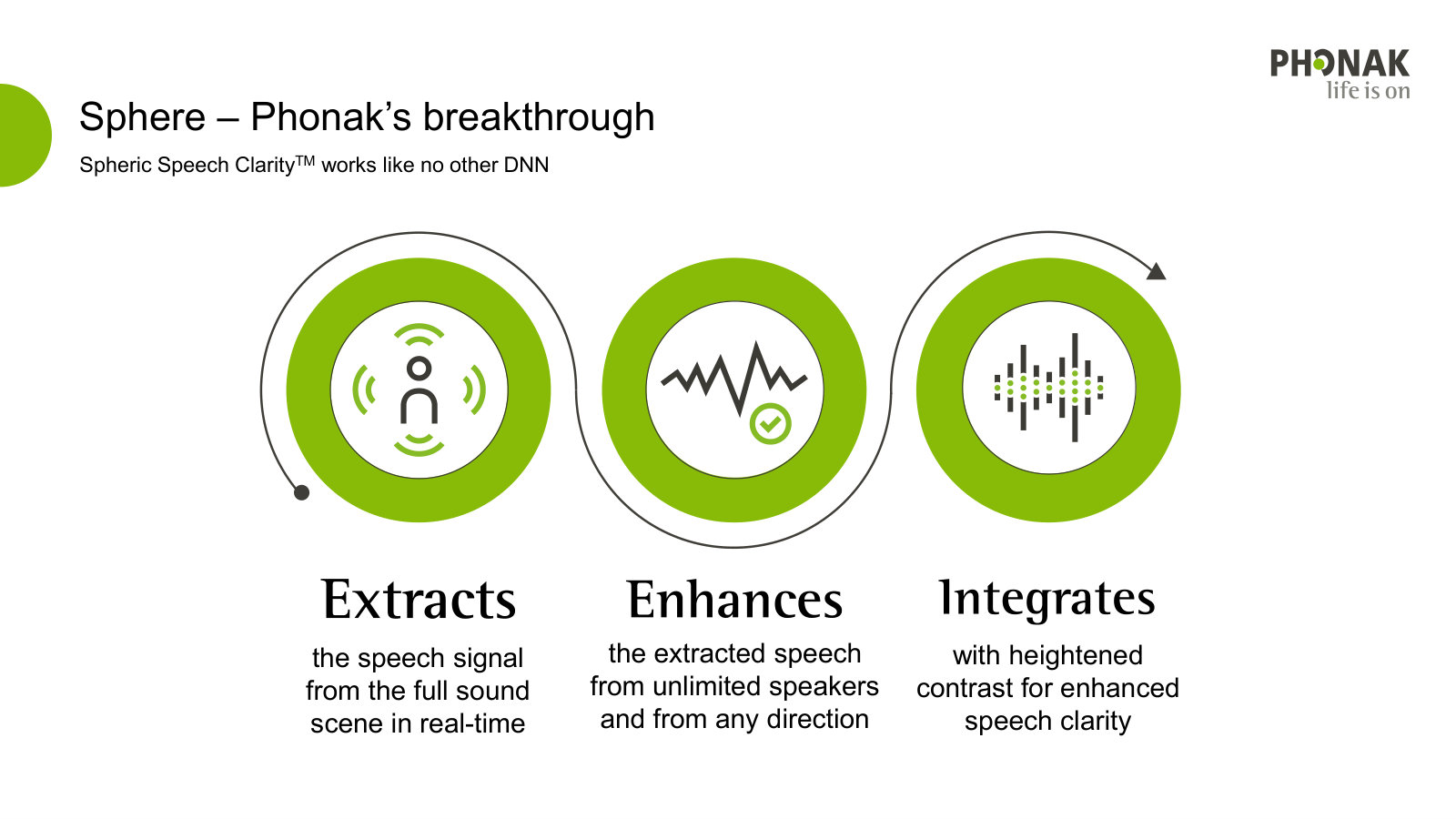
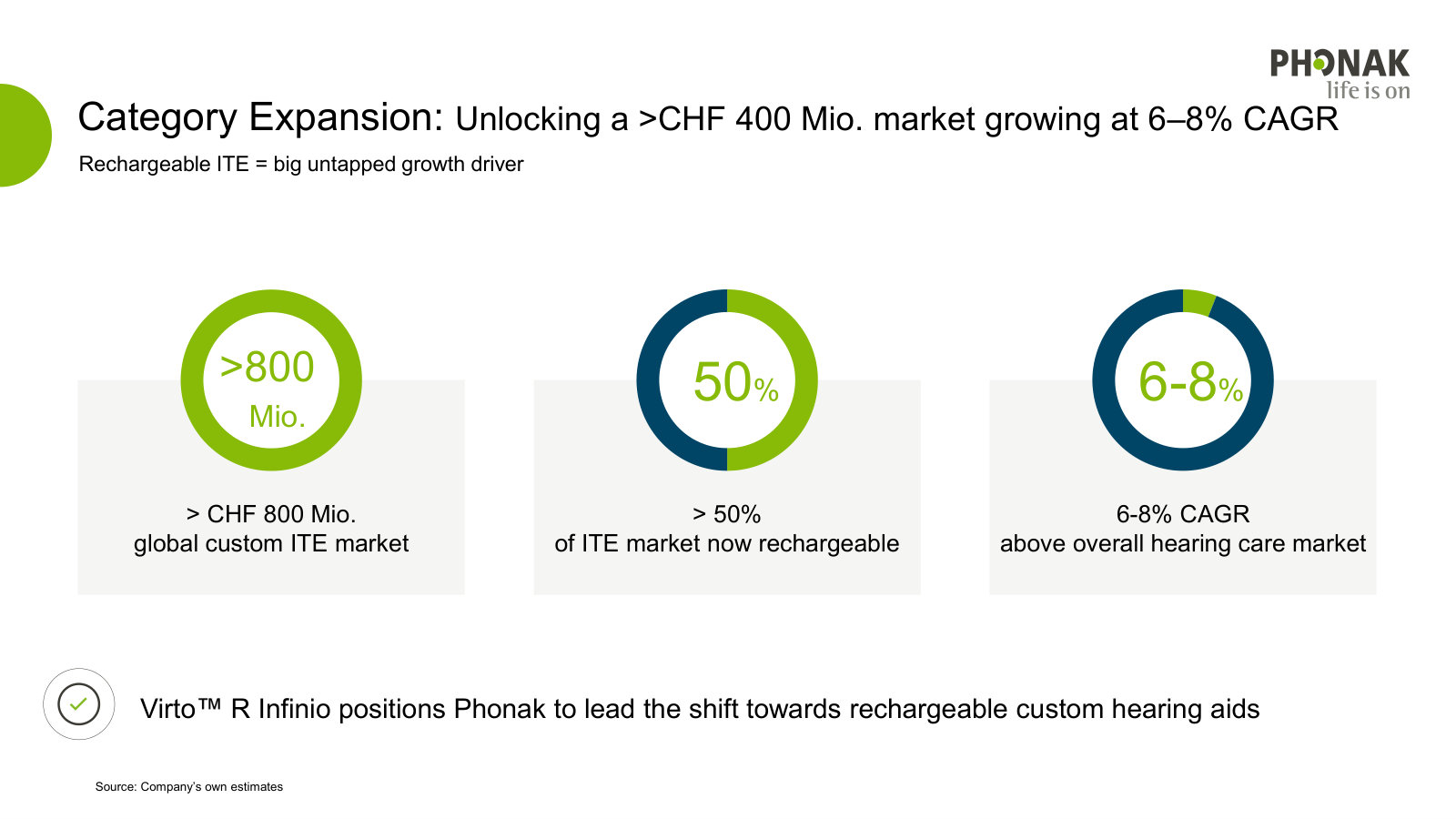
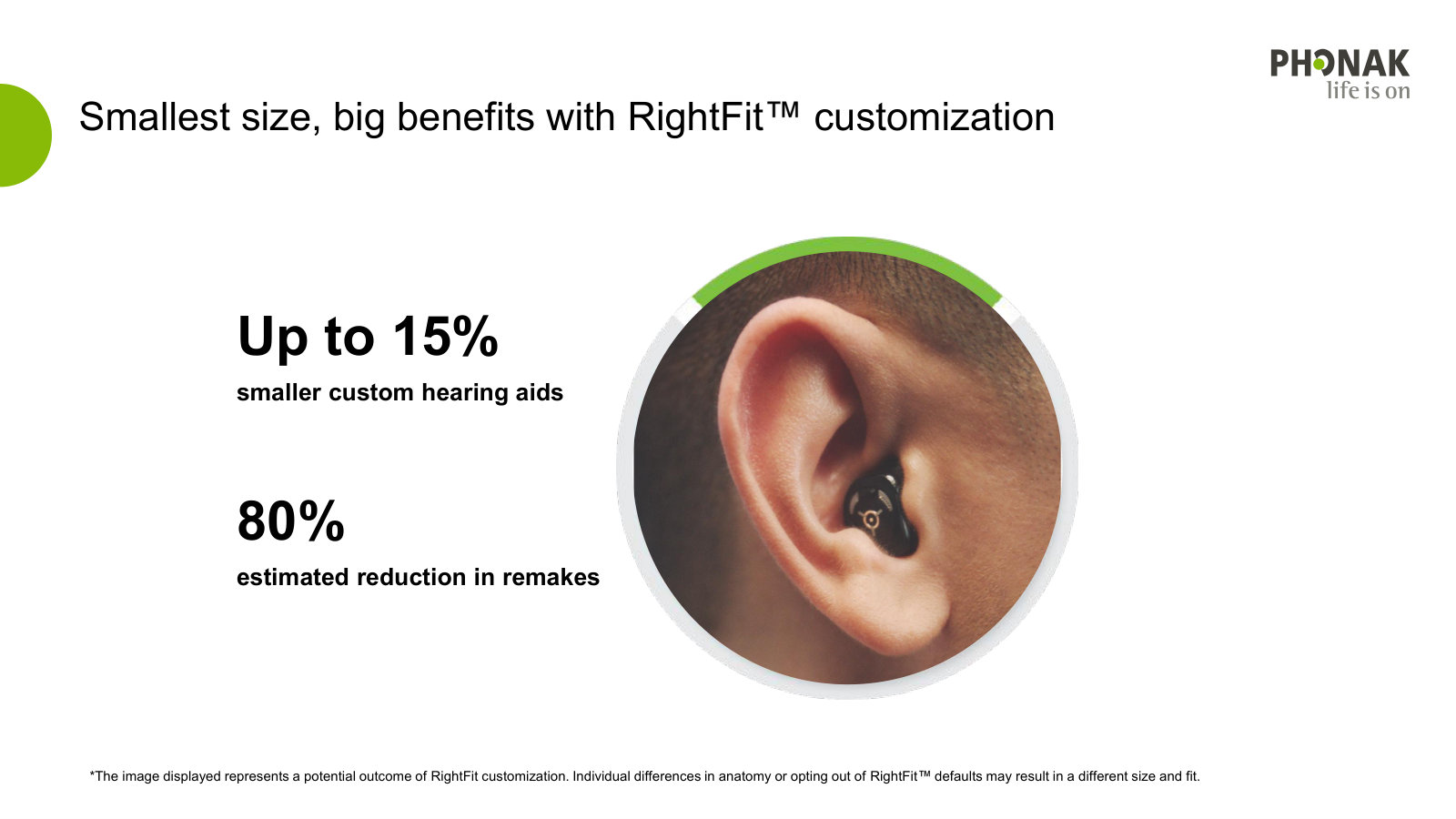
The current product story — why Sphere's AI is a defensible edge, the traction it has won, and the new categories it opens. · Open the full document →
Company Overview / Investor Presentation — FY2023/24
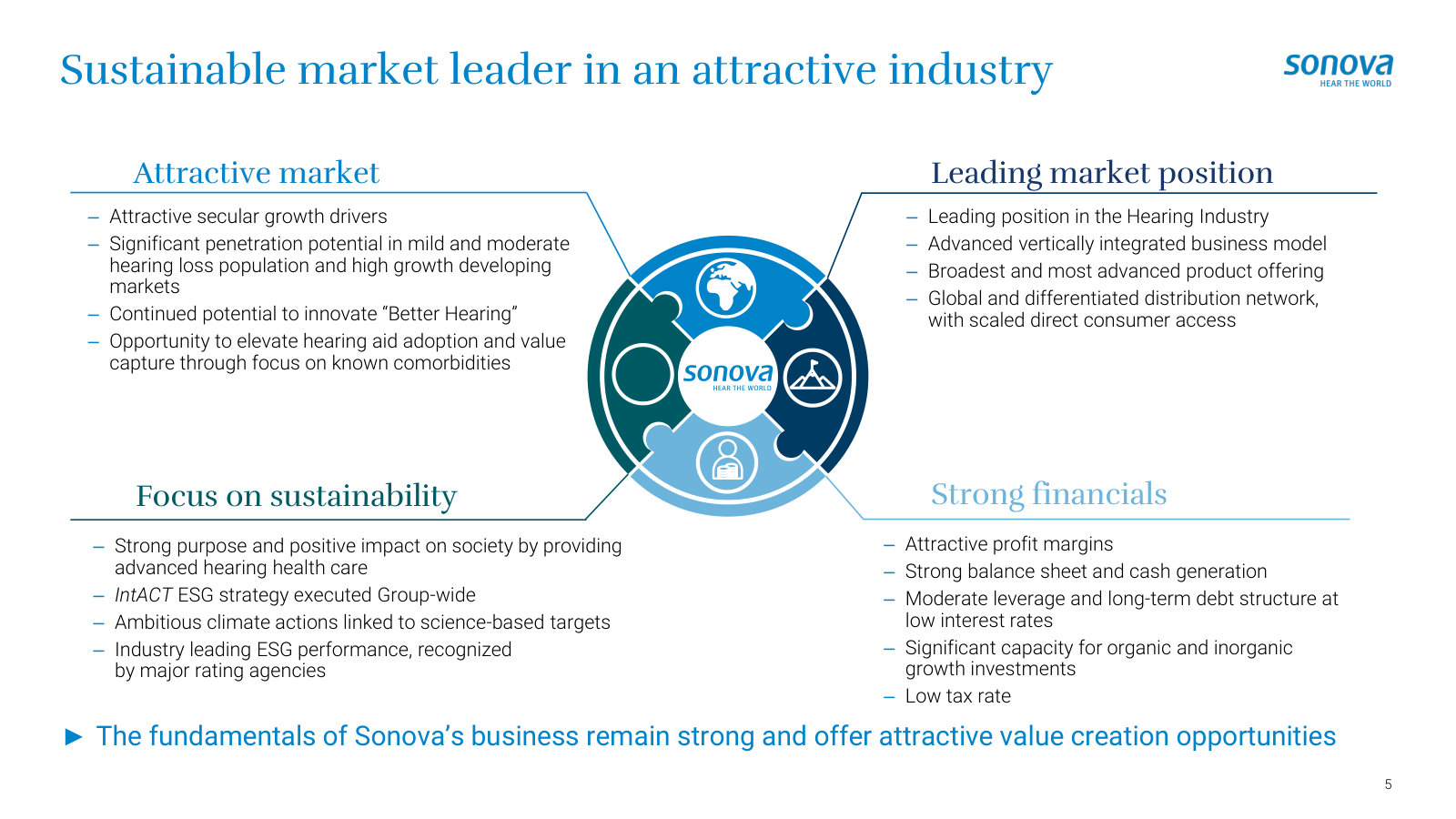
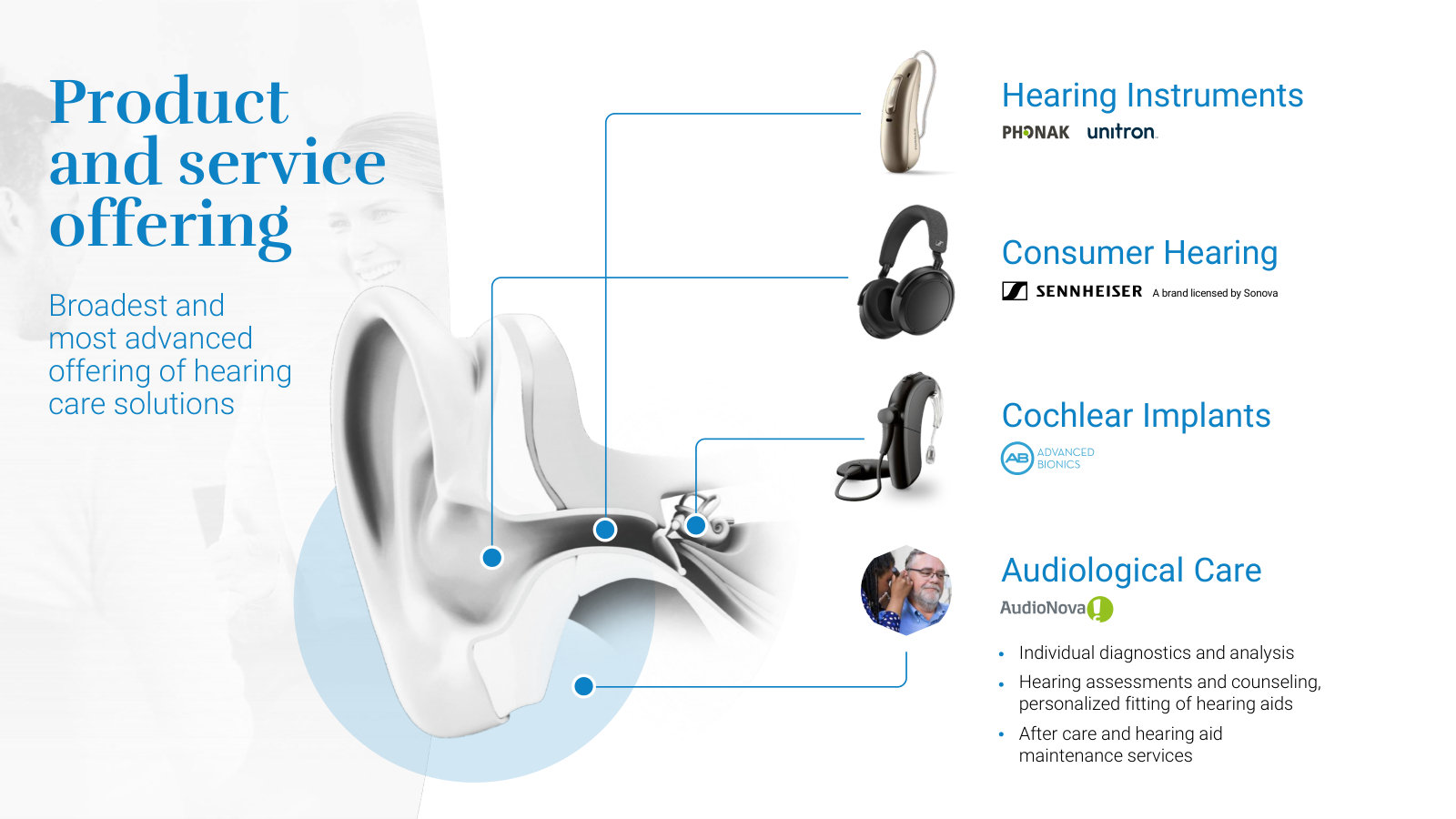
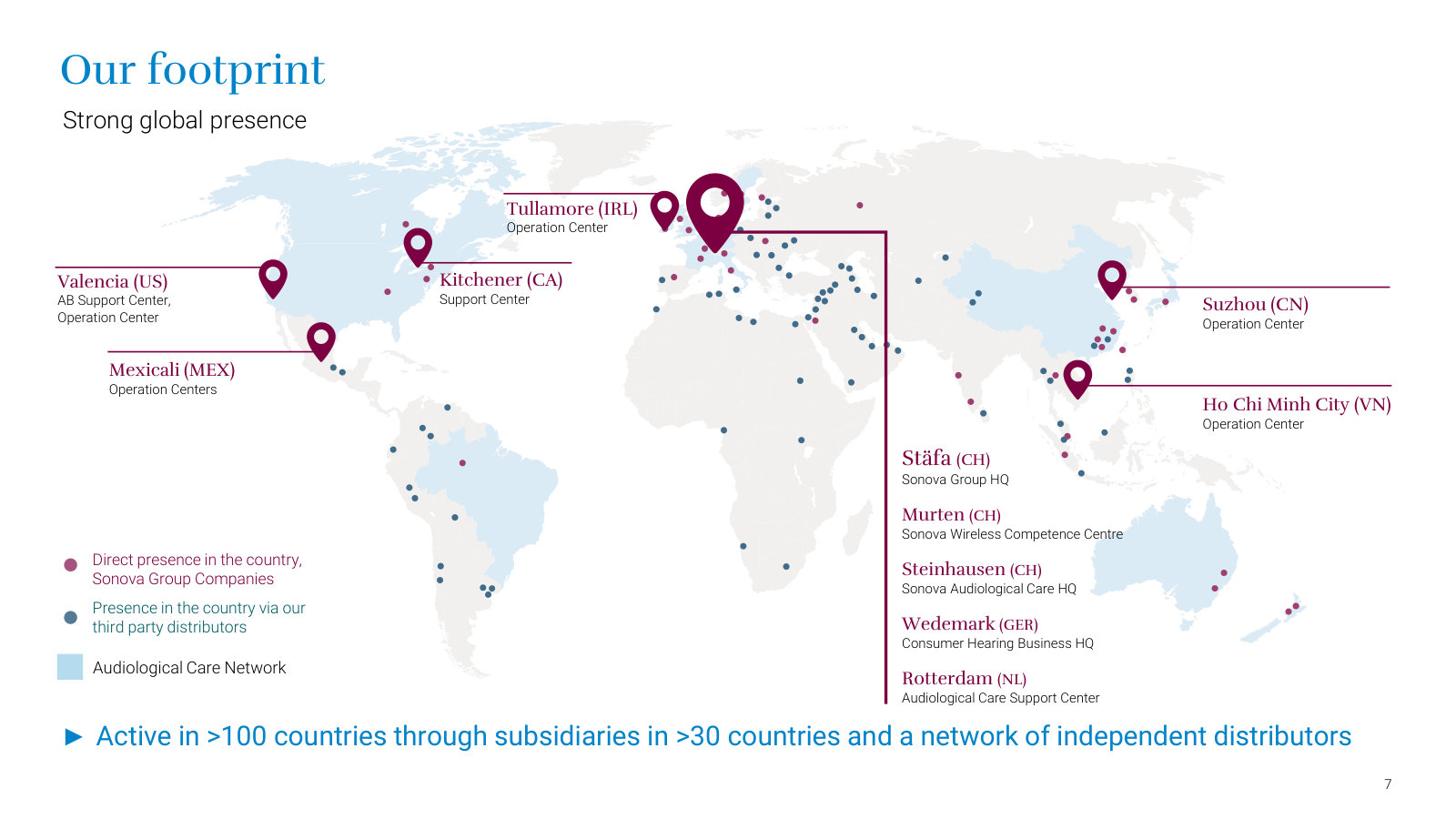
The plain primer — what Sonova sells, where it operates and how under-penetrated its market is; the fastest orientation. · Open the full document →
More from management
Half-Year Results 2025/26 — 1H FY2025/26 · 31 pages · The most recent half-year results, the interim step before the featured full-year deck. · Open →
Full-Year Results 2024/25 — FY2024/25 · 47 pages · The prior full-year results — the comparison base the current year is measured against. · Open →
J.P. Morgan Healthcare Conference 2025 — Jan 2025 · 14 pages · A concise, external-audience overview of strategy and products from the J.P. Morgan healthcare conference. · Open →
Sonova Holding AG's annual reports contain management's most considered account of the business. These are the sections, passages and visual pages worth opening in the originals preserved in Sources.
Sonova Holding AG — FY2025/26 Annual Report (fiscal year ended 31 March 2026) — FY2025/26
Latest report: introduces the renewed CHF 6bn strategy and the decision to divest Consumer Hearing, reshaping the segments. · Open the full document →
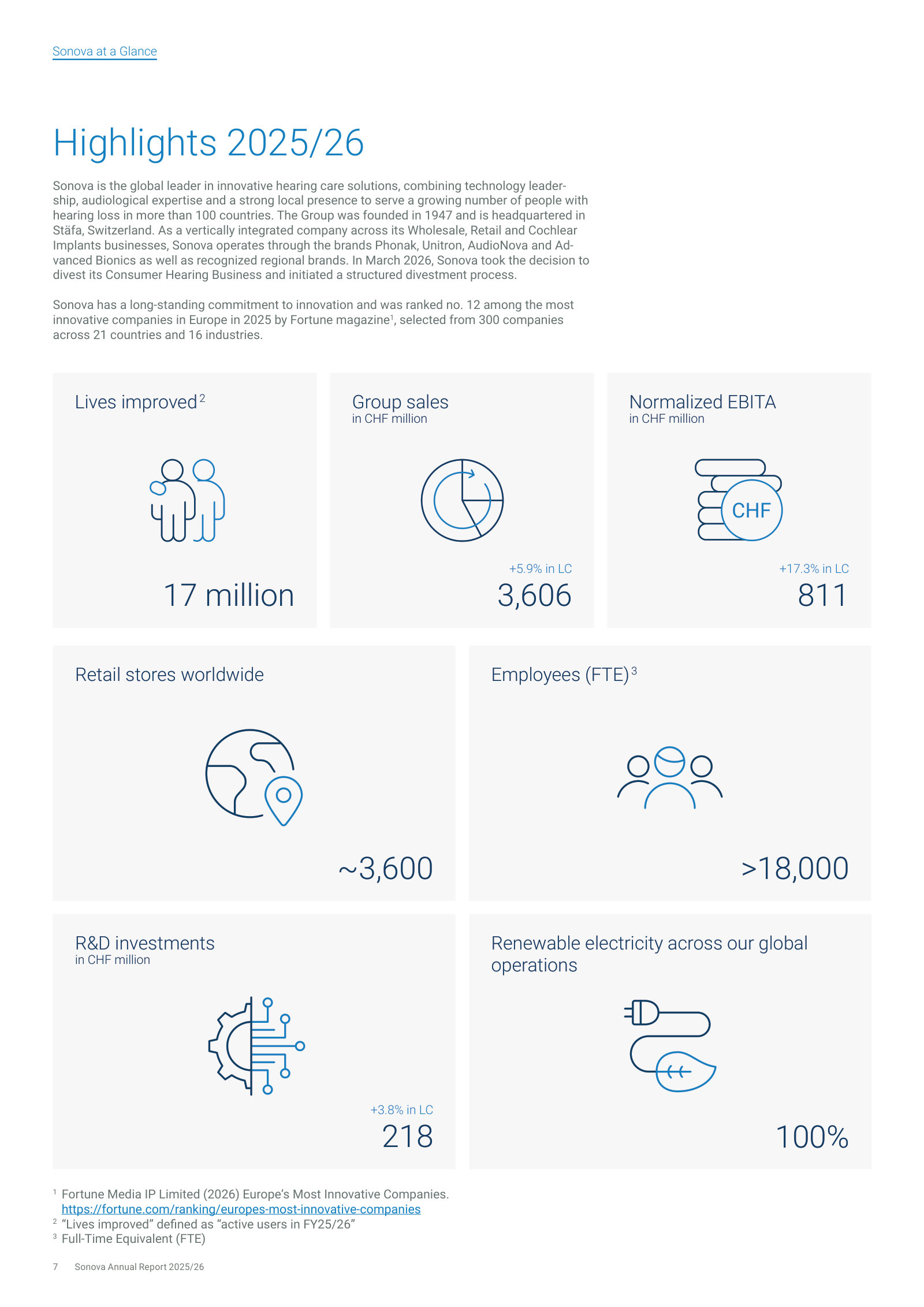
Sonova at a Glance — p. 7 · Read the full section →
The one-page portrait of what Sonova is: a vertically integrated hearing-care group across wholesale, retail and cochlear implants.
Who Sonova is, in its own words — and the March 2026 decision to exit Consumer Hearing.
Sonova is the global leader in innovative hearing care solutions, combining technology leadership, audiological expertise and a strong local presence to serve a growing number of people with hearing loss in more than 100 countries. The Group was founded in 1947 and is headquartered in Stäfa, Switzerland. […] In March 2026, Sonova took the decision to divest its Consumer Hearing Business and initiated a structured divestment process.
p. 8 · Read in context →
How we create value / Our renewed strategy and ambition — p. 9 · Read the full section →
Management frames the structural growth thesis and sets the CHF 6bn revenue ambition behind the reset strategy.
The growth thesis and the CHF 6 billion revenue ambition built on three strategic priorities.
The world hearing care market shows clear signs of structural growth and Sonova is very well positioned to capture this opportunity. […] Our ambition is to grow Sonova to CHF 6 billion in revenue by the 2030/2031 financial year and our renewed strategy is key to achieving this goal. It is built around three strategic priorities: innovate for adoption, succeed locally with a multi-channel, multi-brand approach, and excel in operations for growth.
p. 10 · Read in context →
Financial Review — p. 88 · Read the full section →
Where management explains what actually drove the year — and restates the business around the Consumer Hearing divestment.
The portfolio review: divesting Consumer Hearing and renaming Hearing Instruments/Audiological Care to Wholesale/Retail.
On 23 March 2026, Sonova announced that, following a strategic portfolio review, Sonova intends to divest its Consumer Hearing business. As a result, the business is classified as discontinued operations […] In addition, the Hearing Instruments business will be referred to as the Wholesale business, and the Audiological Care business as the Retail business, from this point forward.
p. 89 · Read in context →
Cochlear Implants segment — Continued headwinds — p. 92 · Read the full section →
The company-specific risk playing out: China volume-based procurement and a competitor launch pressuring the CI business.
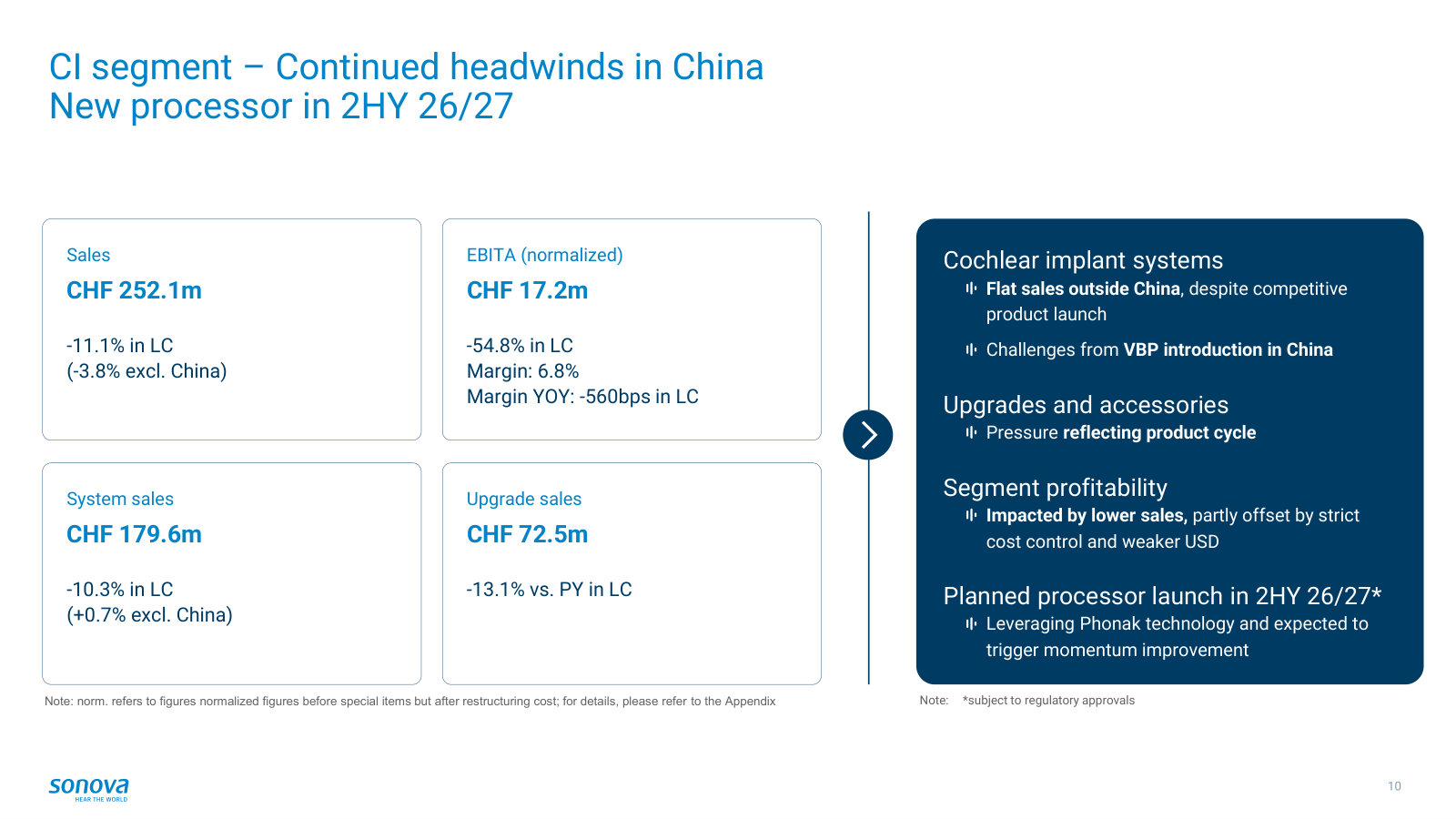
CI sales down 11.1% in local currencies, hit by China VBP and new competitive pressure.
Sales in the Cochlear Implants segment totaled CHF 252.1 million, a decline of 11.1% in local currencies and 17.1% in Swiss francs. […] The business in China was substantially hampered by challenges following the introduction of volumebased procurement (VBP). Developed markets saw increased competitive pressure following a product launch by the largest competitor in the second half-year.
p. 92 · Read in context →
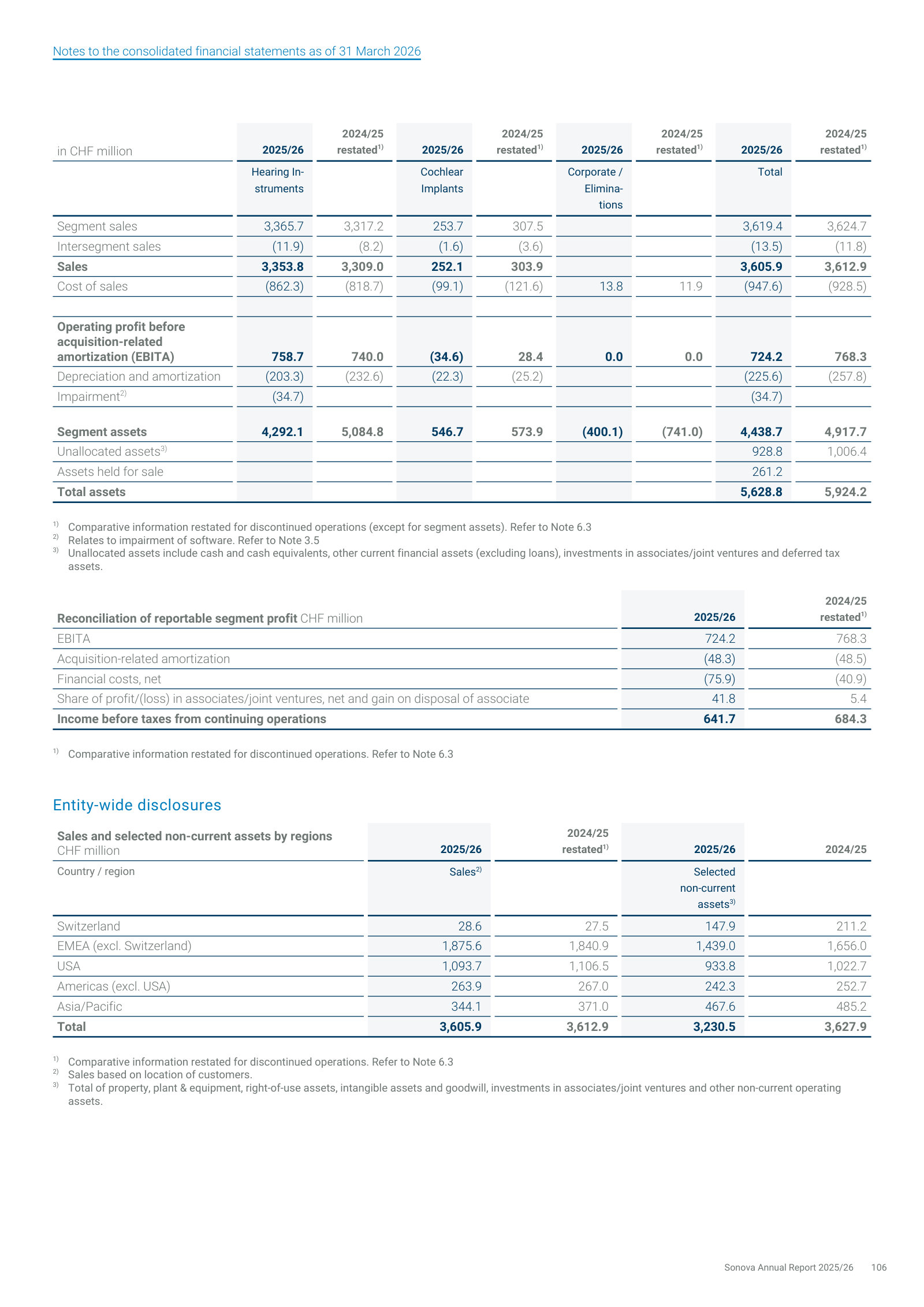
Note 2.2 Segment information — p. 106 · Read the full section →
How the two segments are built — centralized Swiss R&D, a global production footprint, and the retail vs wholesale split.
Note 2.3 Revenue — p. 108 · Read the full section →
The revenue-recognition policy defines the model — device-plus-service bundles, retail fitting, and hospital CI sales.
When Sonova books revenue: on delivery, after retail fitting, and on bundled device-plus-service contracts.
The Group recognizes revenue at point in time when control of the products is transferred to the buyer, mainly upon delivery. […] For retail customers, revenue recognition usually occurs after fitting of the device or when the trial period lapses. For hearing instruments sold in bundled packages (i.e. including accessories and services), the transaction price is allocated to each performance obligation on the basis of the relative stand-alone selling price of all performance obligations in the contract.
For cochlear implants, sales are generally recognized at point in time when control of the products is transferred to the buyer (mainly hospitals), either at delivery or after surgery.
p. 109 · Read in context →
Key audit matters — Goodwill — p. 167 · Read the full section →
Acquisition-built retail leaves goodwill at 41% of assets and 87% of equity — the estimate that could genuinely bite.
Goodwill of CHF 2,284m — 41% of assets, 87% of equity — rests on management's impairment judgments.
As of 31 March 2026, the Group has goodwill of CHF 2,284.2 million representing 41% of the Group’s total assets and 87% of the Group’s total equity. […] In performing the impairment analysis, management applies considerable judgment in respect of future market and economic conditions, such as economic growth, expected inflation rates, demographic developments, expected market share, revenue and margin development of the cash generating units (CGUs) to which goodwill has been allocated. Changes in these assumptions might lead to a change in the carrying value of goodwill.
p. 167 · Read in context →
Sonova Holding AG — FY2024/25 Annual Report (fiscal year ended 31 March 2025) — FY2024/25
The 'before' picture: four businesses including Consumer Hearing — the structure the FY2025/26 reset dismantles. · Open the full document →
Strategy and Businesses — The Sonova Group — p. 14 · Read the full section →
Shows the prior four-business architecture, making the FY2025/26 segment redefinition and divestment visible.
The old four-business structure: Hearing Instruments, Audiological Care, Consumer Hearing and Cochlear Implants.
The Hearing Instruments business stands at the core of Sonovaʼs identity as a champion of better hearing. […] The Audiological Care business, operating under the AudioNova and other renowned national brands, leverages the full range of Sonova products with expert professional hearing care, delivered in-store and through other channels with audiological expertise, efficiency, and personal attention. […] Consumer Hearing offers a range of premium wireless headphones, earbuds, and soundbars under the Sennheiser brand (under license), providing a deep immersive experience for consumers who love great sound, along with early-entry hearing devices that seamlessly address the first stages of hearing loss. […] Cochlear Implants, operating under the Advanced Bionics brand, provides complete hearing solutions for those whose hearing loss is too advanced for hearing aids.
p. 15 · Read in context →
More annual reports
Sonova Holding AG — FY2023/24 Annual Report (fiscal year ended 31 March 2024) — FY2023/24 · 288 pages · Pre-reset edition under the four-business model; baseline for the Infinio launch cycle. · Open →
Sonova Holding AG — FY2022/23 Annual Report (fiscal year ended 31 March 2023) — FY2022/23 · 305 pages · Post-pandemic recovery year and the 2022–2025 buyback program; earlier segment definitions. · Open →
Sonova Holding AG — FY2021/22 Annual Report (fiscal year ended 31 March 2022) — FY2021/22 · 287 pages · Earliest edition on the shelf; useful for multi-year comparison of the four-business era. · Open →
Competitors describe Sonova Holding AG's market in their own filings and calls. These verified passages and visual pages show where their strategies meet, using source documents preserved in Sources.
Demant A/S (DEMANT)
Sonova's closest full-line competitor: Demant (Oticon, Bernafon, Philips) goes head-to-head in hearing aids and, through its clinics and the KIND acquisition, in hearing-care retail and diagnostics. Its filings size the shared market and state an explicit ambition to lead hearing healthcare.
Demant states its ambition to become the leader in hearing healthcare and, via the KIND acquisition, its expansion in hearing-aid retail to more than 4,500 clinics globally - the same manufacturer-plus-retail model Sonova runs.
Our strategy is clear: We want to become the leading hearing healthcare company […] We proudly announced and finalised the acquisition of KIND, one of the world’s leading retailers of hearing aids. […] The KIND acquisition makes Demant a leading retailer in Germany and will increase the Group’s revenue by almost 10%. […] Combined with Demant’s existing global clinic footprint, we now have more than 4,500 clinics globally.
p. 7 · Read in context →
Demant's read on the OTC/self-fitting threat and on managed-care pricing pressure: it says over-the-counter hearing aids have had limited impact on the US prescription market so far, but flags newer form factors as a potential risk if they succeed.
The prevalence of large managed care organisations poses a risk to average selling prices in the hearing aid market, as volumes are increasingly consolidated among fewer players. […] Aside from the dynamics of managed care, new channels have emerged in recent years, including over-the-counter hearing aids, which have been publicly available since 2022. While these devices increase general access to treating hearing loss, their impact on the prescription hearing aid market in the US remains limited. Recently, new form factors have also entered the over-the-counter hearing aid market, and while this may increase awareness of hearing loss and expand the penetration of hearing healthcare solutions to new users, it could pose a risk to the prescription hearing aid market, if successful.
p. 38 · Read in context →
Amplifon S.p.A. (AMP)
The global leader in hearing-care retail - the channel where Sonova's own retail arm competes. Amplifon sizes the retail market, claims an ~13% global share, and describes an aggressive store-acquisition and consolidation strategy.
Amplifon's 2025 results and retail M&A: about EUR 2.4bn revenue and ~250 hearing-care centres acquired, plus a network streamlining and the early-2026 divestiture of its UK operations under its 'Fit4Growth' program.
Consolidated revenues for the year reached €2.4 billion, up 1.7% at constant exchange rates […] We continued – especially in the first half of the year – our international expansion, acquiring around 250 hearing care centers across Europe, the United States, and China. […] The program also included a streamlining of the network (with the closure or consolidation of 160 clinics) and a strategic review of the portfolio, which led, in early 2026, to the divesture of our UK operations, allowing greater focus on core, higher potential markets.
p. 8 · Read in context →
Amplifon's stated first strategic pillar - consolidating retail leadership and taking leadership in markets where it is not yet the leader - in the same retail channel where Sonova competes.
The Group aims to strengthen its leadership in all core markets, consolidating its position where it is already a leader and achieving leadership in markets where the Company is not leader yet.
p. 17 · Read in context →
EssilorLuxottica SA (EL)
A large-cap new entrant colliding with Sonova at the low/mild end: EssilorLuxottica's Nuance Audio hearing glasses target mild-to-moderate loss with vision-retail scale, and the company frames traditional hearing aids' visibility, discomfort and price as the adoption barrier it aims to break. Hearing is a small line inside a vision conglomerate.
EssilorLuxottica's Chairman/CEO on its Nuance Audio hearing glasses reaching 15,000 stores across twelve markets - an indication of the distribution reach a vision-retail entrant brings to hearing.
We also launched Nuance Audio hearing-enhancing glasses, now available across 15,000 stores in twelve markets.
p. 5 · Read in context →
EssilorLuxottica's framing of the hearing-solutions market as underpenetrated, attributing the gap partly to the visibility, discomfort and price of traditional hearing aids and citing an 83% WHO service gap - the incumbent model its eyewear device positions against.
Like vision care the hearing solutions market is underpenetrated for a number of reasons, including the visibility of traditional hearing aids, discomfort and price. According to the World Health Organization, globally there is an 83% service gap
p. 26 · Read in context →
Audientes A/S (AUDNTS)
A directional, pure-play read on the value/self-fitting/OTC threat: a micro-cap building affordable, self-fitting hearing aids for underserved and emerging markets - the low-cost end that pressures incumbents like Sonova, though at negligible current scale.
Audientes describes its positioning as a self-fitting, affordable hearing-aid maker aimed at accessibility - a directional view of the value/OTC end of Sonova's market (Audientes is a pre-scale micro-cap).
Audientes A/S is a Danish hearing technology company dedicated to developing smart, self-fitting, and affordable hearing aids and advanced hearables. Our mission is to make high-quality solutions for hearing improvement and enhancement accessible to everyone who needs them globally. […] Ven is a self-fitting, binaural hearing aid designed for individuals with severe to profound hearing loss in one or both ears.
p. 3 · Read in context →
More peer documents
DEMANT_annual_report_FY2024 — 208 pages · Prior-year Demant market-trends section sizes the hearing-aid market and details US managed-care/ASP dynamics, useful for a year-over-year read on the shared market. · Open →
AMP_annual_report_FY2024 — 320 pages · Amplifon's FY2024 report repeats the ~13% share claim and 2024 highlights (store counts, 26 countries), useful to track the share and footprint trajectory. · Open →
AUDNTS_annual_report_FY2023 — 33 pages · Earlier Audientes report laying out its self-fitting product platform and roadmap, including hearing-enhancement smart glasses and BTE/RIC plans. · Open →
Source: S&P Capital IQ consensus via Xpressfeed · Generated 2026-07-23.
FY28 revenue consensus cut ~7% in six months, EPS only ~3%
The last 30 days show small upward revisions across both years, so the six-month markdown appears to have paused rather than reversed.
Currency: CHF · Scale: money in millions, absolute · Point-in-time consensus; Δ90d is Now versus 90d.
| Metric | FY | 180d | 90d | 30d | Now | Δ90d |
|---|---|---|---|---|---|---|
| Revenue | FY2027 | CHF 4.11bn | CHF 3.90bn | CHF 3.81bn | CHF 3.83bn | -1.9% |
| Revenue | FY2028 | CHF 4.36bn | CHF 4.17bn | CHF 4.03bn | CHF 4.04bn | -3.0% |
| EPS (normalized) | FY2027 | CHF 10.91 | CHF 10.71 | CHF 10.53 | CHF 10.60 | -1.1% |
| EPS (normalized) | FY2028 | CHF 12.09 | CHF 11.79 | CHF 11.65 | CHF 11.73 | -0.5% |
Margin-led model: mid-single-digit revenue growth, low-double-digit EPS growth
Earnings estimates rise faster than revenue in every visible year, the signature of a margin-expansion story rather than a volume one.
Currency: CHF · Scale: money in millions, absolute · YoY uses the prior fiscal year from the feed; analyst count and range use the first displayed period.
| Metric | FY2027E | FY2028E | FY2029E | YoY | Analysts | Low / high |
|---|---|---|---|---|---|---|
| Revenue | CHF 3.83bn | CHF 4.06bn | CHF 4.32bn | +6.1% | 18 | CHF 3.75bn / CHF 4.06bn |
| EBITDA | CHF 1.06bn | CHF 1.14bn | CHF 1.23bn | +12.9% | 16 | CHF 928.41m / CHF 1.11bn |
| EPS (normalized) | CHF 10.64 | CHF 11.80 | CHF 13.11 | -0.2% | 19 | CHF 9.04 / CHF 11.49 |
| Gross margin | 73.7% | 73.7% | 73.8% | +2.1pt | — | — |
Street cautious: nine holds of 19, targets spanning CHF 170-300
Currency: CHF · Scale: money in millions, absolute · Analyst counts shown explicitly.
| Street view | Reading | Analysts |
|---|---|---|
| Recommendation mix | Buy 4, Outperform 3, Hold 9, Underperform 1, Sell 2 | 19 |
| Consensus score | 2.68 | 19 |
| Target price | mean CHF 223.7; median CHF 220.0; high CHF 300.0; low CHF 170.0 | 19 |
Where analysts split: FY27 EBITDA and outer-year EPS ranges are wide
The FY29 EBITDA range rests on just 11 analysts, so treat the outer-year spread as thin-coverage noise as much as true disagreement.
Currency: CHF · Scale: money in millions, absolute · Spread/mean is absolute high-low divided by absolute mean.
| Metric | Period | Mean | Low–high | Spread/mean | Analysts |
|---|---|---|---|---|---|
| EBITDA | FY2027E | CHF 1.06bn | CHF 928.41m–CHF 1.11bn | 17.6% | 16 |
| EPS (normalized) | FY2029E | CHF 13.11 | CHF 12.02–CHF 14.22 | 16.8% | 14 |
| EBITDA | FY2029E | CHF 1.23bn | CHF 1.14bn–CHF 1.30bn | 12.9% | 11 |
Coverage thins in the outer years
FY29 EBITDA, net income and GAAP EPS each draw 11-14 analysts versus 16-19 for FY27, so treat the FY29 tape as indicative rather than settled.
Visible Alpha broker models via S&P Xpressfeed · 14 brokers · 447 line items · freshest revision 2026-07-23.
Broker models frame Sonova as a mid-single-digit organic grower where the FY-2028 story is margin, not volume: EBITA margin is modeled to step from ~19.6% in FY-2026 to ~22.6% in FY-2028 while organic growth holds near 5%. Hearing-instrument retail is overtaking wholesale as the fastest-growing division, and cochlear implants trough in FY-2027 before a partial recovery. Consensus on the group total is tight; the real disagreement lives in the pace of the FY-2028 segment rebound.
Margins are the story: EBITA margin steps from ~19.6% to ~22.6% by FY-2028
| Line | FY-2025A | FY-2026A | FY-2027E | FY-2028E | YoY | Brokers |
|---|---|---|---|---|---|---|
| EBITA margin(%) | 19.9% | 19.6% | 22.0% | 22.6% | +2.4pt | 11 |
| EBITA | CHF 762.98m | CHF 741.76m | CHF 832.02m | CHF 907.03m | +12.2% | 12 |
| Gross profit | CHF 2.80bn | CHF 2.70bn | CHF 2.81bn | CHF 3.00bn | +4.0% | 10 |
| EBITDA | CHF 932.18m | CHF 943.64m | CHF 1.04bn | CHF 1.14bn | +10.3% | 8 |
Retail is overtaking wholesale as the growth engine; cochlear implants are the drag
| Line | FY-2025A | FY-2026A | FY-2027E | FY-2028E | YoY | Brokers |
|---|---|---|---|---|---|---|
| Segment revenue | — | — | — | — | — | — |
| Revenue - Hearing Instruments business | CHF 1.82bn | CHF 1.86bn | CHF 1.96bn | CHF 2.07bn | +5.5% | 12 |
| Revenue - Hearing instrument retail | CHF 1.48bn | CHF 1.48bn | CHF 1.58bn | CHF 1.71bn | +6.8% | 12 |
| Revenue - Cochlear implants | CHF 302.27m | CHF 273.69m | CHF 250.20m | CHF 268.23m | -8.6% | 12 |
| Revenue - Consumer hearing business | CHF 241.72m | CHF 229.82m | CHF 218.46m | CHF 256.82m | -4.9% | 11 |
Constant currency: wholesale growth fades from ~8% to <5% while retail holds ~7%
Wholesale constant-currency growth decelerates from ~8% toward ~5% across the forecast while retail re-accelerates above 7%. Cochlear swings from -4% in FY-2026 to +6% by FY-2028 as it laps its reset.
| Line | FY-2025A | FY-2026A | FY-2027E | FY-2028E | YoY | Brokers |
|---|---|---|---|---|---|---|
| CC growth | — | — | — | — | — | — |
| Hearing instruments business - CC growth(%) | 8.4% | 8.3% | 6.5% | 4.8% | -1.8pt | 11 |
| Hearing instrument retail - CC growth(%) | 5.9% | 5.2% | 7.3% | 7.2% | +2.0pt | 11 |
| Revenue - Cochlear implants - Constant currency(%) | 9.5% | -4.1% | 0.0% | 6.1% | +4.1pt | 11 |
The FY-2028 rebound sits in the segments brokers least agree on
| Line | Period | Median | Q1–Q3 | Min–max | Brokers |
|---|---|---|---|---|---|
| Revenue - Cochlear implants | FY-2028E | CHF 268.27m | CHF 262.75m–CHF 278.77m | CHF 235.33m–CHF 288.92m | 10 |
| Revenue - Consumer hearing business | FY-2028E | CHF 248.23m | CHF 243.30m–CHF 257.11m | CHF 231.69m–CHF 317.02m | 7 |
| Revenue - Hearing Instruments business | FY-2028E | CHF 2.06bn | CHF 2.04bn–CHF 2.09bn | CHF 1.96bn–CHF 2.20bn | 10 |
Deep coverage on divisions, thin on product splits
Division-level lines carry 10-13 brokers and were refreshed this week, but product splits are thin: cochlear-implant-systems and upgrade/accessories rest on 4-5 brokers and consumer hearing shows a single broker in FY-2027. Read those as indicative, not consensus.
Headline P&L consensus, momentum and beat/miss live in the CapIQ tab.
Source: S&P Capital IQ transcripts via Xpressfeed · latest indexed call 2026-05-18 · generated 2026-07-23.
Latest call digest
Sonova Holding AG, 2026 Earnings Call, May 18, 2026 · 2026-05-18T11:00:00
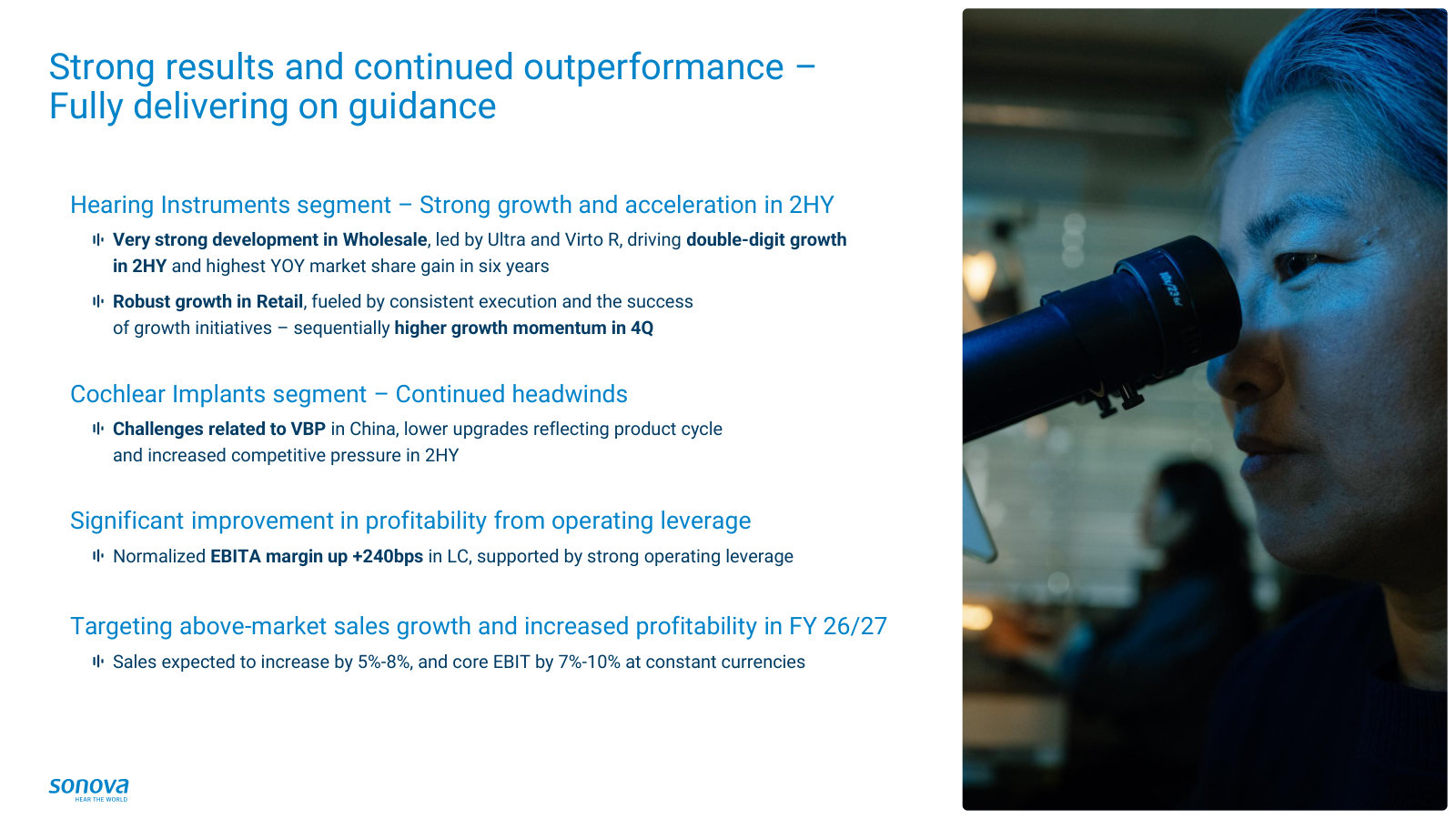
Sonova FY2025/26 full-year call — May 18, 2026. The prepared remarks were confident: management said it "fully met our guidance," with Hearing Instruments growth accelerating to double digits in the second half and the highest year-on-year share gain since the Marvel platform. The Virto R rechargeable in-the-ear device was framed as an outright success at roughly CHF 120 million of annualized revenue, alongside the Infinio Ultra / Sphere Ultra rollout. Cochlear Implants remained the weak spot, hit by China VBP, softer upgrades and a competitor launch. Two structural changes anchor the story: Consumer Hearing is now classified as discontinued operations pending divestment, and guidance moves to a new "core EBIT" metric. FY2026/27 guidance is sales +5% to 8% and core EBIT +7% to 10% at constant FX, plus a CHF 6 billion revenue ambition by FY2030/31.
Prepared remarks vs. Q&A reality. The scripted tone was uniformly upbeat; the Q&A exposed the load-bearing assumptions. The path to the top of the sales range depends on market acceleration, Virto R carryover and a second-half platform launch, not on visible demand today. The Cochlear Implants recovery rests entirely on a new sound processor whose timing is "subject to regulatory approvals." Management repeatedly declined specifics on Costco/VA economics and would not confirm whether EasyGuard has entered those channels. VA share was flagged near a peak (~54%) that could ebb as new entrants arrive, tempering the otherwise strong U.S. read.
Participant coverage from the latest call.
| Group | Participants | Count |
|---|---|---|
| Management | Operator; Thomas Bernhardsgruetter — Former Senior Director of Investor Relations, Sonova Holding AG; Eric Bernard — Chief Executive Officer, Sonova Holding AG; Elodie Carr-Cingari — Chief Financial Officer, Sonova Holding AG | 4 |
| Analysts | Andjela Bozinovic — Research Analyst, BNP Paribas, Research Division; Veronika Dubajova — Head of EMEA MedTech & Healthcare Services, Citigroup Inc., Research Division; Marco Pires-Cox — Research Analyst, Barclays Bank PLC, Research Division; Aisyah Noor — Equity Analyst, Morgan Stanley, Research Division; Oliver Metzger — Research Analyst, ODDO BHF Corporate & Markets, Research Division; Susannah Ludwig — Research Analyst, Bernstein Institutional Services LLC, Research Division; Daniel Jelovcan — Research Analyst, Zürcher Kantonalbank, Research Division; David Adlington — Head of Medical Technology & Services Equity Research, JPMorgan Chase & Co, Research Division; Falko Friedrichs — Research Analyst, Deutsche Bank AG, Research Division; Martinien Rula — Equity Associate, Jefferies LLC, Research Division; Urs Kunz — Senior Analyst, Research Partners AG; Niels Granholm-Leth — Head of Equity Research, DNB Carnegie, Research Division; Richard Felton — Equity Analyst, Goldman Sachs Group, Inc., Research Division | 13 |
Curated latest-call exchanges; one row per analyst topic.
| Analyst | Firm | Topic | What changed in Q&A |
|---|---|---|---|
| Andjela Bozinovic | BNP Paribas | Sales guidance composition & Virto R | Pressed on what sits at the top vs. bottom of the range and Virto R's contribution; management cited Virto carryover, VA/large-account share and the H2 platform launch, and reported no visible competitor impact yet. |
| Veronika Dubajova | Citigroup | Market recovery & H1/H2 phasing | Asked whether the modest market acceleration is actually visible and if core EBIT growth stays in range each half; CFO said within range in both halves, with CI weighting H2. |
| Marco Pires-Cox | Barclays | Share-gain composition & cost inflation | Sought the Ultra vs. Virto R split and any RIC-to-ITE structural shift; CEO said gains were broad-based with no real cannibalization. |
| Aisyah Noor | Morgan Stanley | APAC KPIs & non-core items | Asked for benchmarks on the Asia push and dilution safeguards; CEO declined specific KPIs but pointed to strong, profitable Japan growth. |
| Oliver Metzger | ODDO BHF | Retail M&A landscape & ITE ASP | Asked whether competitor distraction eases retail M&A competition and the addressable ceiling for rechargeable ITE; management saw a more favorable field and durable Virto R pricing. |
| Daniel Jelovcan | Zürcher Kantonalbank | U.S. growth drivers & new platform size | Probed Costco's U.S. contribution and whether the next platform gets smaller; CEO stressed VA share/price and hinted at size compression. |
| David Adlington | JPMorgan | Path to top-end & GN/Amplifon | Asked the biggest lever to reach 8% and the net effect of the GN Hearing / Amplifon deal; management cited market plus launches and limited direct exposure. |
| Falko Friedrichs | Deutsche Bank | Retail organic growth & CI trajectory | Asked whether retail beats end-market growth and if CI grows positively this year; CEO confirmed CI can grow positively, weighted to H2. |
| Niels Granholm-Leth | DNB Carnegie | Sam's Club conflict & discontinued-ops drag | Raised potential channel conflict with Costco and the CHB full-year drag; management deflected on channel specifics and declined to quantify. |
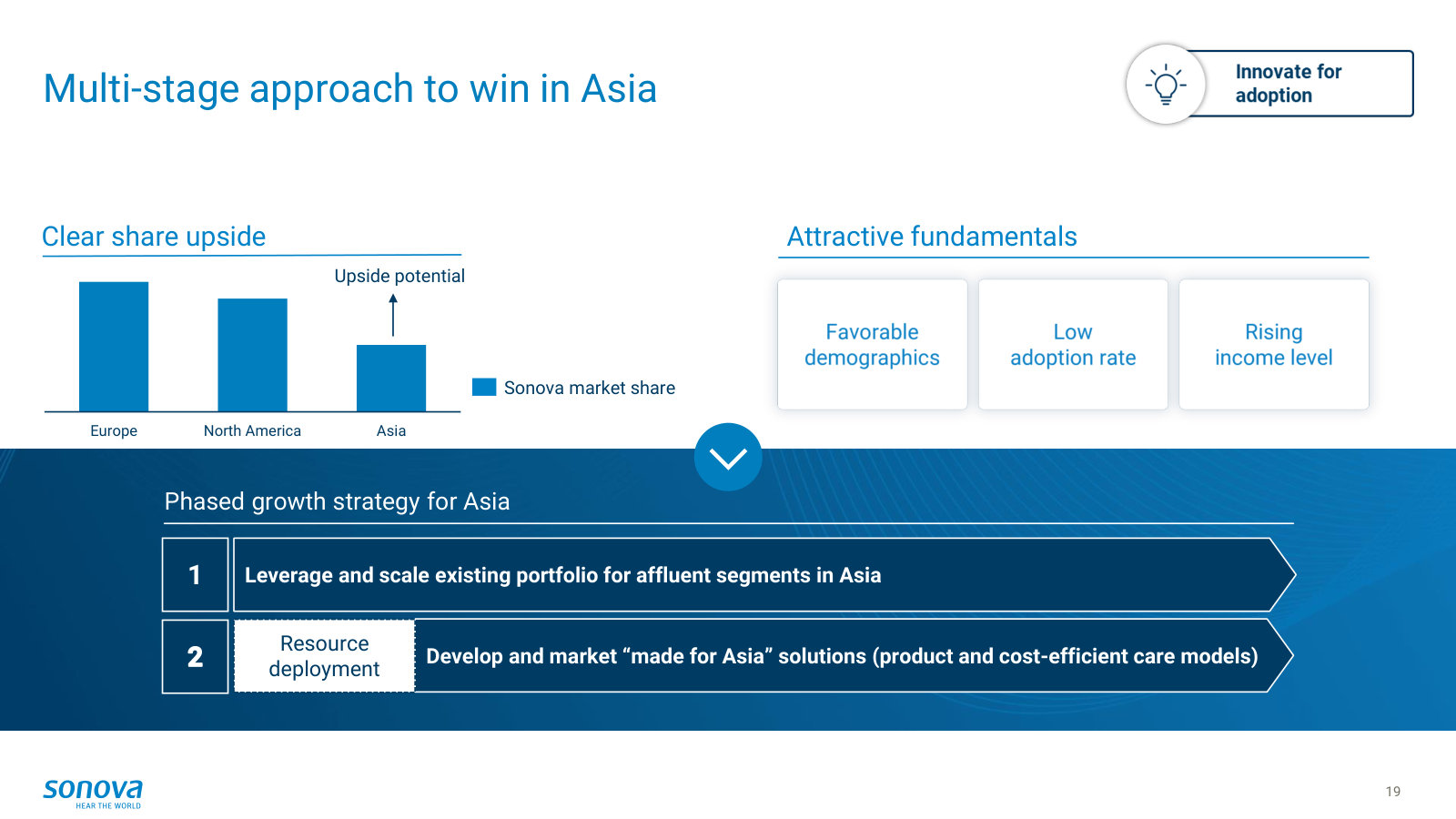
| Richard Felton | Goldman Sachs | APAC market share | Asked current APAC share vs. the global average; CEO indexed most of Asia at 3-6 vs. 10 elsewhere, framing it as room to at least double the business. |
Theme tracker
Themes are curator-classified across supplied calls.
| Theme | Status | Quarters mentioned | Read-through |
|---|---|---|---|
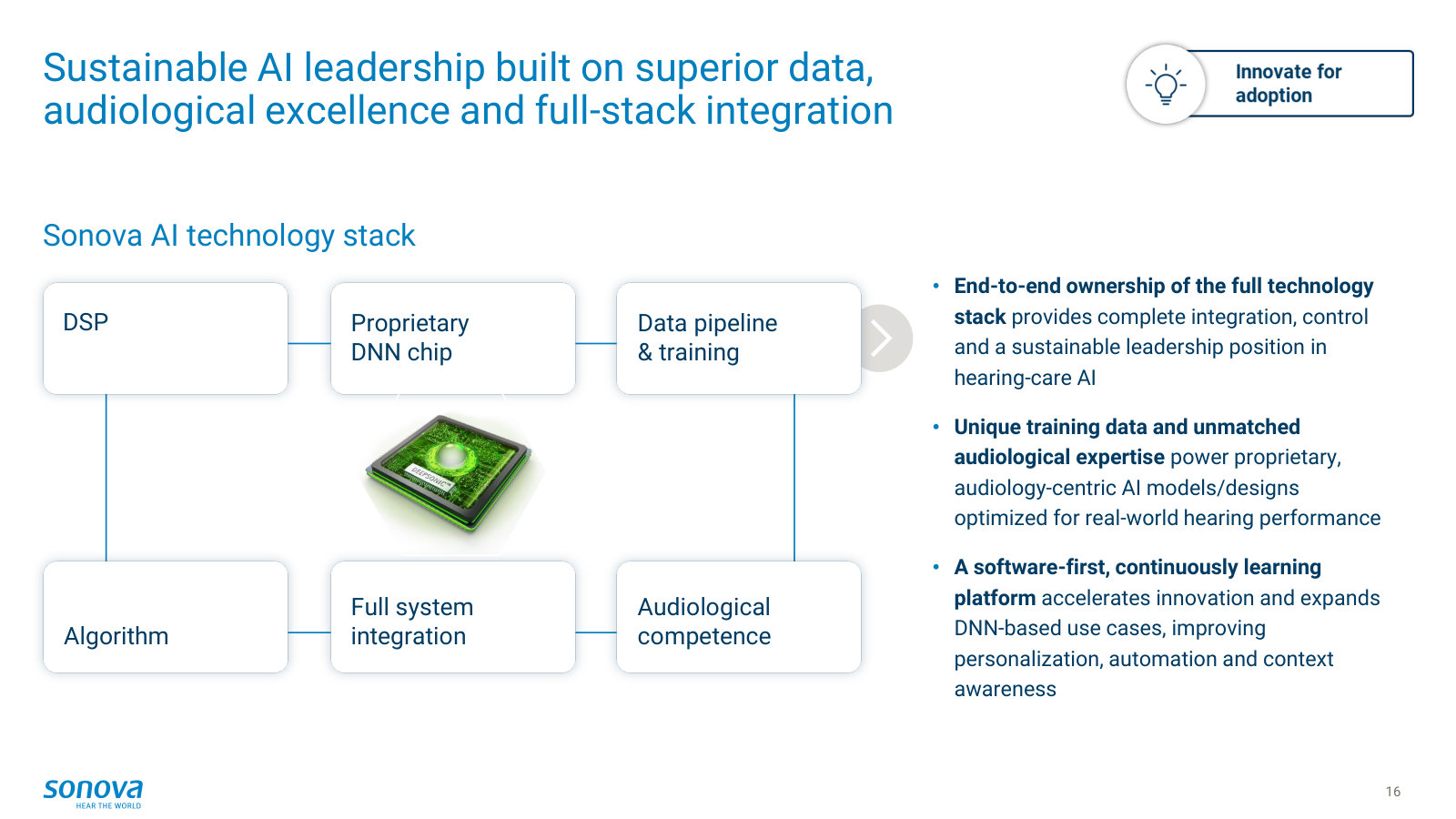
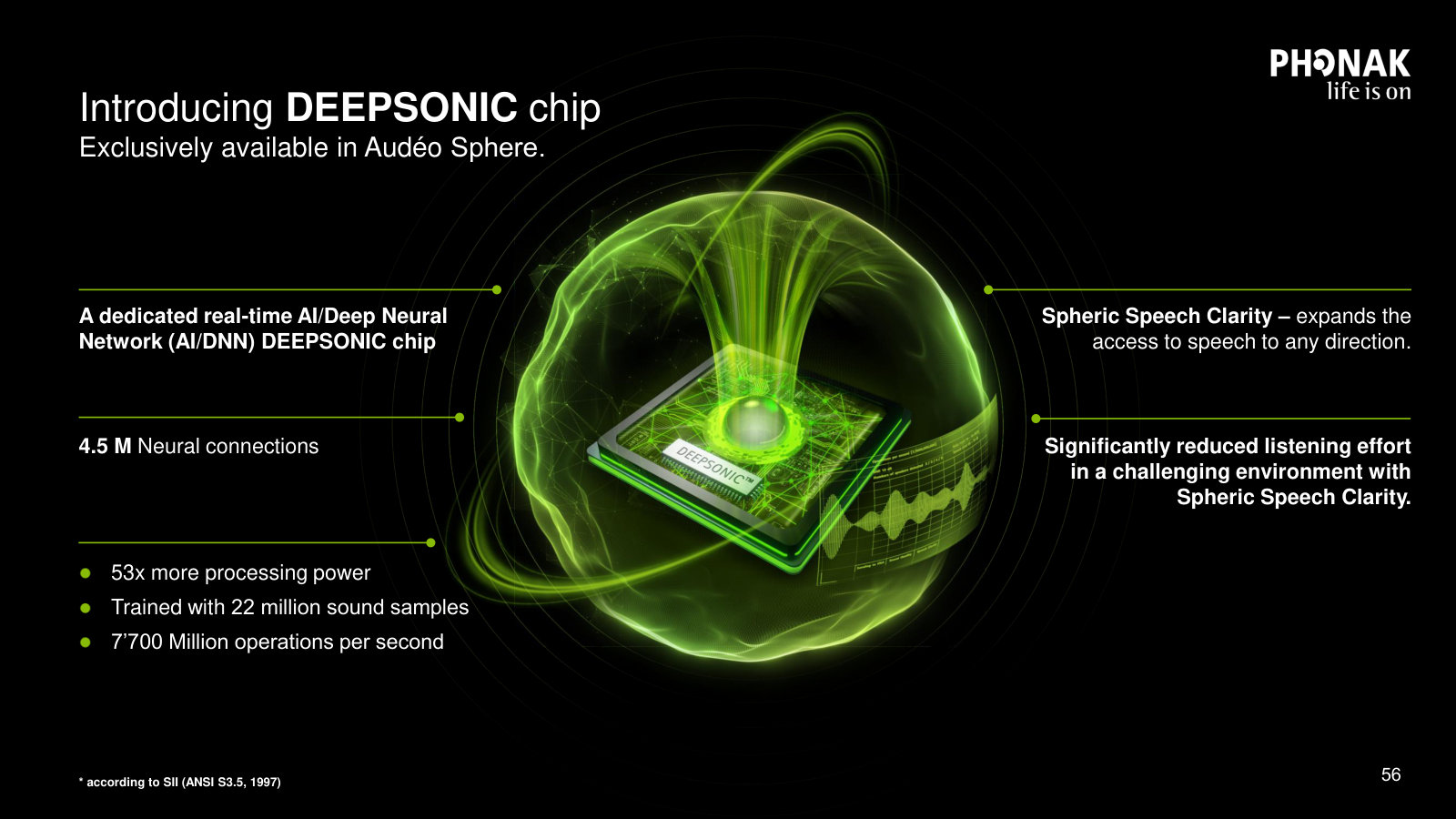
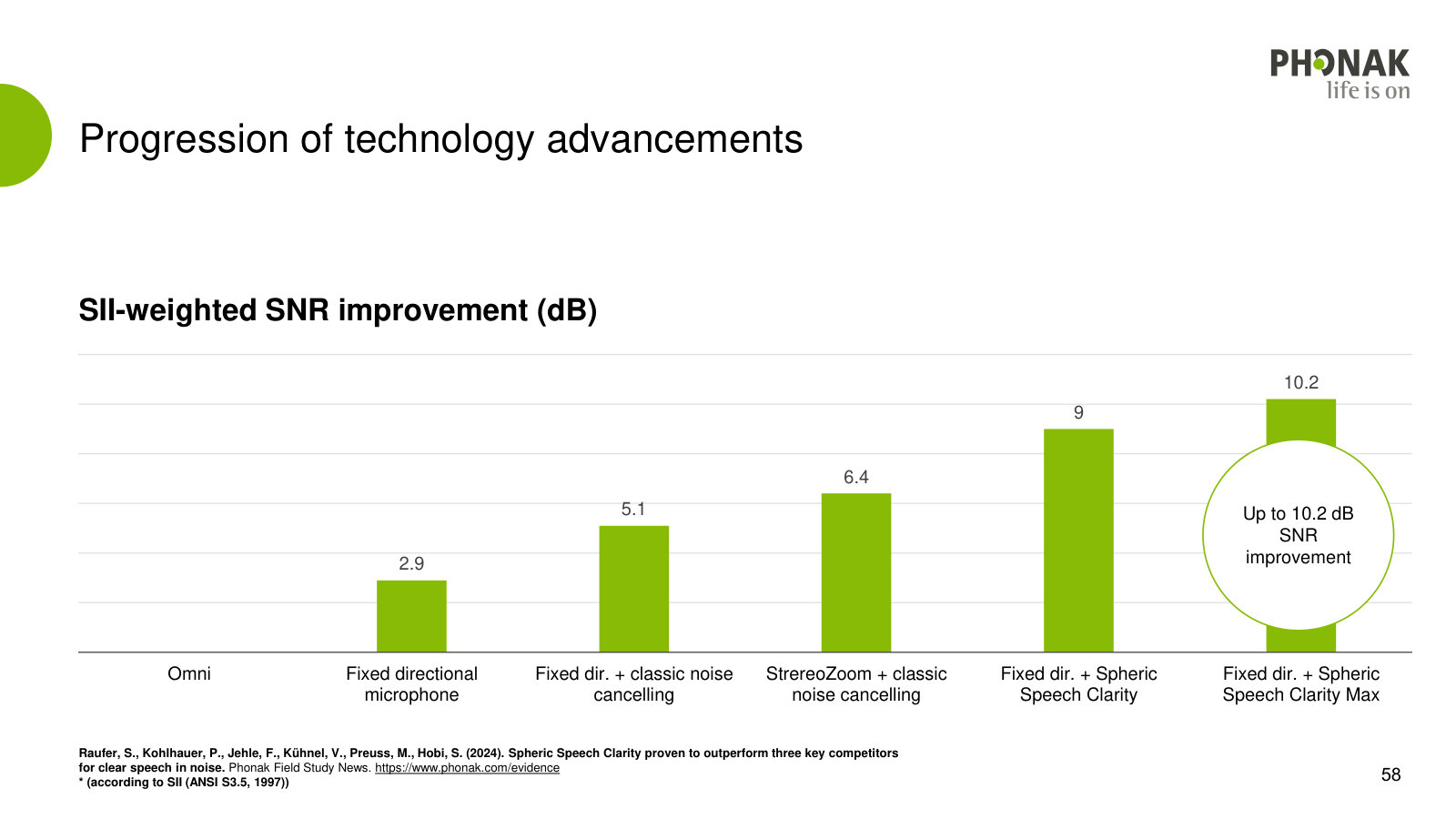
| AI-enabled hearing leadership (Infinio Sphere / Ultra, DEEPSONIC chip) | emerged | Nov 2024, May 2025, Nov 2025, May 2026 | Since the August 2024 launch, a proprietary AI speech-in-noise chip has become the core competitive narrative, replacing the generic platform-cadence story (Paradise, Lumity) of prior years. |
| Virto R / rechargeable in-the-ear category | emerged | Nov 2025, May 2026 | A rechargeable-ITE gap was flagged for years without a product; Virto R shipped in August 2025 and by May 2026 was described as a ~CHF 120m run-rate driver, filling a long-standing hole. |
| Cochlear Implants weakness awaiting a new processor | persisted | Nov 2024, May 2025, Nov 2025, May 2026 | Upgrade-cycle exhaustion (Marvel from 2021), China VBP and a competitor launch keep the segment soft; the recovery case hinges on a not-yet-approved new sound processor. |
| Costco / VA / large U.S. accounts | persisted | May 2025, Nov 2025, May 2026 | A recurring topic across the whole history; the recent return to Costco and rising VA share are named growth drivers, but management consistently guards the specifics. |
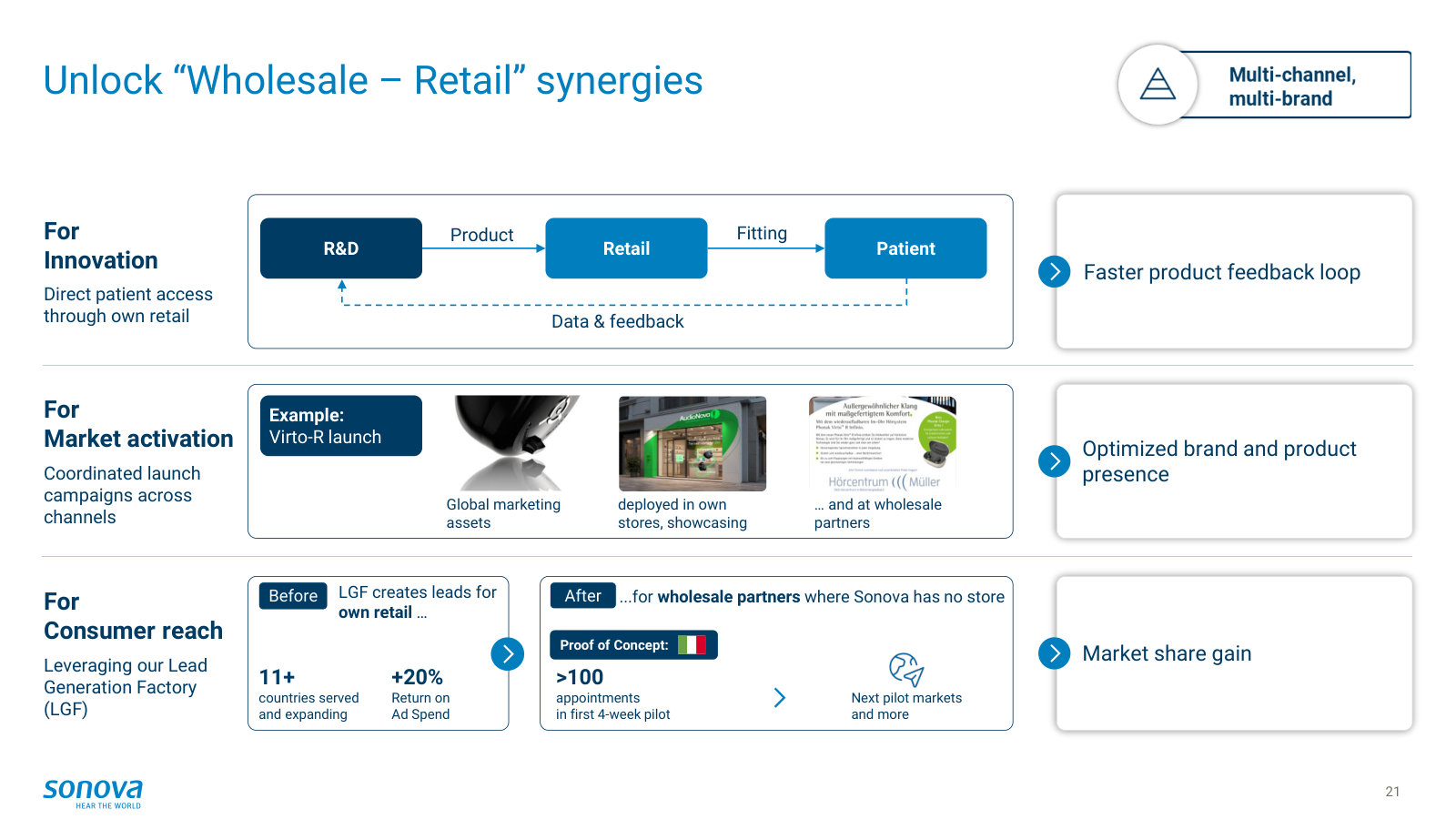
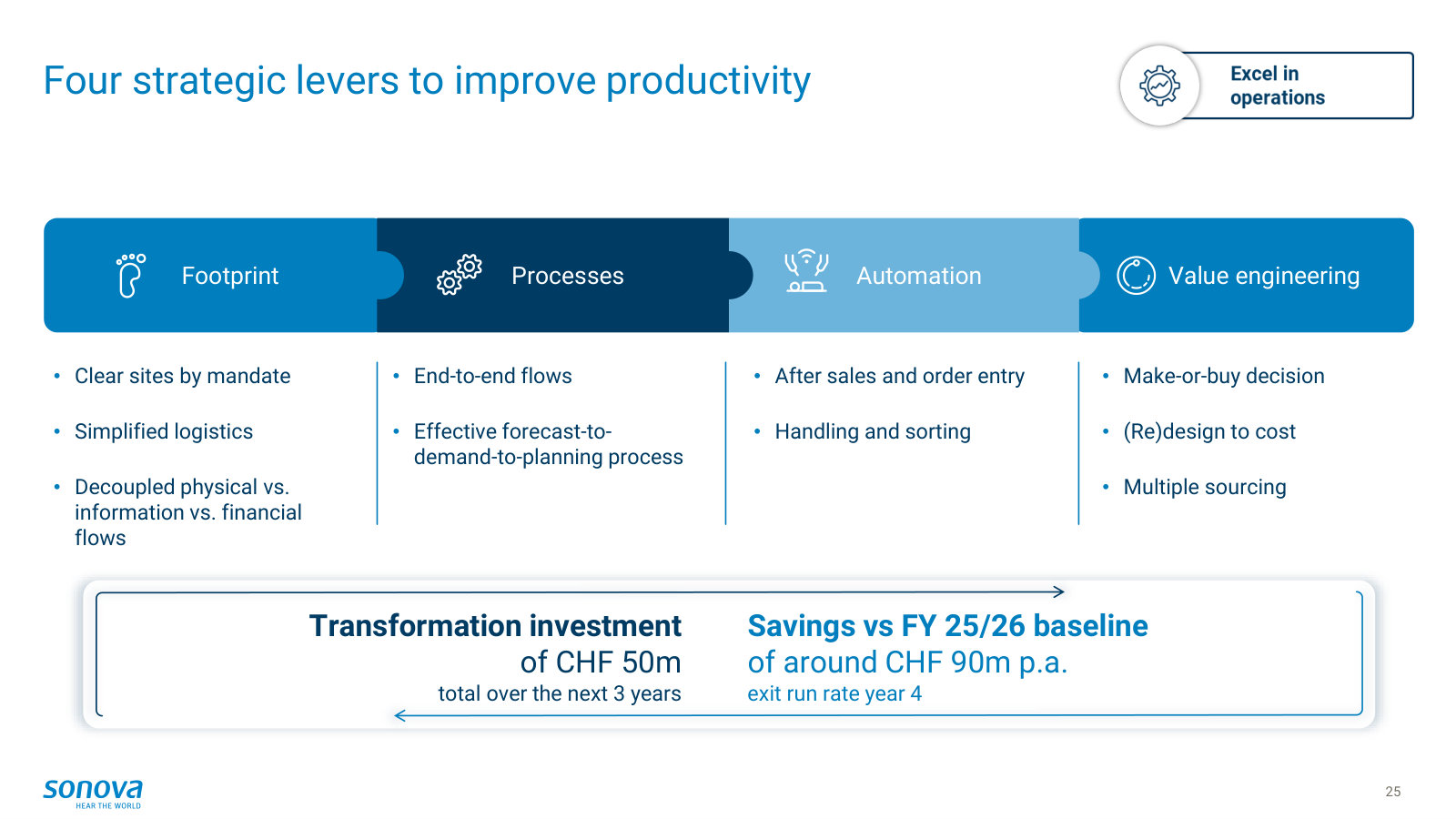
| Retail lead generation & structural cost initiatives | persisted | Nov 2024, May 2025, Nov 2025, May 2026 | Lead-generation efficiency, store-network optimization and headquarter streamlining recur; the resulting operating leverage is now a central part of the margin story. |
| Swiss franc FX headwind | persisted | May 2025, Nov 2025, May 2026 | Flagged in every call as a top- and bottom-line drag; management has moved from simply absorbing it to a structural plan to cut CHF cost exposure over the midterm. |
| Tariffs / trade disruption | emerged | May 2025, Nov 2025, May 2026 | Absent from the older calls, tariffs entered the discussion from FY2024/25 (Section 232 probe, CI-to-China, Consumer Hearing); so far described as mitigated with no material EBIT impact. |
| Consumer Hearing (Sennheiser) business | dropped | Nov 2024, May 2025, Nov 2025 | A recurring segment since FY2020/21, now classified as discontinued operations after the March 2026 divestment announcement and effectively removed from the continuing-operations narrative. |
| COVID recovery / pent-up demand framing | dropped | Nov 2020, May 2021, Nov 2021, May 2022 | Dominated the 2020-2022 calls and then disappeared, replaced by macro, inflation and tariff caution as the market-growth reference points. |
| Patent litigation (MED-EL / Cochlear Ltd.) | dropped | May 2022, Nov 2022, May 2023, Nov 2025 | An active swing item in FY2021/22-FY2022/23 (including a German injunction on AB); a settlement resolving all jurisdictions was reported by November 2025, leaving only residual normalization costs thereafter. |
Guidance ledger
Quotes, calls, and speakers are source-verified; outcomes are curator-classified.
| Verbatim guidance | Call | Speaker | Curator outcome | Outcome note |
|---|---|---|---|---|
| “we expect consolidated sales to rise 5% to 8% and core EBIT to grow 7% to 10% at constant exchange rates” | Sonova Holding AG, 2026 Earnings Call, May 18, 2026 · 2026-05-18T11:00:00 | Elodie Carr-Cingari | pending | FY2026/27 guidance issued on the latest call; no subsequent call in the supplied history to judge the result. |
| “to grow Sonova to CHF 6 billion in revenue by FY 2030, '31” | Sonova Holding AG, 2026 Earnings Call, May 18, 2026 · 2026-05-18T11:00:00 | Eric Bernard | pending | Long-term revenue ambition tied to the March 2026 renewed strategy; not testable within the supplied history. |
| “we reiterate our outlook and continue to guide for sales growth of 5% to 9% and normalized EBITA growth of 14% to 18%, both at constant exchange rates” | Sonova Holding AG, H1 2026 Earnings Call, Nov 14, 2025 · 2025-11-14T12:00:00 | Elodie Carr-Cingari | kept | On the May 2026 call, management said pro forma sales rose 5.5% and normalized EBITDA 14.5%, within these ranges. |
| “5% to 9% on the top line against a more muted market, so continuing market share gains in a meaningful way” | Sonova Holding AG, 2025 Earnings Call, May 09, 2025 · 2025-05-09T11:00:00 | Arnd Kaldowski | kept | This was the initial FY2025/26 sales range; the May 2026 call reported the year landed within it on a pro forma basis. |
Q&A pressure map
Question counts and firms are curator tallies; analyst coverage shown above.
| Topic | Questions | Firms | Pressure / response |
|---|---|---|---|
| Sales guidance drivers and path to the top of the range | 4 | BNP Paribas, Citigroup, Barclays, JPMorgan | The most-pressed topic on the latest call; analysts repeatedly asked what bridges the market assumption to the guided range, and management leaned on launches and carryover share rather than visible demand. |
| Cochlear Implants recovery and new-processor timing | 2 | Citigroup, Deutsche Bank | Recurred heavily on the prior (Nov 2025) call as well; the answer consistently defers the recovery to a new processor whose launch is subject to regulatory approval. |
| Costco / VA / large U.S. account economics | 3 | Bernstein, Zürcher Kantonalbank, DNB Carnegie | Management declined to confirm whether EasyGuard has entered Costco or the VA (order 32), a direct non-answer to a specific channel question. |
| APAC / Asia growth strategy | 3 | Morgan Stanley, Zürcher Kantonalbank, Goldman Sachs | Analysts sought KPIs and current share; the CEO gave qualitative color (Japan growth, an index of 3-6 vs. 10 elsewhere) but no formal targets. |
| Virto R / rechargeable ITE and cannibalization | 3 | BNP Paribas, Barclays, ODDO BHF | Repeated questions on whether Virto R pulls from existing form factors; management maintained the volume is largely incremental. |
Language shifts
Only language evidence verified against the referenced component is shown.
| Observation | Verbatim evidence | Call ID | Component |
|---|---|---|---|
| Management retired "normalized EBITA" as the headline profitability metric in favor of "core EBIT," a change in the guidance vocabulary itself. | “our move to core EBIT as the new guidance metric” | 1995362320 | 3 |
| Consumer Hearing shifted from a reported segment to discontinued operations following the March 2026 divestment decision, removing it from the ongoing narrative. | “the business is classified as discontinued operations” | 1995362320 | 1 |
| Language on Virto R hardened from the cautious "very positive market reception" of November 2025 to declaring an outright success at a stated run-rate by May 2026. | “It's an incredible success, and we have reached a cruising altitude of about CHF 120 million per annum of revenue from zero” | 1995362320 | 6 |
| Caution around Cochlear Implants sharpened, with management naming three concurrent pressures rather than a single soft-upgrade cycle. | “continued to face headwinds in the second half, driven by the introduction of VBP in China, softer upgrade sales and heightened competitive pressure following our largest competitor's product launch” | 1995362320 | 2 |
| The market-growth assumption was cut to a guarded 1% to 3% in November 2025 amid macro and tariff uncertainty, before improving to 2% to 4% by May 2026. | “we continue to expect overall market growth of 1% to 3%” | 1966020454 | 3 |
The call history shows a company executing well on product-led share gains while its growth story leans increasingly on items still ahead of it — a second-half platform, a not-yet-approved CI processor, an APAC build-out and a CHF 6 billion ambition — even as the market itself is only tentatively recovering.
Hearing's Fallen Leader
Sonova is the world's largest maker of hearing aids — a Swiss blue-chip that reached roughly CHF 402 in late 2021 on market data and now trades at little more than half that. Sales have stalled around CHF 3.6 billion, operating margins have fallen from 22.6% to 18.7%, and a four-year push into consumer audio is being unwound at a loss. The balance sheet is strong; the growth story is the open question.
What Sonova is
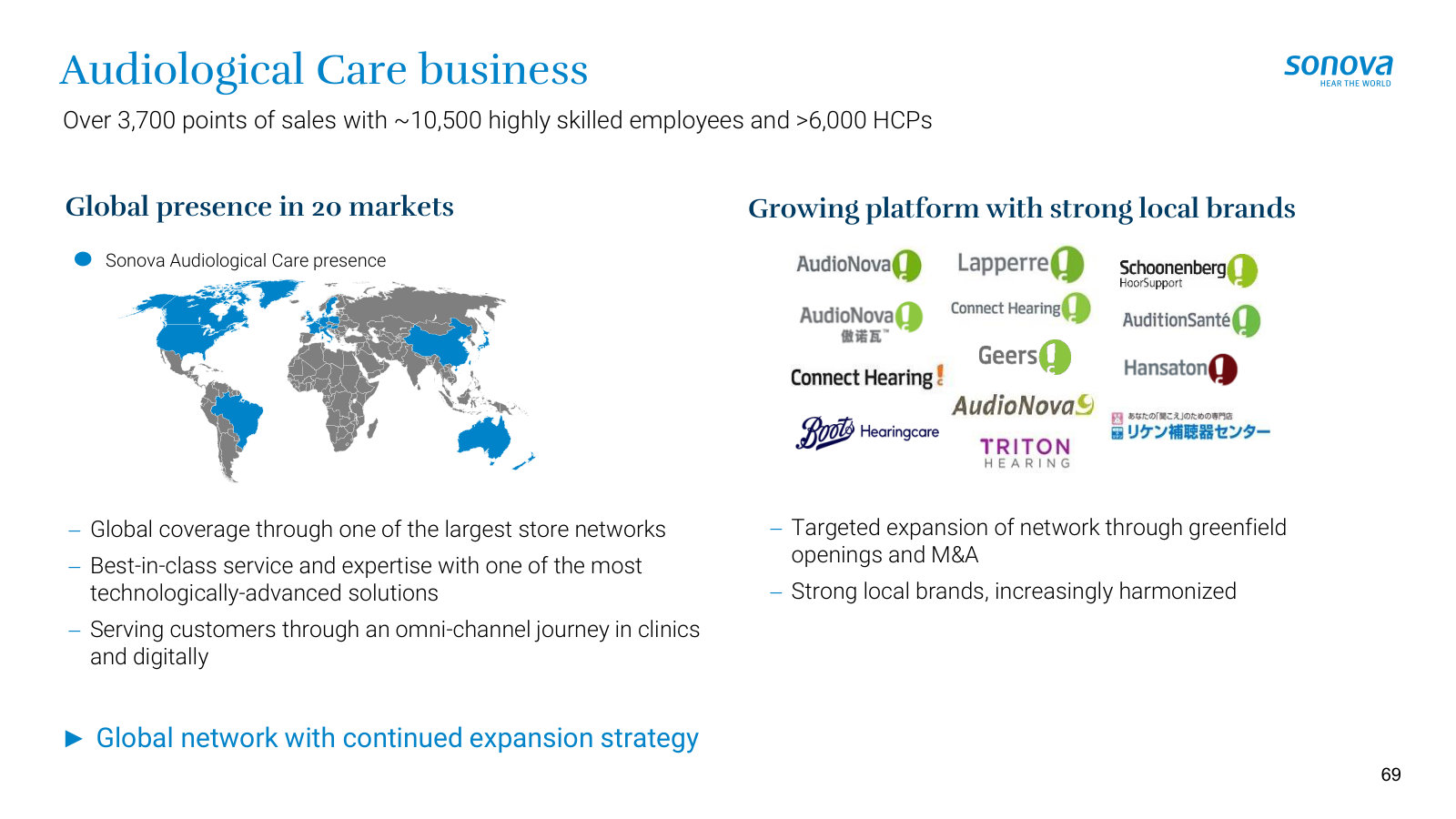
Sonova Holding AG designs, makes and sells hearing solutions under four brands — Phonak and Unitron (prescription hearing aids), Advanced Bionics (cochlear implants), and, until recently, Sennheiser-branded consumer audio (under license) [1]. It runs both sides of the value chain: it manufactures the devices and operates one of the world's largest retail networks of hearing-care stores (AudioNova and other banners) that fit them [2]. The company was founded as Phonak in 1947, has traded on the SIX Swiss Exchange since 1994, and is a constituent of the blue-chip SMI index.
The business reports in two segments. Hearing Instruments — the prescription wholesale devices plus the retail store network — is the engine, at CHF 3,353.8 million of external sales in fiscal 2025/26 [3]. Cochlear Implants — surgically implanted devices for severe-to-profound loss — is the small, higher-tech second leg at CHF 252.1 million, and it is currently shrinking [4]. The company's fiscal year ends 31 March; "FY2026" here means the year ended 31 March 2026.
Share price (CHF, 23 Jul 2026)
FY2026 sales (CHF m, continuing)
FY2026 EPS (CHF, continuing)
Drawdown from late-2021 peak
Sources: share price and drawdown from market data (a late-2021 peak of ~CHF 402; the filings anchor a CHF 387.60 close at 31 Mar 2022, implying a ~46–48% drawdown); sales and EPS from FY2025/26 consolidated income statement [5].
At CHF 209 the company is worth roughly CHF 12.5 billion — a mid-to-large-cap by Swiss standards, and no longer the premium-rated compounder it was four years ago.
Why the market re-rated it
The demand backdrop is one of the most durable in healthcare. About 1.5 billion people — a fifth of the world's population — live with some degree of hearing loss, and roughly 430 million have moderate-or-worse loss, a number that rises as populations age; most of them go untreated [6]. A leader in a low-penetration, demographically tailwinded market is exactly the kind of franchise that earns a premium multiple — which is what Sonova had, until it didn't.
Four things turned the story. Growth normalized after a post-pandemic surge (sales grew 29% in FY2022, then went sideways). Margins compressed. A diversification bet failed. And a technology fear arrived.
Source: FY2025/26 Annual Report, Five Year Key Figures — restated to continuing operations [7].
Revenue has been essentially flat for four years while operating profit has drifted lower. The clearer signal is the margin: EBIT margin fell from 22.6% in FY2022 to 18.7% in FY2026, a step-down of nearly four points that has never fully recovered.
Source: FY2025/26 Annual Report, Five Year Key Figures [8].
Gross margin has actually held above 73%, so the erosion is below the gross line — in operating cost, particularly sales-and-marketing intensity that climbed as growth slowed. Whether that compression is cyclical or structural is one of the report's central threads.
The Sennheiser round-trip
In March 2022 Sonova bought Sennheiser's consumer audio division to push into "hearables" and reach consumers earlier in their hearing journey — a hedge against the fear that consumer electronics would encroach on hearing care [9]. Four years later, on 23 March 2026, management announced it would sell the business back out, booking a CHF 38.3 million pre-tax impairment and classifying Consumer Hearing as discontinued operations [10]. The unit lost CHF 106.5 million after tax in FY2026, which is why reported earnings per share fell to CHF 7.23 even as continuing operations earned CHF 9.02 [11].
The technology fear it was meant to answer became concrete in September 2024, when U.S. regulators cleared software turning Apple's AirPods Pro into an over-the-counter hearing aid. Hearing-aid stocks slid on the news; sell-side analysts argued the OTC market targets a different, milder-loss population than Sonova's prescription base. The debate over whether Apple and OTC devices commoditize the core franchise — or merely widen the funnel into it — is unresolved and belongs to a later chapter.
A strong balance sheet, and no founder
For an investor who wants the probability of ruin near zero, Sonova is reassuring. Net debt was CHF 994.3 million at 31 March 2026 — roughly 1.2 times normalized operating profit before amortization — and it has fallen every year since FY2023 [12]. The dividend was raised through the entire de-rating, from CHF 4.40 to a proposed CHF 4.70 per share [13]. Bankruptcy is not the risk here.
Source: FY2025/26 Annual Report, Five Year Key Figures — restated to continuing operations [14].
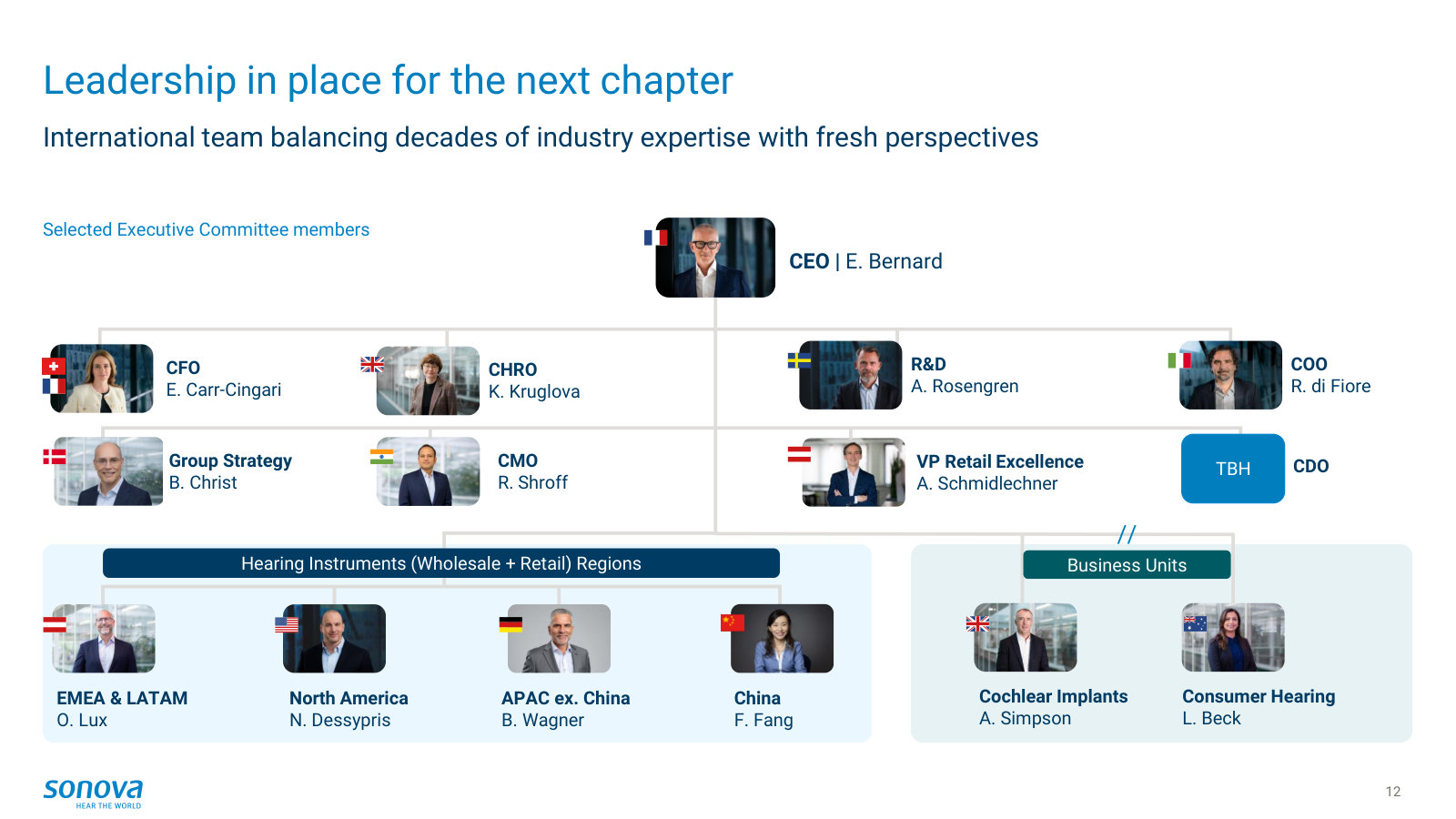
What Sonova is not is founder-run. Its board is entirely non-executive and independent, with no controlling shareholder [15], and the company changed both its chief executive — Arnd Kaldowski to Eric Bernard, who took over in September 2025 — and its chairman during 2025 [16]. Skin in the game runs low: this is professionally managed, widely held Swiss equity, not an owner-operator with a large personal stake. For an investor who prizes aligned insiders, that is a genuine gap in the fit — one that management compensation and ownership deserve their own examination.
What management now promises, and what the market pays for it
Alongside the divestment, management set a fresh ambition: CHF 6 billion of revenue by FY2030/31, up from CHF 3.6 billion today, built on a re-focused hearing-care portfolio [17]. Consensus is more restrained but still points up: analysts model earnings per share recovering to roughly CHF 10.4 in FY2026/27 and CHF 11.4 in FY2027/28, back above the FY2023 peak. At CHF 209, the shares change hands near 20 times that forward number and yield about 2.2% — cheaper than the 30-plus multiple of the boom years, but not the deep-value price of a broken business.
That framing sets up the question this report is built to answer.
The central question: is Sonova a durable, structurally growing hearing-care leader that the market has mispriced through a four-year lull of flat sales, margin compression and a failed diversification — a genuine fallen star with a path back — or a business whose growth, margins and competitive insulation have permanently stepped down to a lower level?
Everything that follows tests one side of that question or the other: whether the margin step-down reverses, whether the moat holds against OTC and Apple, whether capital allocation and incentives are trustworthy, and what a demanding margin of safety would require the price to be.
Financials and Estimates
Sonova's reported franc figures and its underlying operating record tell two different stories, and separating them is the first task of any financial read. On a restated continuing-operations basis, group sales have been flat in Swiss francs for four years while growing mid-single-digits in local currency; the normalized operating margin troughed in FY2024 and has since recovered about two points; cash conversion stays high and net debt keeps falling. A strengthening Swiss franc — not franchise decay — explains most of the reported softness, though it has kept franc-denominated earnings flat.
The record, three ways
A cold reader meeting Sonova's income statement will find three different earnings-per-share numbers for the year ended 31 March 2026, and needs to know which is which. Basic EPS including discontinued operations was CHF 7.23; from continuing operations it was CHF 9.02; and normalized for nonrecurring items it was CHF 10.42 [1]. The CHF 1.79 gap between the first two is the accounting loss on the Consumer Hearing (Sennheiser) business now classified as discontinued; the CHF 1.40 gap above that is management's add-back of items it deems one-off [2].
Sales (CHF m)
Norm. EBITA Margin
Operating FCF (CHF m)
Net Debt (CHF m)
ROCE
Source: FY2025/26 Annual Report, Five Year Key Figures [3].
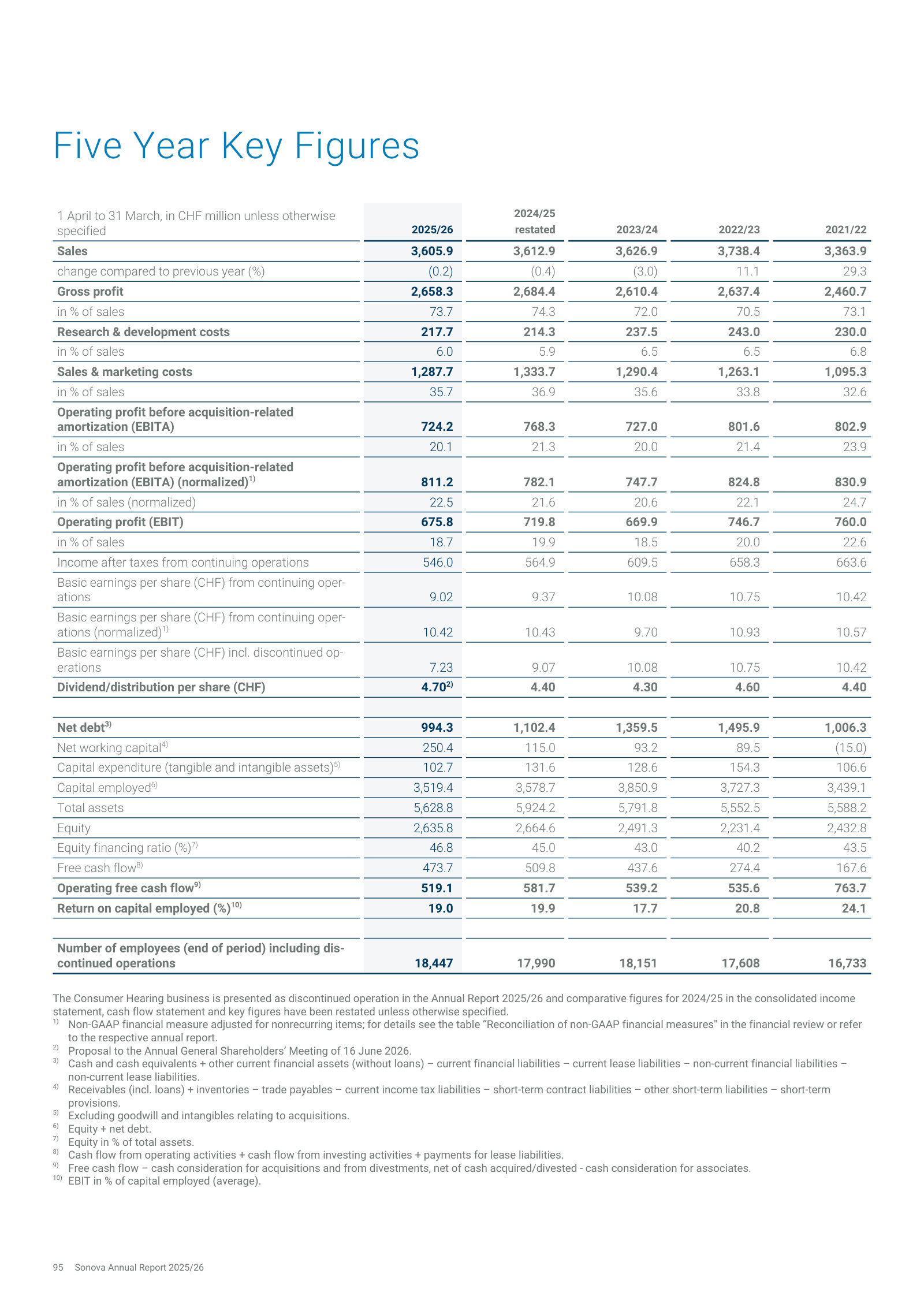
The restatement matters because it removes a moving part. When the FY2025/26 report reclassified Consumer Hearing as a discontinued operation, it restated every comparative year to the continuing business, so the five-year record below is finally like-for-like [4]. Read on that clean basis, the core hearing business — Hearing Instruments and Cochlear Implants — is the whole company.
Source: FY2025/26 Annual Report, Five Year Key Figures (continuing operations, restated) [5]. Fiscal years end 31 March.
Two facts stand out and frame everything that follows. Sales in francs have gone nowhere — CHF 3,363.9m in FY2022 to CHF 3,605.9m in FY2026, with a FY2023 peak of CHF 3,738.4m in between — and normalized EPS has been flat-to-down, CHF 10.93 at its FY2023 peak against CHF 10.42 now [6]. Return on capital employed has stepped down from 24.1% to 19.0% over the same span [7]. For a shareholder who owns the franc-denominated earnings stream, five flat years are the plain fact the price reflects.
Sales: francs against local currency
The reason the franc line looks flat is currency, and the size of the effect is unusually large for a company this quality. Sonova sells almost entirely outside Switzerland but reports in a franc that has strengthened against nearly every customer currency, so reported growth has trailed underlying growth by three to nine points every year.
Sources: FY2022/23 Annual Report [8]; FY2023/24 results release [9]; FY2024/25 results release [10]; FY2025/26 results release [11].
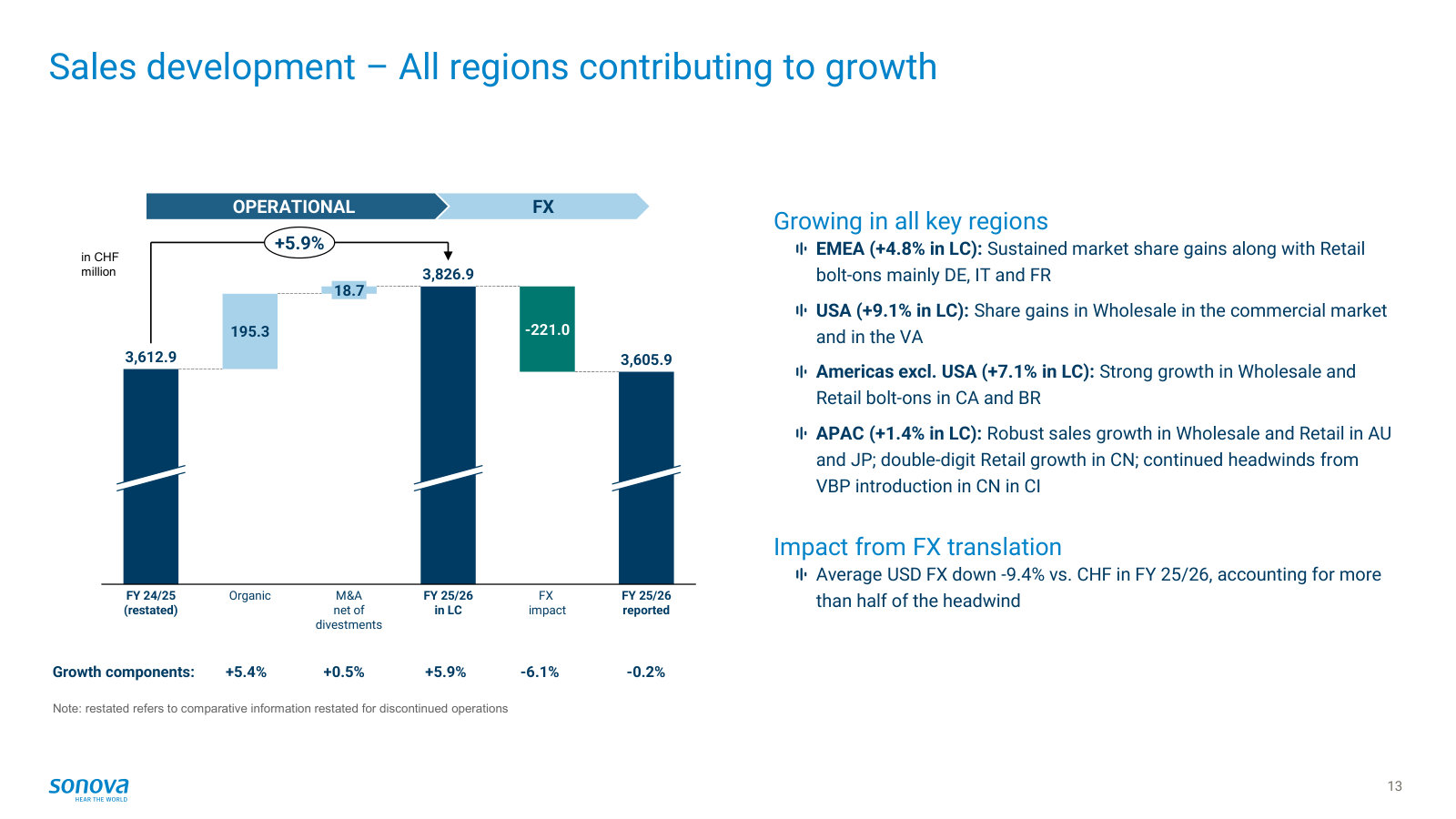
In FY2026, group sales rose 5.9% in local currencies but fell 0.2% in francs, with the combined wholesale and retail businesses growing 7.5% in local currency and wholesale accelerating to 10.9% in the second half [12]. The pattern is consistent, not a one-year quirk: FY2023 grew 14.6% local against 11.1% reported, and FY2024 grew 3.2% local while franc sales fell 3.0% [13] [14]. The underlying business has grown every year; the franc has taken most of it back. That distinction — franchise decay or translation drag — is what the rest of the report weighs.
The honest caveat is that for a franc-reporting, franc-dividend-paying company, translation is not free. The FY2023–FY2025 growth figures also still include the Consumer Hearing business now being divested, so the earlier years flatter the core slightly; only FY2026 is a clean continuing-operations comparison [15]. A strong franc may persist for years, so the local-currency growth is real but does not automatically convert into franc returns for the holder.
Margins: a trough, then a recovery
The margin story is the clearest evidence that the recent weakness is largely cyclical. On the normalized EBITA measure — which strips acquisition-related amortization and one-off items to show underlying profitability — the margin fell from a post-COVID high of 24.7% in FY2022 to a trough of 20.6% in FY2024, then recovered to 22.5% in FY2026 [16]. It has climbed two points off the bottom but sits about two points below the peak.
Source: FY2025/26 Annual Report, Five Year Key Figures (continuing operations, restated) [17].
The engine of the FY2026 recovery was operating leverage, not price. Normalized sales-and-marketing costs rose only 1.5% in local currency against 5.9% sales growth, and gross margin held at 73.7% [18]. Normalized EBITA grew 17.3% in local currency — but currency alone cut it by CHF 106.5m, or 1.5 margin points, which is why the same figure rose just 3.7% in francs [19]. The recovery is genuine; the franc masks it.
A skeptic should weigh two offsets. First, the reported EBIT margin — the number with nothing added back — is 18.7%, still well below the 22.6% of FY2022 and choppy year to year [20]. Second, the CHF 87m bridge from reported to normalized EBITA in FY2026 leans on a CHF 34.7m software impairment and CHF 28.2m of litigation costs [21]. To the company's credit, restructuring costs of CHF 16.7m were left inside normalized EBITA rather than added back, and that charge itself fell from CHF 43.9m the prior year [22]. The add-backs are defensible this year, but a reader should track whether "one-off" litigation and impairment items keep recurring as the company runs a multi-year operating-model transformation.
Cash generation and the balance sheet
Sonova converts profit to cash well and runs a conservative balance sheet — the part of the record least in dispute. Operating free cash flow was CHF 519.1m in FY2026, about 95% of continuing income after tax, on capital expenditure of just CHF 102.7m, under 3% of sales [23]. This is an asset-light manufacturer-plus-retailer, not a capital sink.
Source: FY2025/26 Annual Report, Five Year Key Figures [24]. Free cash flow is after acquisition/divestment consideration; operating free cash flow excludes it.
The one cash-flow wrinkle worth naming is working capital. Net working capital more than doubled to CHF 250.4m in FY2026 from CHF 115.0m, a roughly CHF 135m build in receivables and inventory that held reported free cash flow (CHF 473.7m) below net income [25]. It is worth watching, but on a five-year view cash generation is steady and the FY2022 operating-cash spike reflected a pandemic-era working-capital swing rather than a new normal.
Leverage has fallen through the entire de-rating. Net debt declined from a FY2023 peak of CHF 1,495.9m to CHF 994.3m — about 1.2 times normalized EBITA, inside the company's stated 1.0–1.5x net-debt-to-EBITDA target [26] — while equity financing rose to 46.8% of assets [27]. The dividend is a record CHF 4.70, though the path was not a straight line: it was trimmed to CHF 4.30 in FY2024 before rebuilding [28].
Source: FY2025/26 Annual Report, Five Year Key Figures [29].
Forward estimates
Management and the sell-side both model continued mid-single-digit growth and a gradual earnings recovery — a return toward, not far beyond, the prior peak. For FY2026/27, Sonova guides to consolidated sales growth of 5–8% and core EBIT growth of 7–10%, both at constant exchange rates [30]. Consensus sits inside that frame: revenue near CHF 3,824m and EPS of CHF 10.40 in FY2027, rising to CHF 4,045m and CHF 11.40 in FY2028.
Sources: FY2026 actual per the FY2025/26 Five Year Key Figures [31]; FY2027–FY2028 consensus estimates, as reported.
Two features of the estimates are worth flagging. Consensus FY2027 EPS of CHF 10.40 sits essentially level with the CHF 10.42 the company already earned on a normalized basis in FY2026 — the street expects reported EPS to catch up to the normalized figure rather than a step-change higher [32]. And these are constant-currency-flavoured forecasts; a franc that keeps strengthening would again split reported from underlying results, as it has every year since FY2022.
Against the current price near CHF 209 — where the shares have fallen 32.6% over two years — that consensus puts Sonova on roughly 20 times forward earnings with a dividend yield near 2.2% [33]. Consensus price targets cluster around CHF 206–239 against a mixed, cautious-leaning rating. Whether that multiple is cheap for a recovering compounder or fair for a business whose franc earnings have stalled is a valuation question this chapter deliberately leaves open; the record it establishes is that the operating recovery is real in local currency, incomplete in francs, and cash-backed throughout.
Moat and OTC Threat
The de-rating raised a fair question about whether Sonova's four-point margin step-down is cyclical or a permanent reset. The competitive evidence points to cyclical. Hearing care sits on a documented demographic tailwind (a 4–6% structural growth rate and adoption rates still in the single digits outside the developed world), the manufacturing end is a five-firm oligopoly, and Sonova gained share through the downturn on the strength of one product cycle. The live threat — over-the-counter devices and Apple's AirPods — is concentrated at the mild-loss end that prescription hearing care mostly does not serve.
A market that grows regardless of the cycle
The pool Sonova fishes in is expanding on demographics, not on any single company's execution. Demant, the closest pure-play rival, puts the long-run structural growth rate of the hearing-aid market at 4–6% per year in both units and value — roughly half from aging populations and half from rising adoption — with about 13 million people fitted with some 23 million devices in 2024 [1]. Amplifon, the largest retailer, frames the same demand: over 1.5 billion people live with some hearing loss, at least 430 million need rehabilitation today, rising to 700 million by 2050, against a global cost of untreated hearing loss it estimates near $1 trillion a year [2]. Sonova's own strategy leans on the same reading: demand expanding on aging and longer treatment horizons, with "persistently low adoption rates" leaving headroom across all regions, particularly Asia [3].
Sources: structural market growth per Demant FY2024 Annual Report [4]; annual cost of untreated hearing loss per Amplifon FY2025 Annual Report [5].
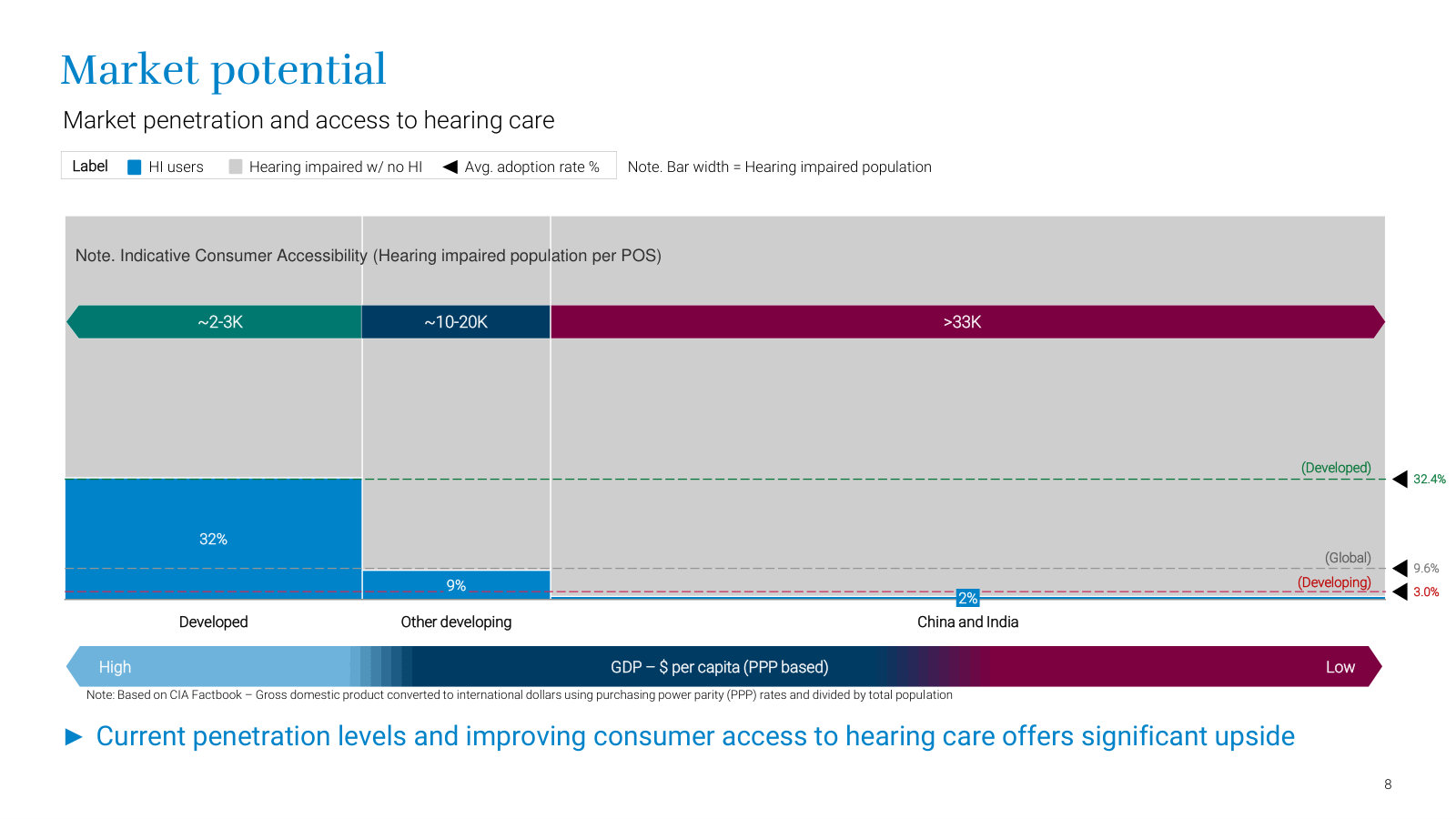
The unconverted demand is what makes the tailwind durable rather than a one-off recovery. Adoption — the share of the hearing-impaired who actually wear a device — runs around 32% in developed markets, roughly 9% in other developing economies, and about 2% in China and India, on Sonova's own market map [6]. Amplifon pegs adoption near 40% in high-income countries and 5–10% in emerging ones [7]. Either way, most people who need a hearing aid do not yet own one, and each cohort of new adopters is larger than the last.
Source: Sonova investor presentation, May 2024, Market potential [8].
The structure: a manufacturing oligopoly on top of a fragmented shop-front
The industry has two very different layers, and Sonova's advantage lives in the concentrated one. The wholesale hearing-aid market — the devices themselves — is roughly $7 billion a year and, in Demant's description, a field of "highly specialised players competing in very product-driven markets where significant R&D initiatives underpin market positions" [9]. Industry market research puts five manufacturers — WS Audiology, GN, Sonova, Starkey and Demant — at about 92% of that global manufacturing market in 2024, with WS Audiology the largest at roughly 27%. The retail layer is the opposite: a roughly $20 billion market of mostly independent, owner-operated clinics [10], where even Amplifon, the global leader, holds only about 13% share [11]. Sonova is one of a handful of firms that spans both: it manufactures under Phonak and Unitron and controls one of the largest owned retail networks through AudioNova.
That structure is what an entrant has to overcome, and it shows up in spending. Sonova put CHF 217.7 million into R&D in FY2026, about 6% of sales, and Demant spent a near-identical share of its revenue [12]. Neither figure is large next to a consumer-electronics giant, so raw R&D budget is not the barrier. The barrier is the combination that a device company alone cannot buy: a proprietary chip and audiology-algorithm stack, clinical validation, the fitting expertise of trained hearing-care professionals, and — in the prescription channel — bundled reimbursement arrangements with bodies such as the UK's National Health Service and the US Department of Veterans Affairs [13]. The switching cost sits with the patient: a moderate-to-severe device is fitted, tuned and serviced over years by a professional, which is a relationship, not a purchase.
The moat in the numbers: share gains through the downturn
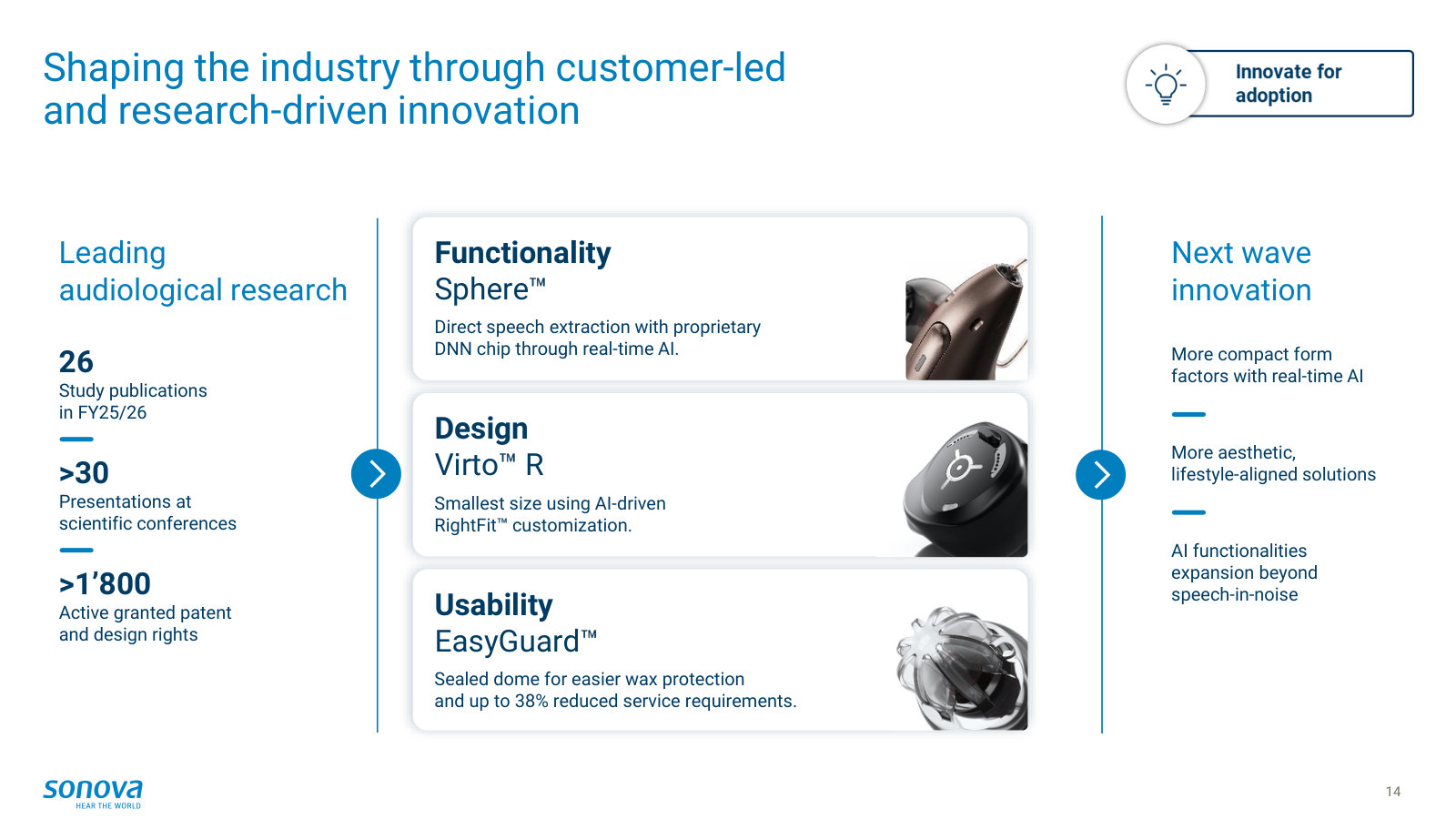
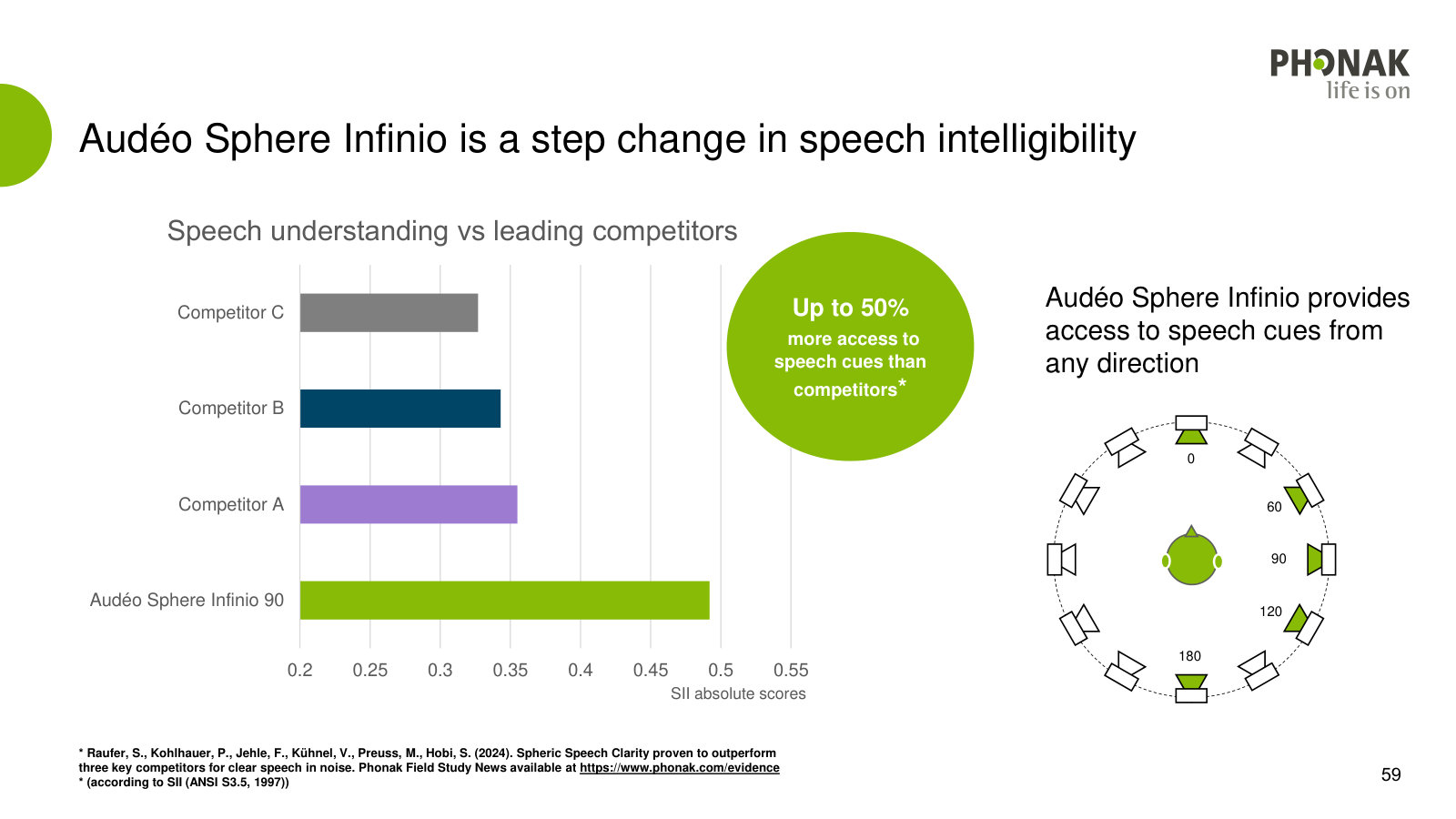
An advantage only counts if it shows up in results. Sonova's did, at the worst point in the cycle. After launching the Phonak Audéo Infinio and Sphere Infinio platforms in August 2024 — built on a dedicated chip and deep-neural-network sound processing — the Hearing Instruments business grew 8.5% in local currency over FY2024/25 and accelerated to 9.8% in the second half, "consistently" taking share, even as a US private-market slowdown pressured volumes and pricing late in the year [14]. The share gains continued into the next year: Hearing Instruments grew 5.7% in local currency in the first half of FY2025/26, again ahead of the 4–6% market, which the company again attributed to sustained share gains [15].
Source: Sonova FY2024/25 results release [16] and 5.7% first-half local-currency growth per the H1 FY2025/26 Semi-Annual Report [17]. Structural market growth per Demant [18].
The margin compression that worried the market was also industry-wide, which is the clearest signal that it was cyclical. Demant's operating margin (before special items) fell from 20.9% in 2023 to 17.2% in 2025, and Amplifon's EBITDA margin slipped from 23.3% to 21.4% in a single year [19][20]. Sonova's normalized operating margin sits inside that same band — and, unlike the two pure-plays, has turned back up, from a 20.6% trough in FY2024 to 22.5% in FY2026 [21]. The reported franc EBIT margin stayed depressed largely because of the strong Swiss franc and the Sennheiser reclassification covered in Financials and Estimates, not because the underlying franchise weakened.
Sources: Sonova normalized EBITA margin in five-year key figures, Annual Report 2025/26 [22]; Demant EBIT margin before special items, FY2025 financial highlights [23]; Amplifon FY2025 financial review [24]. Fiscal bases and margin definitions differ across the three; Sonova's year ends 31 March, Demant and Amplifon report on calendar years.
Taken as a set, the three make a coherent picture: the 2022–24 compression fell on the whole industry — post-pandemic normalization, a weak China market, a US private-market slowdown and heavy new-platform launch costs — and Sonova came through it with more share and a normalized margin that has already recovered, while the two closest peers were still declining in their latest year.
The OTC and Apple threat, in proportion
The disruption case names over-the-counter devices and, since Apple added a hearing-aid feature to AirPods Pro in late 2024, consumer electronics. The force of that threat depends on which hearing loss it reaches. On the World Health Organization data EssilorLuxottica reproduces, about 1,153 million of the 1.5 billion people with hearing loss have mild loss; moderate loss affects 266 million and moderately-severe-to-complete loss a further 164 million [25]. OTC devices, self-fitting earbuds and AirPods are cleared for perceived mild to moderate loss; the prescription market that Sonova serves is weighted toward the moderate-to-severe end, where the device has to be fitted and tuned to an audiogram.
Source: World Health Organization data as presented in EssilorLuxottica FY2025 Universal Registration Document [26].
So far the two markets look additive rather than substitutive. Demant, which has the most to lose, tells its own shareholders that OTC devices have "increase[d] general access to treating hearing loss" but that "their impact on the prescription hearing aid market in the US remains limited" — while adding the honest caveat that new form factors "could pose a risk to the prescription hearing aid market, if successful" [27]. Independent industry commentary in 2024–25 reached the same reading: OTC and AirPods have so far expanded awareness and the entry funnel rather than cannibalized fitted-device sales. Sonova itself plays both sides — it sells OTC self-fitting aids under Sennheiser in the US, China and Japan alongside its prescription range [28] — and its clearest statement of where it thinks the value is came from divesting that consumer-hearing business in 2026, the round-trip covered in Hearing's Fallen Leader. The company is concentrating on the professional channel, not retreating from it.
The threat that deserves more weight is quieter than Apple. Demant flags US managed-care consolidation as a genuine pressure on average selling prices, as volume concentrates among fewer, larger buyers able to push down fitting fees [29]. That is the mechanism already visible in Sonova's late-FY2025 US ASP softness [30], and it works on price rather than on whether people buy a fitted device at all. A well-capitalised new entrant is also now probing the mild end from a different direction: EssilorLuxottica launched Nuance Audio hearing eyewear in 2025, aimed at the same mild-to-moderate customer through an eyeglasses form factor.
What would change this read
The measured conclusion is that the competitive position strengthened during the de-rating rather than eroded, which places the margin step-down on the cyclical side of the ledger. The strongest fact against it is that the normalized-margin recovery leans heavily on one product cycle — the Infinio/Sphere launch — and product leadership in this industry rotates roughly every two to three years as rivals answer. The read would change if share gains reverse as Demant, WS Audiology and GN ship competitive platforms; if OTC or AirPods-class devices climb credibly into moderate loss rather than staying at the mild end; or if managed-care and channel pressure compress prescription ASPs faster than volume growth can offset. The line items that settle it are Hearing Instruments local-currency growth relative to the 4–6% market, the normalized EBITA margin trajectory off its FY2024 trough, and US ASP commentary in the half-year releases — each checkable in the next two reporting cycles.
Segment Economics
Sonova reports two segments, but only one earns money. Hearing Instruments is 93% of continuing sales and about 98% of normalized operating profit; Cochlear Implants is 7% of sales, roughly 2% of profit, and posted a reported operating loss in FY2025/26. Inside Hearing Instruments, a high-margin Wholesale franchise gaining share organically is being partly offset by a lower-margin retail roll-up whose deal-driven growth is fading. That mix — not just the franc — shapes the reported margin.
Two segments, one profit engine
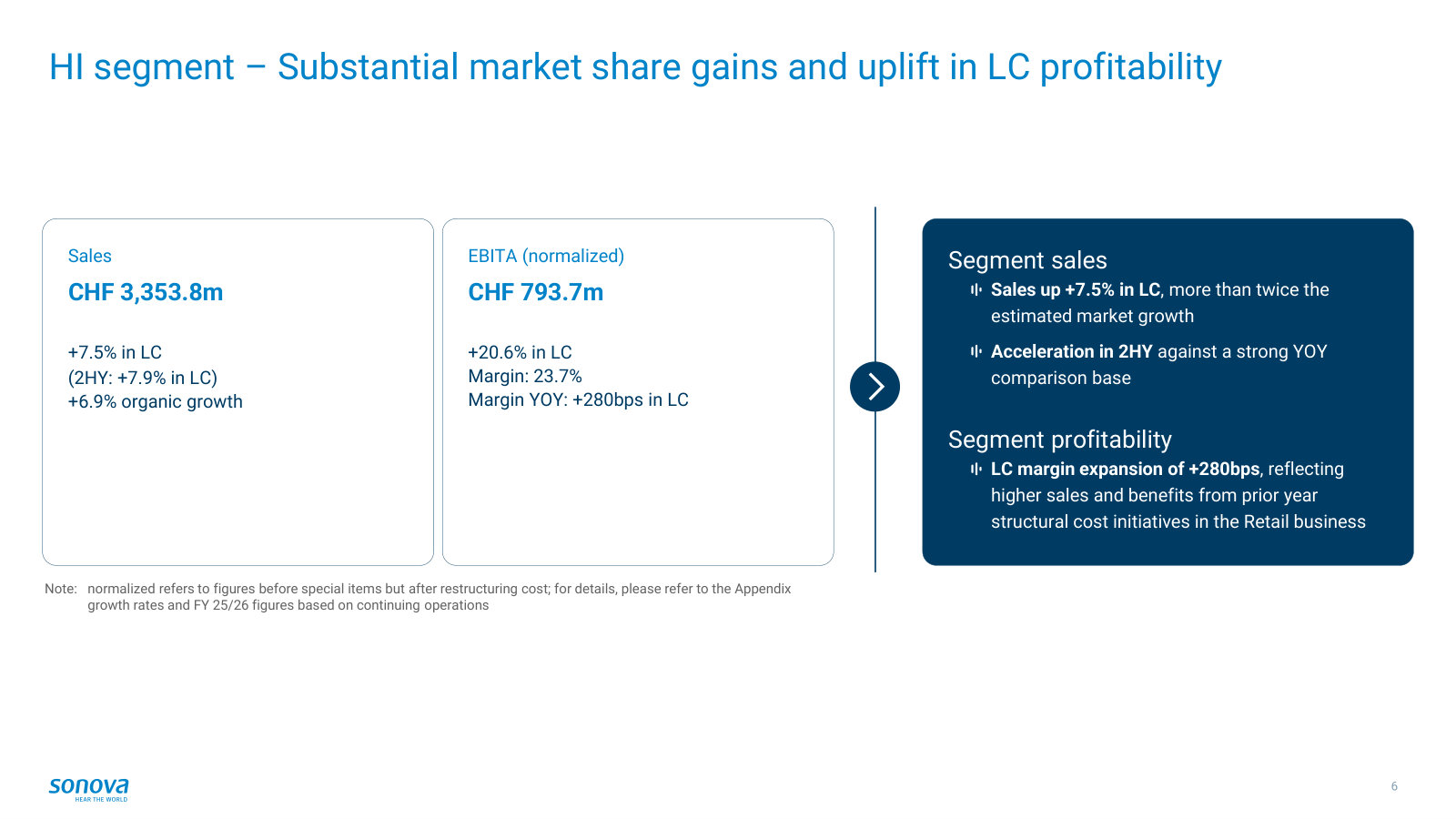
On the continuing basis Sonova reports today (Consumer Hearing reclassified to discontinued operations), the Hearing Instruments segment reached CHF 3,353.8 million of sales in FY2025/26 [1] against CHF 252.1 million for Cochlear Implants [2]. The profit split is more lopsided than the sales split. Hearing Instruments generated normalized EBITA of CHF 793.7 million at a 23.7% margin; Cochlear Implants contributed CHF 17.2 million at a 6.8% margin, and on a reported basis Cochlear Implants was a CHF 34.6 million operating loss after legal and legacy product-liability charges [3].
Hearing Instruments — % of sales
Hearing Instruments — % of normalized profit
Sources: derived from segment sales and normalized EBITA, Annual Report 2025/26 [4] [5] (group normalized EBITA CHF 811.2 million [6]).
The three-year sales picture makes the asymmetry visible: the Hearing Instruments segment grew every year while Cochlear Implants, roughly flat for years, dropped sharply in FY2025/26.
Source: Hearing Instruments = Wholesale + Retail businesses; segment and business sales per FY2023/24, FY2024/25 and FY2025/26 filings [7] [8] [9].
For a cold reader, the practical translation is simple: to understand Sonova's economics is to understand its Hearing Instruments segment. Cochlear Implants matters for the narrative and for a piece of the growth rate, but it is close to a rounding error in the profit that supports the valuation.
Inside Hearing Instruments: two very different businesses
From FY2025/26 Sonova relabelled its two hearing-aid businesses: the manufacturing-and-distribution arm (Phonak, Unitron, Advanced Bionics wholesale) is now the Wholesale business, and the owned store network (AudioNova and related banners) is the Retail business [10]. They sit in one segment but earn their growth in opposite ways.
Source: Wholesale (Hearing Instruments business) and Retail (Audiological Care business) sales, FY2023/24–FY2025/26 filings [11] [12] [13].
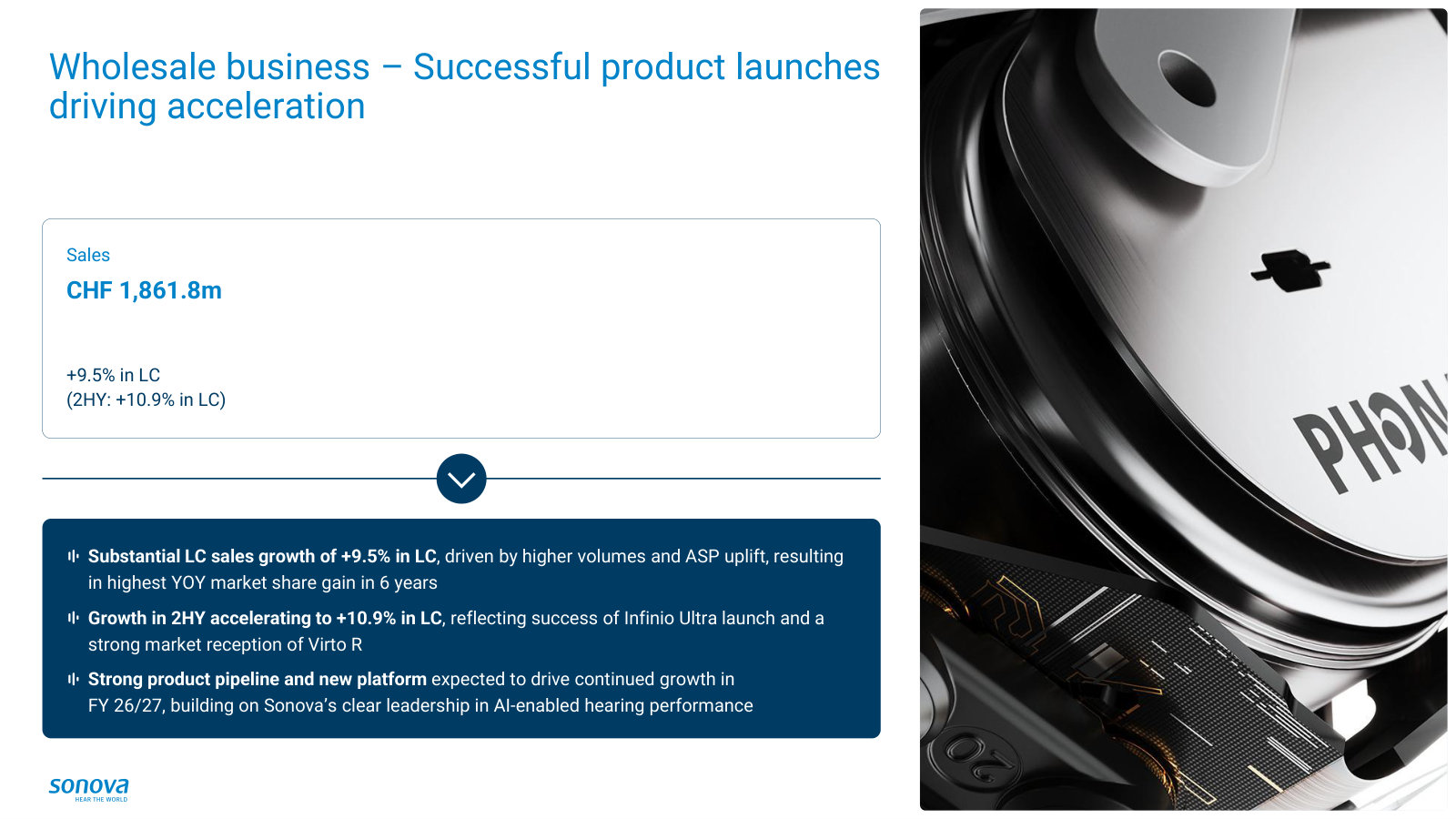
Wholesale is the franchise and it is accelerating. Wholesale sales grew 0.7% in local currencies in FY2023/24 — held back by the non-renewal of a large contract — then 8.5% in FY2024/25 and 9.5% in FY2025/26 as the Phonak Audéo Infinio and Sphere Infinio platforms shipped [14] [15] [16]. Against a market Sonova sizes at 4–6% structural growth, high-single-digit and, in the second half of FY2025/26, double-digit Wholesale growth is share being taken. This is the part of Sonova that owns the chip, the deep-learning audiology and the professional channel — and its growth is almost entirely organic. Sonova's growth engine is an accelerating, high-margin Wholesale franchise (+9.5% local, segment margin up to 23.7%) but its ~7pp lead over Demant (+2% organic) was delivered on falling R&D intensity (6.8% -> 6.0% of sales), so the Sphere lead is a timing edge to be re-won every two to three years rather than a structural, spend-driven moat. The Product Lead takes up whether that timing edge holds.
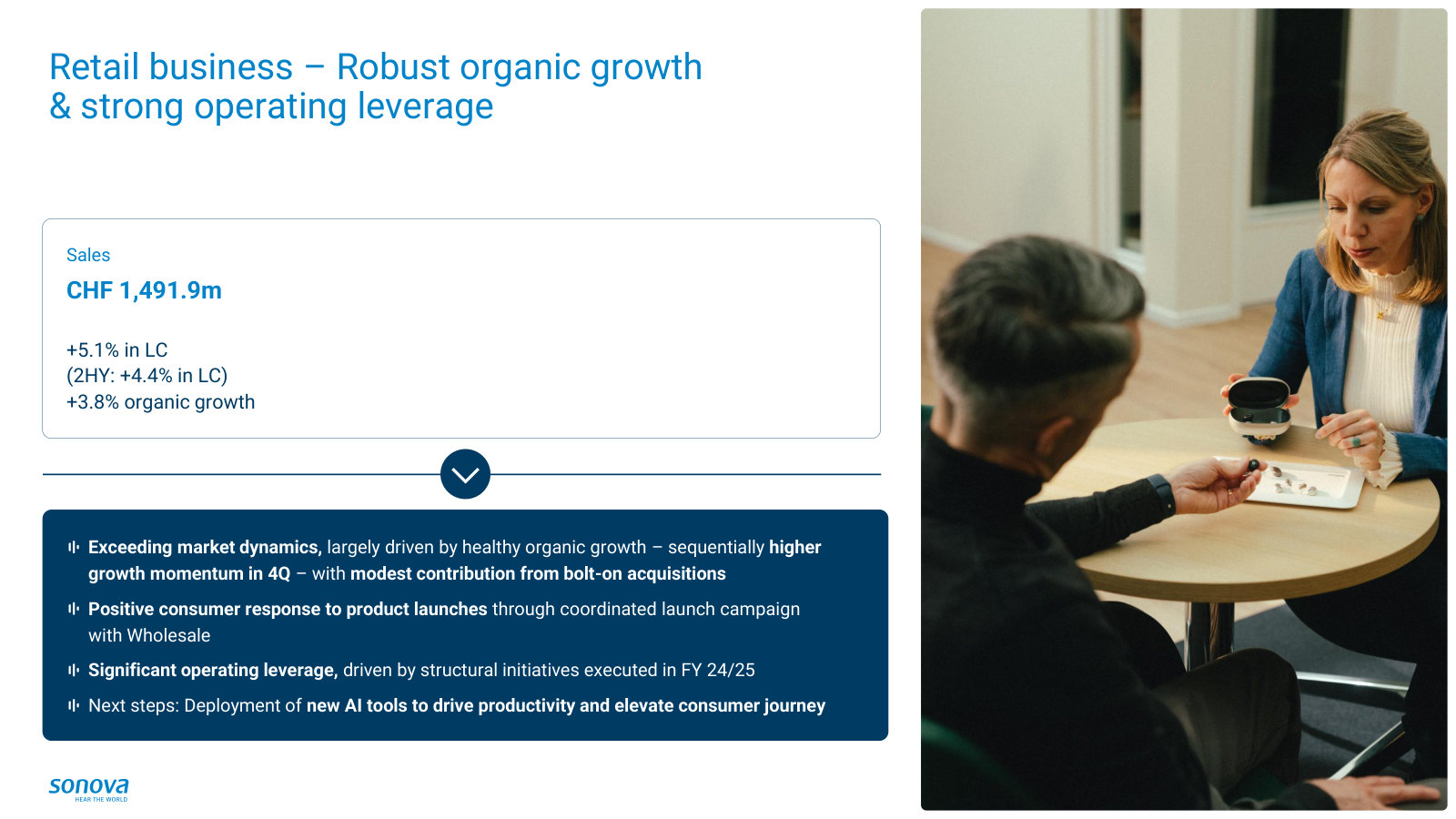
Retail grows by buying, and that engine is slowing. The AudioNova store network grew 9.2% in local currencies in FY2023/24, 6.4% in FY2024/25 and 5.1% in FY2025/26 — decelerating even as Wholesale sped up [17] [18] [19]. More telling is the split between organic and bought growth: acquisitions added 4.5 points of Retail growth in FY2023/24, 3.1 in FY2024/25 and just 1.3 in FY2025/26, while organic growth ran 4.7%, 3.3% and 3.8% [20] [21] [22]. Group-wide, bolt-on acquisitions added only 0.6 points to Hearing Instruments growth in FY2025/26, or CHF 18.7 million of sales [23]. So very little of the top line is bought rather than earned, and less each year.
The two businesses also carry different margins, and that is the quieter story behind the group's reported compression. Retail spends more on sales and marketing per franc of revenue than the rest of Sonova, so as its share of the mix rose through FY2023/24, group sales-and-marketing costs climbed from 33.5% to 35.3% of sales [24]. Part of the four-point reported EBIT-margin step-down the report has traced (Financials and Estimates) is therefore a segment-mix effect — a bigger slice of a structurally lower-margin business — rather than erosion in the core franchise. The evidence for that reading is the Hearing Instruments segment's own margin, which rose to a normalized 23.7% in FY2025/26 from 22.6% the year before, helped by cost-efficiency measures in Retail and operating leverage in Wholesale [25].
The counter to that read: the retail roll-up also absorbs the acquisition cash and lease liabilities that dilute per-share returns, and organic Retail growth of 3–4% is barely at the market rate — so the segment mix is a genuine and probably permanent drag on group margin, not only an optical one. It is manageable, not free.
Cochlear Implants: small, and now shrinking
Cochlear Implants has been a small, stable contributor for years. On the earlier reporting basis its sales sat near CHF 280–300 million for five years, then fell 11.1% in local currencies (17.1% in francs) to CHF 252.1 million in FY2025/26 [26].
Source: Cochlear Implants external segment sales, FY2021/22–FY2025/26 filings [27].
Three forces pulled it down at once. In China, the introduction of volume-based procurement (VBP) cut prices and hampered the business; excluding China, system sales were actually up 0.7% in local currencies [28]. In developed markets, the largest competitor — Cochlear Ltd — launched a new sound processor in the second half, and Sonova cited that competitive pressure directly [29]. And the upgrade cycle tapered: sales of upgrades and accessories fell 13.1% as recipients had already adopted the Marvel processor introduced in 2021 [30]. The swing is real: only a year earlier the segment grew 9.5% in local currencies on double-digit system-sales gains [31].
The profit consequence is disproportionate to the segment's size. Cochlear Implants' normalized EBITA margin halved to 6.8% from 11.4%, and on a reported basis the segment swung to a CHF 34.6 million operating loss [32] — a year earlier its adjusted EBITA had been CHF 42.8 million at a 14.1% margin [33]. That loss is why the group's reported EBITA of CHF 724.2 million sits below the Hearing Instruments segment's CHF 758.4 million [34] [35]. Cochlear Implants is a genuine structural negative — VBP pricing and a resurgent competitor are not one-off — but at 7% of sales and 2% of normalized profit, it dents the reported number more than it dents the franchise. If it were carved out, the retained business would look stronger, not weaker.
Where the growth comes from geographically
The regional cut confirms that the growth is broad and that the United States is the standout. Every region grew in local currencies in FY2025/26; the U.S. led at 9.1%, on Wholesale share gains across the commercial market and the Department of Veterans Affairs after the Virto R Infinio launch [36].
Source: Sales by region, Annual Report 2025/26 [37].
EMEA remains the anchor at 53% of sales, growing 4.8% on share gains plus bolt-on retail acquisitions in Germany, Italy and France [38]. Asia/Pacific looks weakest at 1.4%, but that number hides a split: Wholesale and Retail grew strongly in Australia and Japan and the Chinese retail business posted double-digit growth, while the Cochlear Implants headwind in China dragged the regional total down [39]. Currency distorts the region-level comparison: a strong franc cut FY2025/26 reported sales by CHF 221.0 million, six percentage points of growth, so the reported-franc figures understate the operating momentum the local-currency column shows [40].
What the segment lens adds
Broken apart, Sonova reads better than its consolidated numbers suggest, with two honest qualifications. The profit engine — Wholesale hearing instruments — is taking share, growing high-single-digits organically, and expanding its margin; the reported group weakness is substantially a shrinking, low-profit Cochlear Implants unit plus a lower-margin retail mix, neither of which impairs the core franchise. The qualifications are that Cochlear Implants faces a structural, not cyclical, squeeze, and that the retail roll-up permanently dilutes group margin while consuming acquisition cash. The three watch items that would change this read are concrete: whether Wholesale holds its share premium once competitors ship rival deep-learning platforms; whether Retail's organic growth stays above the low-single digits as acquisitions fade; and whether Cochlear Implants stabilizes ex-China or keeps sliding as Cochlear Ltd presses its developed-market launch.
The Product Lead
Sonova's recent share gains trace to one product cycle: the Phonak Sphere Infinio platform and its dedicated on-device DEEPSONIC AI chip, launched in August 2024. The technology lead is real and measurable — a 10.2-decibel signal-to-noise gain against 6.4 before — but it was won while research spend fell and every large rival shipped its own AI. Sonova's growth engine is an accelerating, high-margin Wholesale franchise (+9.5% local, segment margin up to 23.7%) but its ~7pp lead over Demant (+2% organic) was delivered on falling R&D intensity (6.8% -> 6.0% of sales), so the Sphere lead is a timing edge to be re-won every two to three years rather than a structural, spend-driven moat.[1][2][3] The 23.7% figure is the Wholesale segment margin, detailed in Segment Economics.
That distinction matters for the two-year return. Per What the Price Implies, the exit multiple, not earnings, drives that return — the scenarios move the multiple by roughly 50% against a normalized-EPS change of about 19%. If Wholesale local-currency growth converges toward the 4–6% market rate as rivals ship their next platforms, the premium compresses toward the bear 16x case — about a 15% two-year total loss — while a sustained premium is what supports a re-rating. The counter-fact sits in the same frame: rivals already ship on-device AI (Demant's Oticon Intent shipped in early 2024, before Sphere), and the falling R&D intensity may be operating leverage on a front-loaded, six-year DEEPSONIC build that Sonova has already extended with Infinio Ultra in October 2025 — not a hollowing-out of the pipeline.
What the lead actually is
The advantage has a specific engineering shape. Sonova's August 2024 launch was a pair of platforms: Phonak Infinio, built on a new ERA connectivity chip, and Phonak Audéo Sphere Infinio, which adds a second, purpose-built processor — the DEEPSONIC deep-neural-network chip — running alongside ERA in a dual-chip system [4]. DEEPSONIC was six years in development, trained on 22 million sound samples, and carries 4.5 million neural connections performing 7.7 billion operations a second — enough to separate speech from background babble in real time, on the device, rather than in the cloud [5].
The reason that matters is that speech-in-noise is the problem hearing-aid users most want solved, and the gain here is quantified rather than asserted. Sonova's prior best noise-cancelling delivered about a 6.4-decibel improvement in signal-to-noise ratio; Sphere Infinio reaches up to 10.2 decibels, which the company translates into users being two to three times more likely to understand every word against leading competitors [6]. At first fit, 93% of users preferred Infinio over a key competitor [7]. A dedicated real-time AI/DNN chip, exclusive to the Sphere line, is the piece rivals cannot simply copy in software [8].
That lead has shown up where it counts — in orders. The Wholesale business, which sells the devices, grew 9.5% in local currencies in FY2025/26 and won share globally, explicitly on the reception of the Infinio and Sphere platforms; management also flagged that the new products pulled in major-market customers who had not ordered the previous generation [9][10]. The quality-of-growth split is covered in Segment Economics; the point here is narrower — that outperformance traces to a single, datable product event.
AI is now table stakes, not a moat
The complication is that Sonova is not the only maker with a neural network in its hearing aids. Demant's Oticon brand launched Oticon Intent at the start of 2024 — before Sphere — with what Demant calls "powerful artificial intelligence" for speech clarity and noise cancellation, and Demant states it has been "investing significantly in AI-based signal processing for many years" [11]. Demant went on to launch first- and second-generation deep-neural-network devices across all its brands in early 2025, and in 2025 added Oticon Zeal, an AI-driven in-the-ear model [12][13]. The other large makers moved in the same window: Starkey shipped its Genesis AI and Edge AI platforms across 2023–24, and WS Audiology and GN round out a Big Five in which on-device AI is now the norm rather than the exception. What separates the makers is therefore not the presence of AI — everyone has it — but whether a particular implementation converts into durable share.
On the evidence so far, it does, and by a wide margin. Sonova's Wholesale business grew 9.5% in local currencies in its year to March 2026; Demant's Hearing Aids business grew 2% organically in calendar 2025 [14][15]. The periods differ by a quarter and the definitions differ slightly, but a seven-point gap against the maker most committed to AI is too large to be a measurement artifact.
Sonova Wholesale +9.5% local per Annual Report 2025/26 [16]; Demant Hearing Aids +2% organic per FY2025 Annual Report [17]. Fiscal periods and growth definitions differ; Sonova's year ends 31 March, Demant reports calendar years.
Demant is candid about what comes next: it expects "an intense competitive environment where everyone will fight even harder to compensate for the soft market" [18]. That is the honest frame: Sonova is ahead on execution this cycle, but the field is armed with the same category of technology and motivated to close the gap.
A lead delivered on a shrinking R&D budget
Here the numbers cut against a simple "innovation machine" story. Sonova produced its best product cycle in years while its research spend fell. R&D costs ran at 6.8% of sales in FY2021/22 and stepped down to 6.0% by FY2025/26; in absolute francs they dropped from CHF 243.0 million in FY2022/23 to CHF 214.3 million in FY2024/25 before recovering slightly to CHF 217.7 million [19]. Demant, the closest pure-play rival, spends a near-identical share of revenue on R&D, so raw budget is not what separates the two.
Source: Annual Report 2025/26, Five-Year Key Figures [20]. Part of the franc decline reflects the strong Swiss franc and the removal of divested consumer-audio R&D; the percentage-of-sales trend is currency-neutral.
The decline reads two ways, and both are legitimate. The bullish reading is that DEEPSONIC was a multi-year investment — six years to develop — that is now generating returns without needing more spend, so falling R&D intensity against rising share is operating leverage working exactly as intended [21]. The skeptical reading is that in an industry Demant describes as "very product-driven markets where significant R&D initiatives underpin market positions," trimming intensity to 6.0% of sales while three or four rivals sharpen their own AI is choosing near-term margin over the next platform. Which reading is right depends on whether the next launch cycle arrives on time and lands as well as this one — something no current filing can settle.
Cadence, and what keeps a lead sticky
Two things soften the "one cycle" risk without removing it. First, Sonova is already extending the platform rather than resting on it. It introduced Infinio Ultra in October 2025 — the company's phrase is "expanding innovation leadership" — advancing the AI a further step and widening the range into new form factors such as Virto R Infinio [22][23]. Management also notes the DEEPSONIC chip keeps being trained on new listening situations for future releases, so the same silicon is meant to carry more than one product generation [24].
Second, a prescription hearing aid is fitted, tuned, and serviced by a professional over years, which is the patient switching cost described in Moat and OTC Threat. A rival that ships a better chip next year does not instantly reclaim a patient who has been fitted on a Phonak device inside a clinic relationship. That installed-base friction is why product leadership tends to translate into a multi-year order tail rather than a single strong quarter — but it is friction, not a wall, and it works in rivals' favour too when they are the ones taking the fit.
What would change this read
The measured conclusion is that the product lead is genuine and is being extended, but it is a timing advantage rather than a structural one: it must be re-won every two to three years against rivals with the same category of technology and a similar budget. On the evidence to date — a seven-point Wholesale growth gap over the most AI-committed peer, a quantified sound-quality edge, and an already-launched successor platform — the advantage looks likely to persist through the near-term forecast horizon, which places the recent share gains on the durable rather than the fluke side of the ledger.
The strongest fact against that read is the R&D trajectory: Sonova is defending a technology position with declining research intensity (6.8% to 6.0% of sales) in a market its own competitor calls R&D-driven, and the entire recovery narrative leans on one launch that any of four rivals could answer. The read would weaken if Wholesale local-currency growth fell back toward the 4–6% market rate as competitors ship their next platforms; if the next Phonak flagship slipped or landed without a measurable performance step; or if R&D intensity kept sliding while share stalled. Each is visible in the semi-annual releases and the annual R&D line within the next two reporting cycles.
Owners and Stewards
Sonova's two co-founding families still own roughly 17% of the company, worth about CHF 2.2 billion — a large, patient stake that a value investor should weigh. But those families sit outside the boardroom, and the people who actually run and govern Sonova hold almost none of it: the full board and executive team own about 0.10% between them. Pay is modest and tied to returns on capital. The record of what management did with surplus cash is the weaker point — it bought back stock and a consumer-audio business near the top of the cycle.
This chapter answers two of the reader's standing questions directly — how much insiders own, and what management is paid — and then tests the part that matters most for a company trading near half its peak: whether the people allocating the capital can be trusted to do it well.
Who owns Sonova
The register still carries its founders. Beda Diethelm and the family of Hans-Ulrich Rihs — both shareholders since before the November 1994 IPO of what was then Phonak Holding — together hold 10,396,572 shares, about 17.4% of the company [1]. At CHF 209 a share that stake is worth roughly CHF 2.2 billion. For an investor who prizes owners with real money at risk, this founder stake is a genuine positive, and one an outside screen for "no controlling shareholder" would miss.
Source: significant shareholders and share-ownership tables, FY2025/26 Annual Report [2], [3].
The catch is that the founders are passive. The filing is explicit: Diethelm and Rihs "can trade freely," there are no shareholders' agreements binding them, and neither family holds a board seat or an executive role [4]. Their stake aligns them with outside shareholders economically, but they exert no visible control over strategy or capital allocation. Sonova is not, in any operating sense, a founder-run company.
The people who do run it own very little. At 31 March 2026 the entire active Board of Directors held 53,378 shares — worth about CHF 11 million across ten directors, with the new chair, Gilbert Achermann, the largest holder at 22,520 shares [5]. The eight Group Executives held 7,259 shares outright, plus 39,787 options and 5,764 performance share units; CEO Eric Bernard's direct holding was 4,685 shares [6]. Directly held board and executive shares come to roughly 60,600 — about 0.10% of the company, worth some CHF 12.7 million against a market value near CHF 12.5 billion.
Founder families
Founder stake (CHF m)
Board + management
Board + mgmt (CHF m)
Source: derived from the significant-shareholders and share-ownership tables, FY2025/26 Annual Report, at the 23 Jul 2026 close of CHF 209.4 [7], [8].
Sonova does impose share-ownership guidelines on its directors and executives, and reports that in March 2026 one director and three executives were "marginally below" target after the share-price fall — a live sign the guidelines have teeth, even if the absolute holdings are small [9]. The honest read for a skin-in-the-game investor: the founders supply the alignment, but as passive holders; the fiduciaries running the business are agents, not owners.
What management is paid
Pay is not the problem here. For the 2025/26 year, CEO Eric Bernard — appointed mid-year, on 15 September 2025 — received total compensation of CHF 2.6 million, against a full-year base salary set at CHF 1.0 million [10]. All eight Group Executives together were paid CHF 8.5 million, comfortably inside the CHF 16.8 million ceiling shareholders had approved [11]. For a company earning north of CHF 540 million a year, this is a restrained package.
CEO total pay (CHF m)
8 executives (CHF m)
Approved ceiling (CHF m)
Say-on-pay approval
Source: Compensation Report, FY2025/26 Annual Report; say-on-pay is the 2025 AGM binding vote on executive compensation [12], [13].
Two features matter more than the absolute amounts. First, the variable half genuinely varies. Group Executives' cash bonus paid out at 88.2% of target in 2025/26, but the five-year record runs from 85.7% down to 35.3% in the weak 2022/23 year — the plan pays less when the business underperforms [14]. Second, the long-term equity is gated on return on capital: performance options vest against a hard ROCE target, and the 2022 tranche vested at only 96.5% because the 24.0% target was narrowly missed (actual 23.79%) [15]. A ROCE gate ties the executives' payout to the same capital-efficiency the shareholder cares about.
Source: Compensation Report §6.2.2, FY2025/26 Annual Report [16].
Shareholders have signalled they are content: at the 2025 AGM they approved board compensation with 94.41% of votes, executive compensation with 89.97%, and the compensation report itself with 92.20% [17]. Pay is not where a skeptic should spend time.
What management did with the cash
Capital allocation is where the record turns mixed. Sonova is a strong cash generator, and over the five years to March 2026 it returned roughly CHF 2.4 billion to shareholders — about CHF 1.26 billion in dividends and CHF 1.12 billion in buybacks — while cutting net debt and lifting the dividend to a record CHF 4.70. On the surface, disciplined. The timing complicates that picture.
The buybacks were front-loaded into the two years when the stock was most expensive. Sonova spent CHF 678.1 million in 2021/22 repurchasing 2,012,438 shares at an average near CHF 337, and CHF 446.2 million in 2022/23 on 1,532,910 shares at an average near CHF 291 [18], [19]. Both averages sit 40% to 60% above the CHF 209 the shares trade at today. Then the buying stopped: the CHF 1.5 billion 2022–2025 programme was left roughly 70% unused and expired on 18 April 2025, and no shares were repurchased in 2025/26 — precisely the window in which the stock was cheapest [20].
Source: buyback volumes and cash from FY2022/23 Annual Report cash-flow and share-capital notes; current price is the 23 Jul 2026 close [21], [22].
The pattern shows up in the shape of the returns over time. Buybacks were a large slice of the payout in FY2022 and FY2023 and then vanished, leaving the dividend to carry the whole of shareholder returns through the de-rating.
Source: consolidated cash-flow statements, FY2021/22–FY2025/26 Annual Reports [23], [24].
The dividend record has its own asterisk. The per-share distribution was not a clean climb through the downturn: it rose to CHF 4.60 for FY2023, was cut to CHF 4.30 for FY2024, and only then rebuilt to CHF 4.40 and a record CHF 4.70 [25]. The commitment to the payout is real, but it bent once when profits dipped.
The clearest allocation misstep is a round trip that other chapters have flagged in passing. In March 2022 Sonova paid a purchase consideration of CHF 325.5 million for Sennheiser's Consumer Division, a headphones-and-hearables business [26]. Four years later, on 23 March 2026, it announced it would divest that business; the exit and related impairments produced a loss after tax from discontinued operations of CHF 106.5 million in FY2026 alone [27]. Capital was deployed into a diversification at the top of the consumer-electronics cycle and is being withdrawn at a loss, having consumed management attention along the way.
Sonova spent ~CHF 1.45bn near the cycle top — CHF 1.12bn of buybacks at ~CHF 317 and CHF 325.5m on Sennheiser now exiting at a CHF 106.5m loss — on top of an equity base that is ~100% intangible (tangible book CHF 14.8m, goodwill ~87% of the CHF 2,636m equity), so a questionable capital-allocation record sits over no asset floor. Reinvestment in the core business, by contrast, has earned a 19% return on capital.
Set against that, the core reinvestment record is sound. Research and development runs near 6% of sales, capital expenditure below 3%, net debt fell from CHF 1,496 million at the FY2023 peak to CHF 994 million, and return on capital employed — while down from 24.1% to 19.0% through the margin trough — remains high for a medical-device maker [28]. The money spent inside the business has compounded; the money spent on its own shares and on Sennheiser was spent at the wrong price.
The read for this investor
For a reader who wants founders with skin in the game and a large margin of safety, Sonova lands in an unusual middle. The alignment box is half-ticked: two founding families still own about 17% and roughly CHF 2.2 billion of stock, which is a genuine positive an ownership screen would flag — but they are passive, and the executives and directors steering the company own almost nothing. Pay is modest and ties to return on capital, which limits the risk of value being extracted through the compensation line.
The capital-allocation record is the honest caution. It is not reckless — leverage is low, the dividend is defended, the core is well funded — but the two big discretionary calls of the cycle were mistimed, and a management that bought its own shares 50% above today's price has not shown that it buys when the price is low. What would change this read is behaviour, not disclosure: a fresh buyback authorisation actually executed at today's depressed prices, or a clean, on-terms Sennheiser exit, would show the newly installed CEO and chair allocating differently from their predecessors. Until then, the alignment depends more on the founders' patience than on the stewards' record.
What Backs the Equity
Sonova spent ~CHF 1.45bn near the cycle top — CHF 1.12bn of buybacks at ~CHF 317 and CHF 325.5m on Sennheiser now exiting at a CHF 106.5m loss — on top of an equity base that is ~100% intangible (tangible book CHF 14.8m, goodwill ~87% of the CHF 2,636m equity), so a questionable capital-allocation record sits over no asset floor. The buyback timing and the Sennheiser round-trip are documented in Owners and Stewards; this chapter measures what is left underneath that equity, and what protects it.
For a bankruptcy-averse, asset-minded reader the stake is concrete. The blended ~CHF 317 buyback price sits about 51% above the CHF 209 the shares fetch today, and the CHF 106.5m Sennheiser discontinued-operations loss is roughly 19% of the CHF 546.0m of continuing profit. With tangible book at CHF 14.8m there is no asset floor to fall back on, so the downside protection an asset-minded investor looks for comes from the liability side and the cash flows — net debt near 1.2x normalised EBITA and profit-to-cash conversion close to 95% — not from book value. The counter-fact sits in the same frame: the buybacks shrank the share count about 7.4%, net debt has been cut from CHF 1,495.9m to CHF 994.3m, return on capital employed is 19.0%, and the goodwill clears its impairment tests with no impairment recognised on a pre-tax discount rate raised to 10.9% in Hearing Instruments, the disclosed +1pp/-1pp sensitivity still clearing.
The equity is made of goodwill
At 31 March 2026 the balance sheet carries CHF 2,621.0m of intangible assets and goodwill against total equity of CHF 2,635.8m [1]. Subtract one from the other and tangible book value is CHF 14.8m — and to shareholders of the parent (equity of CHF 2,613.9m) it is slightly negative. Goodwill alone is CHF 2,284.2m, roughly 87% of book equity and 41% of total assets [2].
Source: Consolidated balance sheet [3] and Note 3.5 intangible assets [4], Annual Report 2025/26. Tangible net assets = total equity less intangible assets and goodwill.
Intangibles + Goodwill (CHF m)
Total Equity (CHF m)
Intangibles as % of Equity
Source: Consolidated balance sheet [5], Annual Report 2025/26.
For an investor who screens for asset backing, the reading is direct: there is no net asset floor under this equity. That places Sonova firmly on the franchise side of the ledger rather than the depressed-asset side — the value here is the durability of the cash flows the goodwill represents, not what the balance sheet would fetch in a break-up.
Tangible book went CHF 800m negative, then recovered
Tangible book value was actually positive at 31 March 2021 (CHF 351m), then fell to roughly CHF 827m negative by March 2023 before climbing back to zero. Two forces drove the swing, and both are already documented elsewhere in this report. The Sennheiser Consumer Hearing acquisition in 2022 added goodwill and an indefinite-life brand intangible, pushing intangibles to a CHF 3,058m peak. At the same time the buy-high buyback programme and dividend returned more cash than the business retained, shrinking book equity — treasury shares rose from CHF 307m to CHF 721m across FY2022 alone [6].
Source: Consolidated balance sheets [7] [8] [9], Annual Reports 2021/22 through 2025/26. Values are year-end (31 March).
The recovery toward zero in FY2026 came as intangibles ran off faster than equity — the Sennheiser brand intangible (CHF 98.2m) moved to assets held for sale ahead of the divestment, and amortisation continued [10]. The mechanics matter for interpretation: negative tangible book here was manufactured by capital returns and one round-trip acquisition, not by operating losses eroding a real asset base. It reverses as those two effects unwind, which is what the last three years show. This is the balance-sheet footprint of the capital-allocation record set out in Owners and Stewards.
How solid the goodwill is
A book that is 87% goodwill is only as sound as the impairment tests behind it. Those tests have held with room. No goodwill impairment was recognised in FY2025/26 or FY2024/25 for continuing operations, and management raised the discount rate materially rather than flattering the assumptions: the Hearing Instruments pre-tax WACC went to 10.9% from 9.6%, and Cochlear Implants to 9.8% from 9.0%, both on an unchanged long-term growth rate near 2.1% [11]. The disclosed sensitivity — a further +1 point on the discount rate or −1 point on growth — still produces no impairment in either unit.
Source: Note 3.5 goodwill impairment testing [12], Annual Report 2025/26.
The one impairment actually taken this year was CHF 34.7m against software that "will no longer deliver the economic benefits originally anticipated" — a write-down inside the normalisation add-backs flagged in Financials and Estimates, not a goodwill event [13]. The thinner cushion sits in Cochlear Implants: CHF 257.8m of goodwill rests on a unit whose reported segment economics are deteriorating — the margin path and China volume-based procurement are set out in Segment Economics. The tests pass today, but this is the goodwill most exposed if that decline steepens.
The live tail: Advanced Bionics
The provisions note carries one genuine legacy liability — product-liability claims tied to the Advanced Bionics cochlear-implant recall of 2006 and a 2020 field corrective action, a recurring key audit matter for years [14]. The provision had run down steadily, from CHF 94.4m in 2022 to CHF 28.4m in 2025. In FY2025/26 it turned back up, as reassessment of the expected number and cost of claims added CHF 25.9m, lifting the balance to CHF 36.5m [15].
Sources: Key Audit Matters [16] [17] and Note 3.7 product liabilities [18], Annual Reports 2021/22–2025/26.
The scale is contained: CHF 36.5m is about 1.4% of equity and roughly 0.3% of market capitalisation, with the main cash outflow expected within three years [19]. Two things keep it on the watch list rather than filed away. It moved the wrong way this year after a multi-year run-off, and for the 2006 recall the note states that, allowing for limitation periods, claims have until 2026 to be filed in most jurisdictions — the window is closing during the current year, and settlement can run beyond it. It is a tail to track, not a threat to the balance sheet.
Where the margin of safety actually sits
Pulling the strands together: because there is no tangible asset backing, the downside protection an asset-minded investor looks for has to come from somewhere else. Here it comes from the liability side and the cash flows, not the assets. Net debt of roughly CHF 994m sits near 1.2x normalised EBITA, and the business converts profit to cash at close to 95% with capital expenditure below 3% of sales — the detail is in Financials and Estimates. That combination, not book value, is what makes the bankruptcy risk remote.
The measured read: the near-zero tangible book is a feature of a capital-light, acquisitive franchise that has returned a lot of cash, not a warning sign — and the goodwill behind it is well supported, clearing its tests on a raised discount rate with a stated cushion. The strongest fact against complacency is that goodwill and acquisition intangibles still equal the entire equity base, so any genuine deterioration in Hearing Instruments cash flows would fall on a book with no tangible buffer beneath it, and the Cochlear Implants goodwill is already the thin spot. What would change the read is a goodwill impairment — most plausibly in Cochlear Implants — or a further step-up in the Advanced Bionics provision as the claims window closes.
What the Price Implies
At CHF 209 Sonova trades on roughly 20x forward normalized earnings, about half the multiple it carried at its 2021 peak — yet normalized continuing earnings per share are essentially where they were then. The de-rating was almost entirely a re-rating. From here the price implies only mid-single-digit perpetual growth, roughly what the hearing-care market grows anyway, and the two-year outcome is governed less by earnings than by the exit multiple — the same cyclical-versus-structural question the rest of this report tests.
What you pay today
Share Price (CHF)
Market Cap (CHF m)
Enterprise Value (CHF m)
Net Debt (CHF m)
Forward P/E (FY2027E)
EV / Norm. EBITA
Op. FCF Yield
Dividend Yield
Sources: share price and market cap from market data (23 July 2026), ~59.6m shares; net debt CHF 994.3m [1] and normalized EBITA CHF 811.2m and operating free cash flow CHF 519.1m per FY2025/26 Annual Report [2]; forward P/E on consensus FY2026/27 EPS; dividend CHF 4.70 [3].
The market capitalization is about CHF 12.5bn on roughly 59.6m shares at CHF 209.4. Net debt of CHF 994.3m — around 1.2x normalized EBITA, and falling — lifts enterprise value to about CHF 13.5bn [4]. None of these headline multiples is demanding for a high-margin, cash-generative medical-device leader; none is cheap. The work is in deciding whether ~20x is the right number.
Multiple, not earnings
Sonova trades roughly 46–48% below its late-2021 peak — about CHF 402 on market data, against a CHF 387.60 close on 31 March 2022 that the filings anchor. Almost none of that came from a fall in underlying earnings. Normalized earnings per share from continuing operations were CHF 10.57 in FY2021/22 and CHF 10.42 in FY2025/26 — flat across the whole de-rating [5]. The multiple did the moving: from roughly 37–38x normalized earnings at the peak to about 20x today.
Source: normalized continuing EPS and reported EPS including discontinued operations, five years to FY2025/26, per the Annual Report Five Year Key Figures [6] and Sonova Group key figures [7].
The chart also carries the honest counter to the "flat earnings" read. The lighter bars — reported EPS including discontinued operations — fell from CHF 10.42 to CHF 7.23, a 31% decline, because a strengthening Swiss franc translated local-currency progress away and the Sennheiser consumer business is being exited at a loss [8]. A franc-based owner's headline earnings genuinely stepped down; the underlying earning power of the retained business did not. Both statements are true, and the gap between them is the franc and the divested division — the subject of the Financials and Estimates chapter.
Source: peak/current prices from market data; normalized continuing EPS per FY2025/26 Annual Report [9]. Peak-era EPS uses FY2021/22. The 31 March 2022 close of CHF 387.60 anchors the in-corpus decomposition; the ~CHF 402 late-2021 peak is out-of-corpus market data, shown as the upper end of the range.
Decomposed, the ~46–48% price fall is almost entirely multiple compression — roughly 45–47% — against a ~1% change in normalized earnings. That framing matters for what comes next: a stock that de-rated on multiple, not on broken earnings, is worth a durable-quality assessment, because the re-rating either corrected an over-priced peak or over-corrected a still-good business. The Moat and OTC Threat chapter argues the underlying franchise held; the price says the market is not yet paying for that.
What CHF 209 implies
The multiple can be read back as an expectation. A simple perpetual-growth frame on trailing operating free cash flow of CHF 519.1m [10] against a CHF 12.5bn market value implies the growth rate the price is discounting, given a required return. At an 8.5% cost of equity — reasonable for a low-beta Swiss blue-chip — the price implies about 4% perpetual free-cash-flow growth.
Source: derived from FY2025/26 operating free cash flow and market value; Gordon-growth solution, illustrative [11].
The hearing-care market grows an estimated 4–6% a year on demographics and adoption — the tailwind established in the Moat and OTC Threat chapter. So at CHF 209 the market is paying for Sonova to grow roughly in line with, or a touch below, its own industry: no premium for the share gains it has been posting since the Infinio/Sphere launch, no credit for the normalized-margin recovery off the FY2024 trough, and no value for the buyback optionality of a lapsed programme and a de-levering balance sheet. This is a low bar for a company guiding to 5–8% sales growth and 7–10% core-EBIT growth for FY2026/27, and to CHF 6bn of revenue by FY2030/31 [12] [13]. It is not, however, an obviously wrong bar: if the franc stays strong and reported earnings keep lagging local-currency ones, a franc-based owner may indeed compound at roughly the market rate.
Triangulating the number
No single lens settles it, so it is worth seeing several at once. The methods below fit a stable, cash-generative compounder with modest leverage — earnings multiples and cash yield, cross-checked against the enterprise value.
Sources: normalized EBITA CHF 811.2m, EPS and dividend per share per FY2025/26 Annual Report [14] [15]; forward EPS from consensus estimates.
The lenses agree on a range rather than a point. On earnings the stock is neither cheap nor expensive against its own quality: 20x forward for a business that held gross margins above 73%, converts about 95% of profit to operating cash, and earns a 19.0% return on capital employed [16]. The 4.2% operating free-cash-flow yield, rising toward 5% as net debt falls, and a 2.2% dividend that has grown through the de-rating (with one FY2024 cut to CHF 4.30 before rebuilding to the record CHF 4.70) give the holder a mid-single-digit cash return before any growth [17]. With roughly 8% consensus normalized-EPS growth and the multiple unchanged, the expected total return is around 10% a year — respectable, not spectacular, and entirely dependent on the multiple not falling further.
A clean peer cross-check is not available in this corpus: reliable enterprise-value multiples for Demant, Amplifon and GN Store Nord are not present in the run's data, and one staged peer snapshot resolved to the wrong company. What can be said from primary filings is that Sonova's closest pure-play peer, Demant, has been re-rated down alongside falling margins (EBIT before special items 20.9% to 17.2% over three years), so Sonova's ~20x sits above a struggling comparable — a premium the share-gain and margin-recovery evidence has to keep earning.
A two-year range
The valuation is best expressed as a range whose width is set by the exit multiple. The table below anchors on fiscal 2028 normalized EPS — roughly two years out — and pairs each earnings path with the multiple that plausibly accompanies it, plus about CHF 9.80 of dividends collected along the way.
Source: scenario construction on consensus and normalized earnings; consensus FY2028E EPS ~CHF 11.8. Illustrative, derived from reported financials [18].
Source: derived from the scenario table above; current price CHF 209.4 for reference.
The range brackets the published analyst spread closely — a mean target near CHF 224–239, a high around CHF 300 and a low near CHF 170–186 — which is a reasonable sanity check on the construction rather than a coincidence. The bear case (about -15% over two years) needs the franc to stay strong, competitors to ship credible deep-neural-network platforms that erase the Infinio/Sphere lead, and US managed-care to keep pressing average selling prices — and the multiple to fall to a Demant-like 16x. The bull case (about +48%) needs the share gains to persist, the normalized margin to recover toward 24%, buybacks to resume at today's depressed prices, and a partial reclaim of the historical premium to 24x.
The leverage sits in the multiple. From bear to bull, the earnings assumption moves about 19% (CHF 10.5 to CHF 12.5); the exit multiple moves 50% (16x to 24x). The multiple dominates the outcome, and the multiple moves with whether the market reads the FY2022–24 step-down as cyclical or permanent. The valuation does not settle that question so much as translate it into a price, and it hands most of the two-year return to whichever way the question is answered.
What would change the read
The read here is deliberately a range, not a target, because the inputs that would tighten it are genuinely unresolved. Three are checkable against future filings:
Whether the local-currency growth premium survives the next competitive cycle — the durability question the moat chapter could not close — is the single largest swing factor, because it decides the exit multiple. A sustained slowdown of Wholesale growth toward the 4–6% market rate, visible in the half-year releases, would validate the bear multiple; continued outperformance would support a re-rating.
Whether management restarts buybacks at today's prices is the cleanest near-term signal. The CHF 1.5bn 2022–2025 programme lapsed roughly 70% unused after the front-loaded, buy-high repurchases documented in the Owners and Stewards chapter; a new authorization deployed near CHF 209 would be the first evidence of counter-cyclical capital allocation and would directly lift per-share value.
Whether the franc's translation drag reverses would flatter the reported earnings a franc-based owner actually banks. The FY2025/26 result absorbed a CHF 221.0m hit to reported sales from currency [19]; a stable-to-weaker franc would let local-currency progress reach the income statement the market capitalizes.
Two limitations bound this chapter. The run holds only about six months of daily prices, so the long-run multiple history beyond the sourced 2021 peak is not reconstructable here, and the peer enterprise-value comparison is thin for the reasons noted. Neither changes the core arithmetic: at CHF 209, the price pays for market-rate growth and leaves the recovery, the share gains, and the buyback optionality as unpriced upside — against a real risk that the franc and the competition keep the reported numbers from ever showing it.
The case in one frame
The unusual thing about Sonova is that the bull and the bear start from the same numbers. Both accept that franc sales are flat, that local-currency sales grew 5.9%, that the normalized operating margin has turned up off its trough, and that the roughly 46–48% de-rating was almost entirely a lower multiple rather than lower earnings [1]. They disagree on interpretation and durability, not on the facts — which is exactly what a synthesis can adjudicate. This chapter reconciles the report into one decision frame and names the filing lines whose thresholds would settle it.
Where bull and bear agree
The single picture that carries the whole disagreement is Sonova's FY2025/26 growth measured two ways. In local currencies the business grew and its profit rose sharply; a strong Swiss franc took most of that back in the reporting currency the shareholder actually banks.
Source: FY2025/26 results release, Group key figures [2]; FY2025/26 Annual Report financial review [3].
The bull reads the left-hand bars: 5.9% local sales, normalized EBITA up 17.3% in local currency to CHF 811.2 million, a franc headwind alone cutting that profit by CHF 106.5 million and 1.5 margin points [4]. The bear reads the right-hand bars: a franc holder's reported earnings barely moved on the operating line and fell on the bottom one — basic EPS including discontinued operations dropped 20.3% year-on-year to CHF 7.23, and return on capital employed slid from 24.1% to 19.0% over the same year [5]. Both are looking at the same company. The report's spine is whether the FY2022–24 step-down was cyclical or permanent, and that question sits in the gap between those two bars.
The tension, fact by fact
Each row below is a fact both sides accept, the reading each side takes from it, and the evidence that would decide between them. None of the disputes turn on sentiment; each resolves against a number in a future filing.
Sources: FY2025/26 Annual Report key figures and financial review [6], [7]; Demant FY2025 Annual Report, market and customer risks [8]; prior chapters Moat and OTC Threat, Owners and Stewards, What the Price Implies, Segment Economics.
Two rows deserve a note because they set the direction of the others. Row 4 is where the near-term risk actually sits: Demant, describing the same US market, says over-the-counter devices' impact on the prescription market "remains limited," but that "new form factors … could pose a risk to the prescription hearing aid market, if successful," and — separately and more immediately — that consolidating managed-care organisations "pose a risk to average selling prices" [9]. The sharper 2026 question is price, not demand substitution. Row 5 is where the reward sits: because the de-rating was multiple, not earnings, the outcome is a re-rating question (What the Price Implies).
Three scenarios and the exit multiple
The valuation chapter built the two-year outcome from a single arithmetic: FY2028 normalized earnings times an exit multiple, plus dividends. Reproduced here as the decision frame, it shows what each side has to be right about — and which variable actually moves the answer.
Source: derived in What the Price Implies from FY2025/26 normalized continuing EPS and consensus FY2028 estimates; includes roughly CHF 9.8 of dividends over two years, versus a price of CHF 209.4 (23 July 2026) [10].
Across the range, earnings swing about 19% from bear to bull; the exit multiple swings 50%. The outcome is dominated by re-rating, and re-rating is a judgment about whether the step-down was cyclical. That is why the watch-list below tracks the drivers of the multiple — share, margin, and price discipline — more closely than the earnings line itself.
What to watch
Each item names the line, the filing it appears in (Sonova reports semi-annually — a full-year release in May and a half-year report in November), the current reading, and the threshold that would change the read. All are checkable against a future primary document rather than a headline.
Sources: FY2025/26 results release [11]; FY2025/26 Annual Report financial review [12]; Demant FY2025 Annual Report [13]; US regional sales [14] and Cochlear Implants segment [15], results release.
The first line carries the report's central durability question: the ~7pp Wholesale growth premium over Demant was won on falling R&D intensity (6.8% to 6.0% of sales), which makes the Sphere lead a timing edge to be re-won every two to three years rather than a spend-backed moat (The Product Lead).
Two of these are behavioral tests of the new leadership rather than of the business. Whether a management team that repurchased CHF 1.1 billion of stock 40–60% above today's price then stopped as the shares fell now restarts buybacks near CHF 209, and whether it completes the Sennheiser exit cleanly, will say more about future capital discipline than any single quarter of sales (Owners and Stewards).
Weighing the evidence
The balance of the evidence puts the FY2022–24 step-down on the cyclical side. The same margin compression hit the whole industry — Demant's operating margin excluding special items fell to 17.2% [16] — yet Sonova came through it taking hearing-instrument share, its normalized operating margin has turned back up to 22.5%, and against roughly flat normalized continuing earnings the price fell almost entirely on the multiple, which now discounts only market-rate growth [17]. Management's own guidance — 5–8% sales and 7–10% core EBIT growth at constant currency for FY2026/27 — is consistent with that reading [18].
The strongest fact on the other side is that a franc-based owner's realized returns genuinely stepped down: reported EPS including discontinued operations fell 20%, ROCE dropped more than five points, and the margin recovery leans on a single product cycle while management's two largest discretionary calls of the cycle — the buybacks and the Sennheiser deal — both lost money. On this evidence the two-year risk and reward is skewed to the upside at CHF 209, but the outcome is set by the exit multiple rather than the earnings, and the multiple will only re-rate if the Wholesale growth premium and the margin recovery persist past the next competitor platform. For a downside-minded owner, the floor is not the balance sheet (tangible book is only about CHF 14.8 million) but the low net debt near 1.2x normalized EBITA and roughly 95% cash conversion that support it (What Backs the Equity). That read would flip if Wholesale growth converges toward the 4–6% market, the normalized margin rolls back below roughly 21%, or US selling-price pressure turns explicit in the filings — the first three lines on the watch-list, and the reason to check them before the thesis, not after.