Annual Reports
Sonova Holding AG's annual reports contain management's most considered account of the business. These are the sections, passages and visual pages worth opening in the originals preserved in Sources.
Sonova Holding AG — FY2025/26 Annual Report (fiscal year ended 31 March 2026) — FY2025/26
Latest report: introduces the renewed CHF 6bn strategy and the decision to divest Consumer Hearing, reshaping the segments. · Open the full document →
Sonova at a Glance — p. 7 · Read the full section →
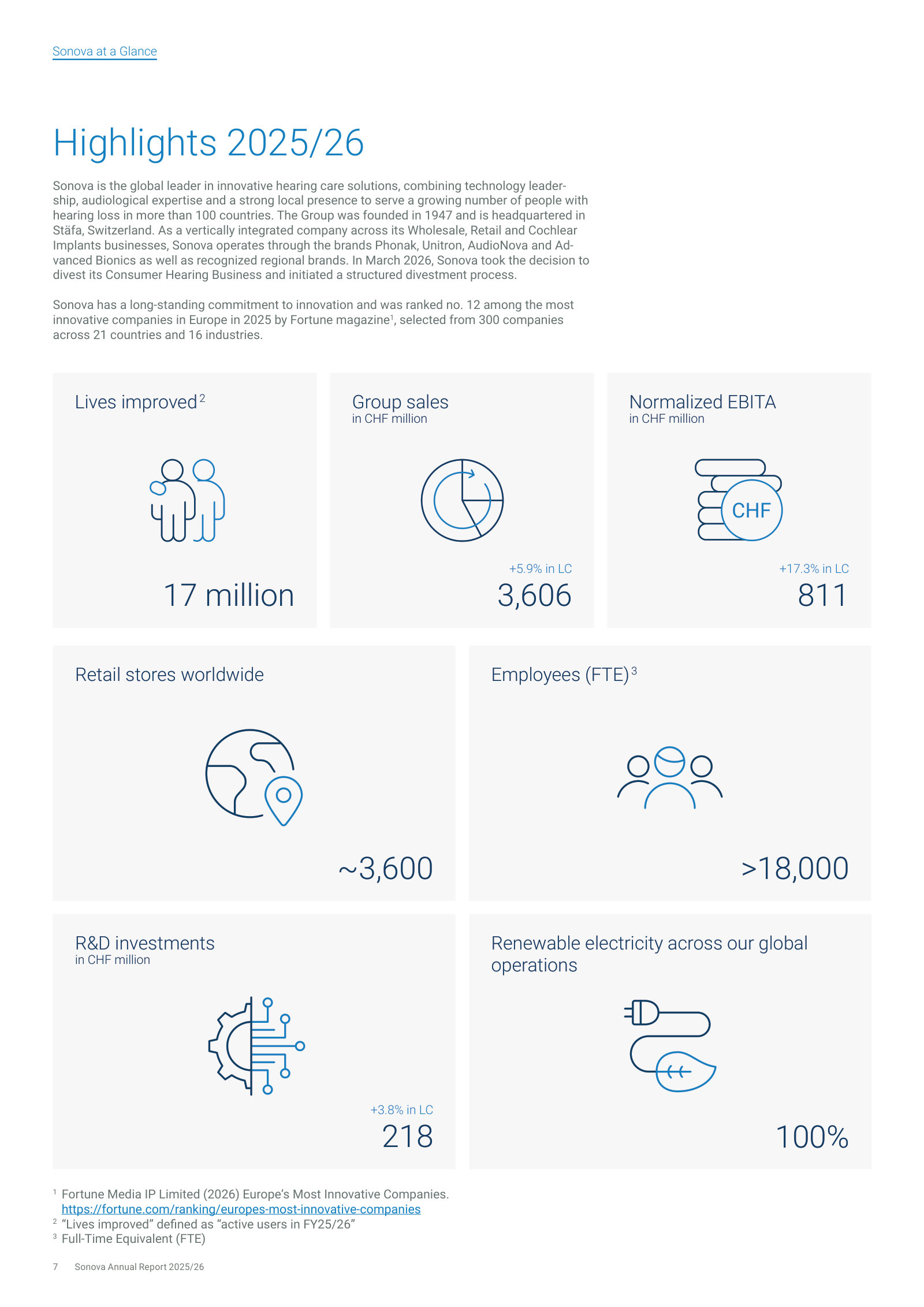
The one-page portrait of what Sonova is: a vertically integrated hearing-care group across wholesale, retail and cochlear implants.
Who Sonova is, in its own words — and the March 2026 decision to exit Consumer Hearing.
Sonova is the global leader in innovative hearing care solutions, combining technology leadership, audiological expertise and a strong local presence to serve a growing number of people with hearing loss in more than 100 countries. The Group was founded in 1947 and is headquartered in Stäfa, Switzerland. […] In March 2026, Sonova took the decision to divest its Consumer Hearing Business and initiated a structured divestment process.
p. 8 · Read in context →
How we create value / Our renewed strategy and ambition — p. 9 · Read the full section →
Management frames the structural growth thesis and sets the CHF 6bn revenue ambition behind the reset strategy.
The growth thesis and the CHF 6 billion revenue ambition built on three strategic priorities.
The world hearing care market shows clear signs of structural growth and Sonova is very well positioned to capture this opportunity. […] Our ambition is to grow Sonova to CHF 6 billion in revenue by the 2030/2031 financial year and our renewed strategy is key to achieving this goal. It is built around three strategic priorities: innovate for adoption, succeed locally with a multi-channel, multi-brand approach, and excel in operations for growth.
p. 10 · Read in context →
Financial Review — p. 88 · Read the full section →
Where management explains what actually drove the year — and restates the business around the Consumer Hearing divestment.
The portfolio review: divesting Consumer Hearing and renaming Hearing Instruments/Audiological Care to Wholesale/Retail.
On 23 March 2026, Sonova announced that, following a strategic portfolio review, Sonova intends to divest its Consumer Hearing business. As a result, the business is classified as discontinued operations […] In addition, the Hearing Instruments business will be referred to as the Wholesale business, and the Audiological Care business as the Retail business, from this point forward.
p. 89 · Read in context →
Cochlear Implants segment — Continued headwinds — p. 92 · Read the full section →
The company-specific risk playing out: China volume-based procurement and a competitor launch pressuring the CI business.
CI sales down 11.1% in local currencies, hit by China VBP and new competitive pressure.
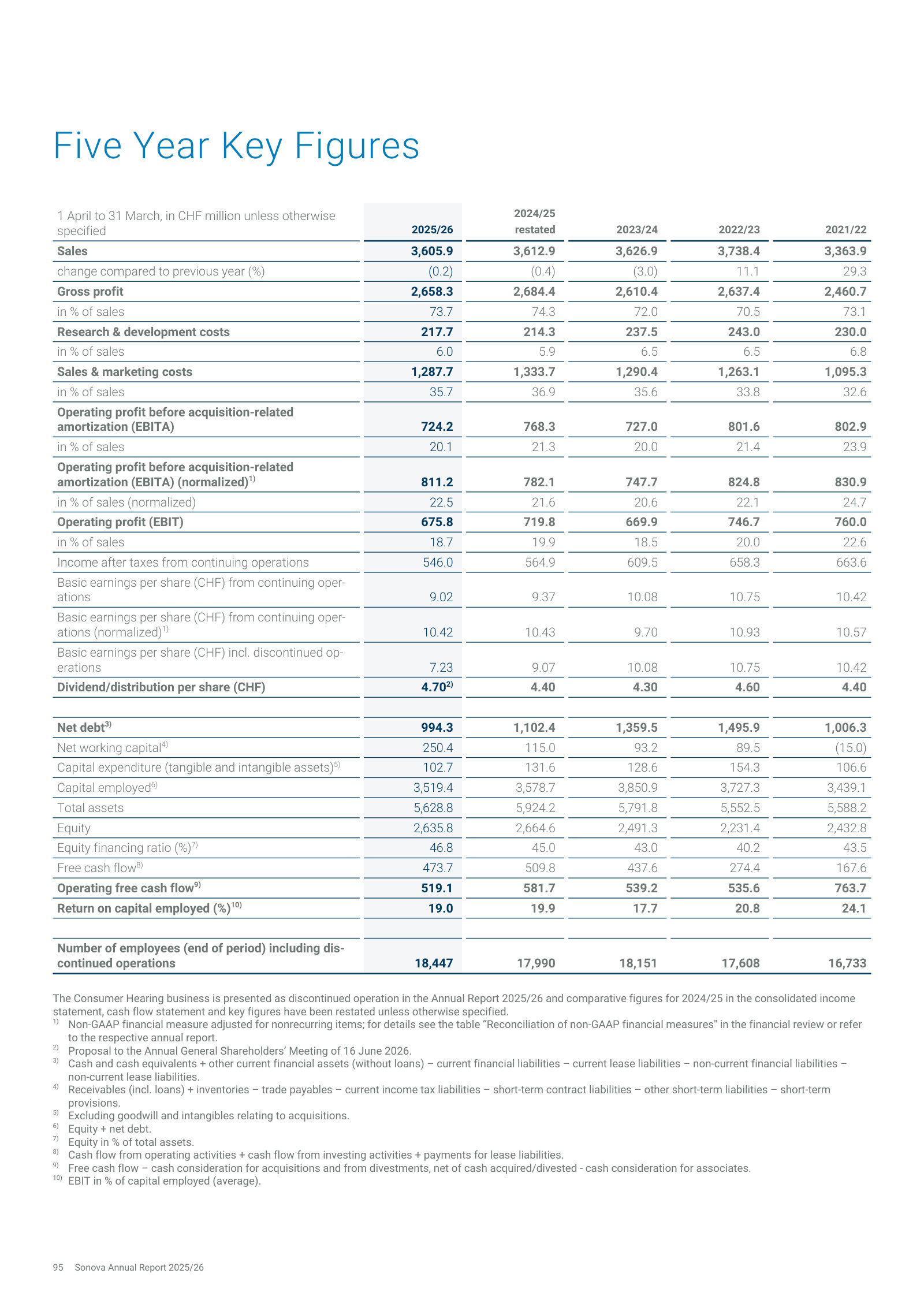
Sales in the Cochlear Implants segment totaled CHF 252.1 million, a decline of 11.1% in local currencies and 17.1% in Swiss francs. […] The business in China was substantially hampered by challenges following the introduction of volumebased procurement (VBP). Developed markets saw increased competitive pressure following a product launch by the largest competitor in the second half-year.
p. 92 · Read in context →
Note 2.2 Segment information — p. 106 · Read the full section →
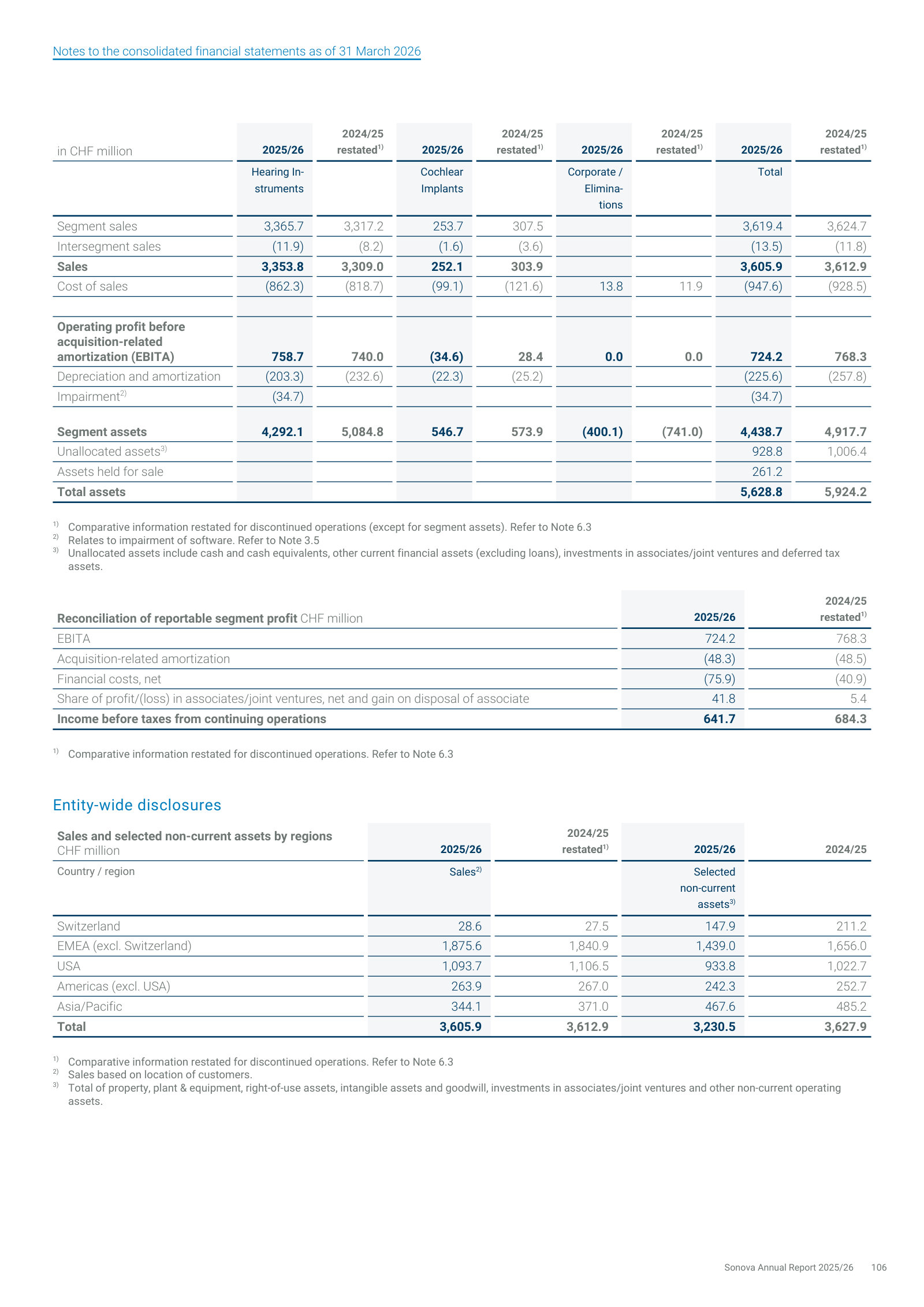
How the two segments are built — centralized Swiss R&D, a global production footprint, and the retail vs wholesale split.
Note 2.3 Revenue — p. 108 · Read the full section →
The revenue-recognition policy defines the model — device-plus-service bundles, retail fitting, and hospital CI sales.
When Sonova books revenue: on delivery, after retail fitting, and on bundled device-plus-service contracts.
The Group recognizes revenue at point in time when control of the products is transferred to the buyer, mainly upon delivery. […] For retail customers, revenue recognition usually occurs after fitting of the device or when the trial period lapses. For hearing instruments sold in bundled packages (i.e. including accessories and services), the transaction price is allocated to each performance obligation on the basis of the relative stand-alone selling price of all performance obligations in the contract.
For cochlear implants, sales are generally recognized at point in time when control of the products is transferred to the buyer (mainly hospitals), either at delivery or after surgery.
p. 109 · Read in context →
Key audit matters — Goodwill — p. 167 · Read the full section →
Acquisition-built retail leaves goodwill at 41% of assets and 87% of equity — the estimate that could genuinely bite.
Goodwill of CHF 2,284m — 41% of assets, 87% of equity — rests on management's impairment judgments.
As of 31 March 2026, the Group has goodwill of CHF 2,284.2 million representing 41% of the Group’s total assets and 87% of the Group’s total equity. […] In performing the impairment analysis, management applies considerable judgment in respect of future market and economic conditions, such as economic growth, expected inflation rates, demographic developments, expected market share, revenue and margin development of the cash generating units (CGUs) to which goodwill has been allocated. Changes in these assumptions might lead to a change in the carrying value of goodwill.
p. 167 · Read in context →
Sonova Holding AG — FY2024/25 Annual Report (fiscal year ended 31 March 2025) — FY2024/25
The 'before' picture: four businesses including Consumer Hearing — the structure the FY2025/26 reset dismantles. · Open the full document →
Strategy and Businesses — The Sonova Group — p. 14 · Read the full section →
Shows the prior four-business architecture, making the FY2025/26 segment redefinition and divestment visible.
The old four-business structure: Hearing Instruments, Audiological Care, Consumer Hearing and Cochlear Implants.
The Hearing Instruments business stands at the core of Sonovaʼs identity as a champion of better hearing. […] The Audiological Care business, operating under the AudioNova and other renowned national brands, leverages the full range of Sonova products with expert professional hearing care, delivered in-store and through other channels with audiological expertise, efficiency, and personal attention. […] Consumer Hearing offers a range of premium wireless headphones, earbuds, and soundbars under the Sennheiser brand (under license), providing a deep immersive experience for consumers who love great sound, along with early-entry hearing devices that seamlessly address the first stages of hearing loss. […] Cochlear Implants, operating under the Advanced Bionics brand, provides complete hearing solutions for those whose hearing loss is too advanced for hearing aids.
p. 15 · Read in context →
More annual reports
Sonova Holding AG — FY2023/24 Annual Report (fiscal year ended 31 March 2024) — FY2023/24 · 288 pages · Pre-reset edition under the four-business model; baseline for the Infinio launch cycle. · Open →
Sonova Holding AG — FY2022/23 Annual Report (fiscal year ended 31 March 2023) — FY2022/23 · 305 pages · Post-pandemic recovery year and the 2022–2025 buyback program; earlier segment definitions. · Open →
Sonova Holding AG — FY2021/22 Annual Report (fiscal year ended 31 March 2022) — FY2021/22 · 287 pages · Earliest edition on the shelf; useful for multi-year comparison of the four-business era. · Open →